AI Ethics has moved from a niche academic debate into a boardroom priority, a regulatory battleground, and a daily concern for anyone who touches technology. If you have ever wondered whether an algorithm quietly decided your loan application, filtered your resume before a human saw it, or shaped the news you scroll through each morning, you already understand why this topic matters. As artificial intelligence becomes woven into hiring, healthcare, finance, and even the justice system, the stakes of getting it wrong keep climbing. This guide breaks down what AI ethics really means in 2026, the risks that come with unchecked automation, and the practical steps you can take to build and use AI responsibly.
Table of Contents
What is AI Ethics?
AI Ethics is the field of study and set of practical guidelines that govern how artificial intelligence systems are designed, trained, deployed, and monitored so they benefit people without causing harm. In simple terms, it is the moral compass for machines and the humans who build them. It asks uncomfortable but essential questions: Is this model fair? Can we explain its decisions? Who is accountable when it fails? And whose data trained it in the first place?
Unlike traditional software that follows fixed rules, modern machine learning systems learn patterns from vast datasets. That learning process can quietly absorb human bias, amplify inequality, and produce outcomes nobody explicitly programmed. Responsible AI, therefore, is not about slowing innovation. It is about steering it. The discipline sits at the intersection of computer science, law, philosophy, and social policy, and it has become central to how regulators in the United States and the European Union think about digital trust.
By 2026, AI ethics is no longer optional. With the EU AI Act phasing in its obligations and U.S. agencies issuing sector-specific guidance, organizations that ignore ethical AI face legal exposure, reputational damage, and lost customer trust. Understanding the core principles is the first step toward using this technology wisely. If you are new to the topic, our guide to AI tools and reviews on AiMaKeZ offers helpful context.
Key Features of a Strong AI Ethics Framework
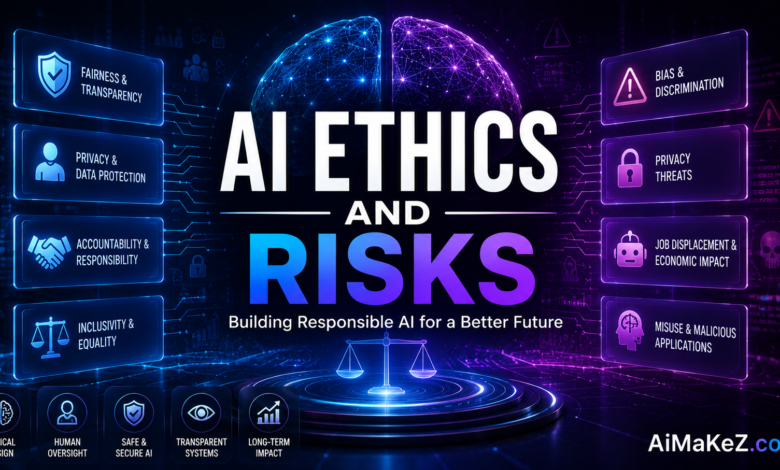
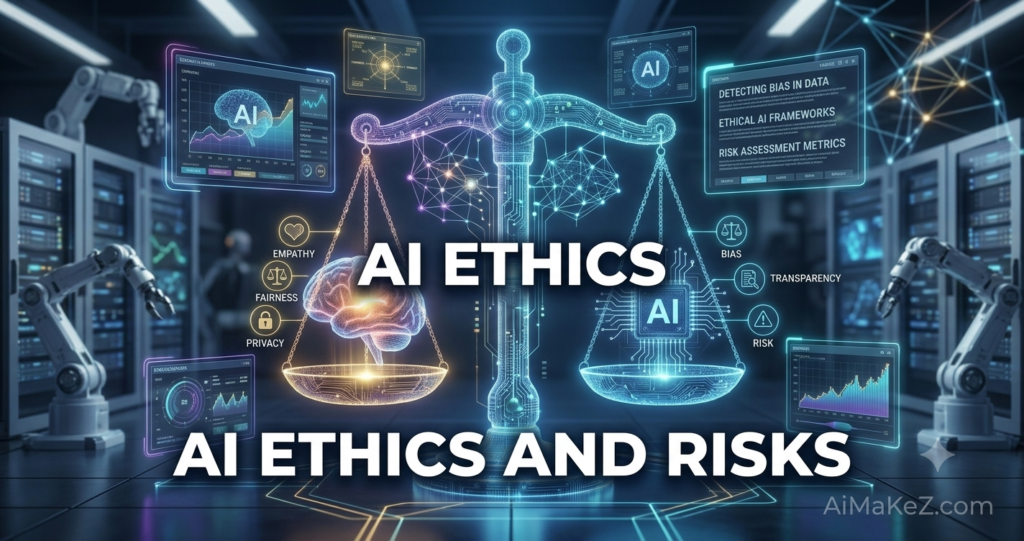
Every credible approach to AI ethics rests on a handful of interlocking pillars. These principles show up repeatedly across the OECD AI Principles, the NIST AI Risk Management Framework, and the EU’s guidelines for trustworthy AI.
Fairness and Bias Mitigation
A fair system treats similar people similarly and avoids discriminating against protected groups. Achieving this means auditing training data, testing models across demographics, and correcting skewed outcomes before deployment. Algorithmic bias is one of the most documented AI risks, and tackling it head-on is non-negotiable.
Transparency and Explainability
Users deserve to know when they are interacting with AI and, ideally, why a model reached a given decision. Explainable AI techniques translate opaque “black box” outputs into reasons a person can understand, which is critical in high-stakes areas like credit scoring or medical diagnosis.
Accountability and Governance
Someone must own the outcomes. Clear governance assigns responsibility, defines escalation paths, and ensures a human stays meaningfully in the loop for consequential decisions. Accountability turns good intentions into enforceable practice.
Privacy and Data Protection
Ethical AI respects consent and complies with data protection laws such as GDPR and CCPA. Techniques like data minimization, anonymization, and federated learning help models perform without hoarding sensitive personal information.
Safety and Robustness
Systems should behave predictably, resist adversarial manipulation, and degrade gracefully when they encounter unfamiliar inputs. Robustness testing prevents costly failures once the model meets the messy real world.
Human Oversight and Contestability
A strong AI ethics framework never treats an algorithm as the final word on decisions that materially affect people. Human oversight means a qualified person retains the authority to review, override, or halt an automated outcome, especially in sensitive domains like lending, employment, and healthcare. Just as important is contestability: the people affected by a decision deserve a clear, accessible route to question it and reach a human who can explain the reasoning and correct mistakes. Building these pathways in from the start turns AI from an opaque gatekeeper into a tool that augments human judgment rather than quietly replacing it, and it is increasingly a legal expectation rather than a nicety.
Benefits of Prioritizing AI Ethics
Treating ethics as a feature rather than an afterthought delivers tangible returns. First, it builds trust. Customers and employees are far more willing to adopt AI tools they believe are fair and transparent, and trust translates directly into adoption and revenue.
Second, it reduces legal and financial risk. Regulatory fines under the EU AI Act can reach a significant percentage of global turnover, and a single biased hiring algorithm can trigger class-action lawsuits. Proactive governance is dramatically cheaper than remediation after a scandal.
Third, ethical practices improve product quality. Auditing for bias often surfaces data problems that were degrading accuracy anyway, so responsible AI and high-performing AI tend to go hand in hand. Finally, strong ethics future-proofs your organization against an evolving regulatory landscape, letting you innovate with confidence instead of scrambling to comply after the fact.
How AI Ethics Works in Practice
Turning principles into daily reality follows a repeatable lifecycle. Here is how mature teams operationalize responsible AI step by step.
- Define the purpose and impact. Before writing a line of code, teams document what the system will do, who it affects, and what could go wrong. This is where an AI impact assessment begins.
- Source and audit data responsibly. Data is checked for consent, representativeness, and hidden bias. Poor data is the root of most ethical failures.
- Build with transparency in mind. Developers choose models and document design choices so decisions can be explained later.
- Test for fairness and safety. The model is evaluated across demographic groups and stress-tested against adversarial and edge-case inputs.
- Deploy with human oversight. Consequential outputs route through a human reviewer, and users are informed they are dealing with AI.
- Monitor and iterate continuously. Live systems drift over time, so ongoing monitoring catches new bias, performance decay, or misuse and feeds fixes back into the cycle.
This lifecycle mirrors frameworks like NIST’s Govern-Map-Measure-Manage functions, giving teams a structured way to embed ethics from concept to retirement.
What separates a genuine practice from a paper exercise is the feedback loop that closes the cycle. Once a system is live, real-world signals feed back into the earlier stages: monitoring surfaces drift, user complaints reveal blind spots, and incident reviews expose gaps in the original impact assessment. Mature teams treat each of these signals as a trigger to revisit their data, retrain or adjust the model, and update documentation, so responsible AI becomes an ongoing loop rather than a one-time launch checklist. This iterative rhythm is exactly what regulators and auditors look for when they ask an organization to demonstrate continuous, good-faith commitment to AI ethics.
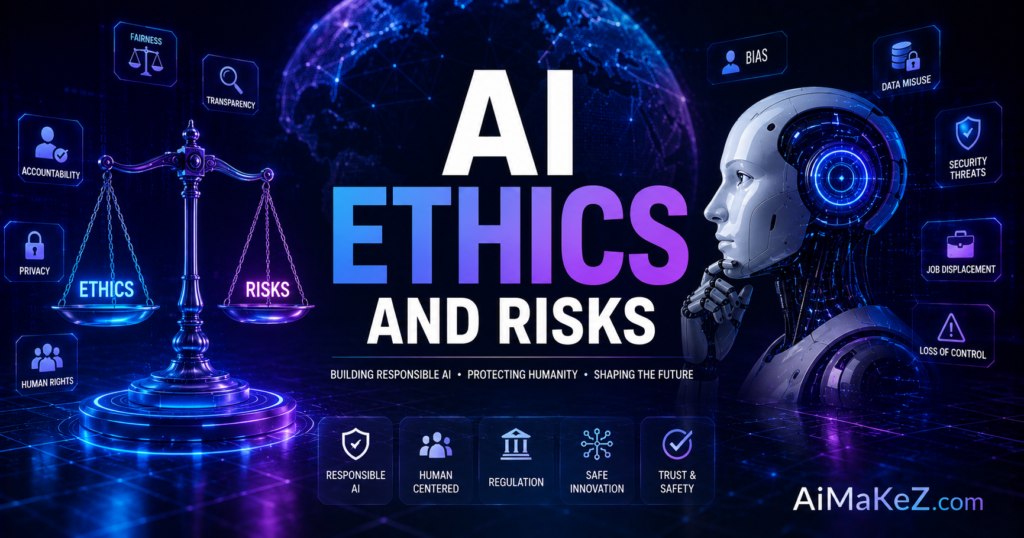
There is also a powerful talent and culture dividend that organizations often overlook. Skilled engineers, researchers, and data scientists increasingly want to work on technology they can be proud of, and a visible commitment to AI ethics helps attract and retain that talent. Teams that debate fairness, document their reasoning, and feel empowered to raise concerns tend to build more thoughtful products and catch problems earlier. In this sense, ethics is not a brake on innovation but a foundation for the kind of steady, trustworthy progress that keeps both employees and customers engaged over the long term.
Real-World Use Cases
AI ethics is not abstract. It shapes concrete decisions across every industry that has embraced automation.
Business and Human Resources
Recruiting platforms now screen thousands of applications automatically. Ethical deployment means auditing these tools so they do not penalize candidates by gender, age, or ethnicity. Several large employers have scrapped resume-screening models after discovering they favored certain demographics, a cautionary tale in algorithmic accountability.
Marketing and Advertising
Personalization engines predict what customers want, but they can also manipulate vulnerable users or exclude groups from seeing housing and job ads. Responsible marketers set guardrails on targeting and disclose when content is AI-generated to preserve consumer trust.
Content Creation
Generative AI can draft articles, images, and videos in seconds. Ethical creators verify facts, disclose synthetic media, respect copyright, and avoid producing deepfakes or misinformation. Transparency labels are becoming standard practice for AI-assisted publishing.
Education
Adaptive learning platforms tailor lessons to each student, yet they must guard against reinforcing achievement gaps or mislabeling learners. Schools that adopt AI tutors alongside clear data-privacy policies protect minors while unlocking personalized education.
Healthcare and Productivity
Diagnostic models can flag disease earlier than human clinicians, but a biased dataset can leave certain populations underserved. Meanwhile, workplace automation boosts productivity but raises questions about surveillance and job displacement. In both cases, human oversight and transparency keep the technology aligned with human values.
Pros and Cons
Adopting a rigorous ethical approach to artificial intelligence brings clear advantages and a few honest trade-offs. The table below summarizes both sides.
| Pros | Cons |
|---|---|
| Builds lasting user and customer trust | Adds time and cost to development cycles |
| Reduces legal and regulatory exposure | Requires specialized skills and tooling |
| Surfaces data flaws that improve accuracy | Fairness and accuracy can sometimes trade off |
| Future-proofs against evolving AI regulation | Standards are still fragmented across regions |
| Strengthens brand reputation and loyalty | Requires ongoing monitoring, not a one-time fix |
Pricing and Investment
AI ethics is a discipline rather than a single product, so “pricing” refers to the investment required to implement it. Costs vary widely by organization size and risk profile.
- Free and open-source tools: Toolkits like IBM AI Fairness 360, Google’s What-If Tool, and Microsoft Fairlearn let teams audit bias at no license cost, ideal for startups.
- Governance platforms: Commercial responsible-AI suites typically run from a few hundred to several thousand dollars per month depending on model volume and compliance features.
- Consulting and audits: Independent algorithmic audits and compliance assessments range from a few thousand dollars for a small model to six figures for enterprise-wide programs.
- Internal staffing: Many mid-to-large firms now hire dedicated AI ethics officers or governance teams, the most significant recurring cost.
Viewed against the potential fines and reputational damage of a failure, these investments are modest insurance.
The Evolving Regulatory Landscape
One reason AI ethics has climbed the corporate agenda so quickly is that it is no longer purely voluntary. Governments around the world are converting ethical principles into binding law, and 2026 marks a turning point in enforcement. The EU AI Act now classifies systems by risk level, banning a handful of practices outright and imposing strict documentation, transparency, and human-oversight duties on high-risk applications in areas like hiring, credit, and biometric identification. Non-compliance can trigger fines calculated as a percentage of global revenue, which is why legal and compliance teams increasingly sit alongside data scientists from day one.
The regulatory picture is not confined to Europe. In the United States, a patchwork of state laws, sector-specific rules, and federal guidance such as the NIST AI Risk Management Framework shapes expectations, while countries from Canada to Brazil and across Asia are drafting their own regimes. For any organization operating across borders, the practical lesson is to build to the strictest standard you are likely to face. Mapping your AI ethics program to a recognized framework like ISO/IEC 42001 makes compliance portable, so a single well-governed process can satisfy many jurisdictions at once rather than forcing costly rework each time a new rule takes effect.
Comparison With Alternatives
Organizations often weigh a full AI ethics program against lighter-touch approaches. Here is how the main options compare.
| Approach | Strength | Weakness |
|---|---|---|
| Comprehensive AI ethics framework (NIST, EU-aligned) | Thorough, regulation-ready, defensible | Resource-intensive to maintain |
| Basic compliance checklist | Fast and cheap to adopt | Misses nuanced bias and edge cases |
| Vendor-provided responsible-AI tools | Automated, scalable auditing | Limited to what the tool measures |
| Ad-hoc self-regulation | Flexible, low overhead | Inconsistent and hard to audit |
For most organizations operating in the U.S. and Europe, a framework-based approach supplemented by automated tooling delivers the best balance of rigor and efficiency.
Best Practices for Responsible AI
Drawing on lessons from teams that have deployed AI at scale, these recommendations consistently separate successful programs from struggling ones.
- Start with diverse teams. Homogeneous groups miss blind spots. Include varied backgrounds and disciplines when designing systems.
- Document everything. Model cards and data sheets create an audit trail that proves due diligence and speeds up compliance.
- Keep humans in the loop. Reserve final say on high-impact decisions for a qualified person, especially in hiring, lending, and healthcare.
- Test continuously, not once. Models drift. Schedule recurring bias and performance audits after launch.
- Communicate openly. Tell users when AI is involved and give them a clear way to contest a decision or reach a human.
- Align with recognized standards. Mapping your program to NIST or ISO/IEC 42001 makes it credible and portable across markets.
Common Mistakes to Avoid
Even well-meaning teams stumble. Watch out for these frequent pitfalls in AI ethics implementation.
- Treating ethics as a checkbox. A one-time compliance review does not catch problems that emerge as data and usage evolve.
- Ignoring data provenance. Training on scraped or unconsented data invites both bias and legal trouble.
- Over-trusting the black box. Deploying models you cannot explain leaves you unable to defend or fix their decisions.
- Skipping post-deployment monitoring. The real world differs from the lab, and undetected drift quietly erodes fairness.
- Confusing legal compliance with ethics. Meeting the minimum legal bar is not the same as doing right by your users.
- Failing to plan for failure. Every AI system will eventually make mistakes, so having an escalation and remediation plan is essential.
Frequently Asked Questions
Why is AI ethics important in 2026?
AI ethics matters because artificial intelligence now influences hiring, lending, healthcare, and information access at massive scale. With regulations like the EU AI Act taking effect and public scrutiny rising, ethical practices protect users from harm while shielding organizations from legal and reputational risk.
What are the biggest risks of artificial intelligence?
The leading AI risks include algorithmic bias and discrimination, loss of privacy, opaque “black box” decision-making, misinformation and deepfakes, job displacement, and the concentration of power in a few large companies. Most of these risks are manageable with strong governance and oversight.
How can companies reduce bias in AI systems?
Companies reduce bias by using representative training data, auditing model outputs across demographic groups, applying fairness toolkits, keeping humans in the loop for key decisions, and monitoring systems continuously after deployment rather than testing only once.
Is AI ethics legally required?
In many regions, elements of it are. The EU AI Act imposes binding obligations on high-risk systems, and laws like GDPR and various U.S. state statutes regulate data and automated decisions. Even where not strictly required, ethical AI is increasingly expected by customers and partners.
Who is responsible when an AI system causes harm?
Accountability generally rests with the organization that deploys the system, along with the developers who built it. Clear governance structures assign specific owners for oversight, which is why documented responsibility is a core pillar of AI ethics.
How does AI ethics differ from AI safety?
The two fields overlap but focus on different horizons. AI ethics is mainly concerned with the here-and-now impact of deployed systems, such as fairness, bias, transparency, privacy, and accountability toward the people affected today. AI safety, by contrast, leans toward preventing large-scale or long-term harms, including the behavior of highly capable systems that could act in unintended ways. In practice, a mature responsible AI program treats them as complementary: ethical guardrails handle immediate societal impact, while safety engineering hardens systems against failure and misuse.
Can small businesses afford to practice AI ethics?
Yes, and the barrier is far lower than most owners assume. AI ethics is more about disciplined process than expensive tooling. A small business can adopt free open-source fairness toolkits, write a short one-page policy on how it uses customer data, keep a human reviewer on any decision that affects a person, and document why each AI tool was chosen. These lightweight habits deliver most of the protective value of a large enterprise program at almost no cost, and they scale gracefully as the company grows.
What role do users play in AI ethics?
Users are not passive bystanders in the AI ethics conversation. Every time someone questions an automated decision, opts out of unnecessary data collection, or reports a biased or misleading output, they generate the real-world feedback that pushes companies to improve. Being an informed user means understanding when AI is involved, reading privacy settings rather than clicking through them, and choosing products from organizations that are transparent about how their systems work. Collective user expectations have repeatedly nudged the market toward safer defaults, so demanding fairness and transparency is one of the most practical ways ordinary people can shape responsible AI.
Final Verdict
AI Ethics is no longer a philosophical luxury reserved for researchers. It is a practical, competitive necessity for any individual or organization deploying intelligent systems in 2026. The technology offers extraordinary benefits, from earlier disease detection to personalized education, but those gains only hold when fairness, transparency, accountability, privacy, and safety are built in from the start.
My recommendation is straightforward: treat ethics as core infrastructure, not a compliance afterthought. Adopt a recognized framework, invest in bias auditing and continuous monitoring, keep humans meaningfully involved in high-stakes decisions, and communicate openly with the people your systems affect. Organizations that embrace responsible AI now will earn durable trust, avoid costly failures, and be ready for whatever regulation comes next. Those that treat AI ethics as an obstacle will find themselves paying far more later. Choose to build technology that is not just powerful, but worthy of the trust people place in it.