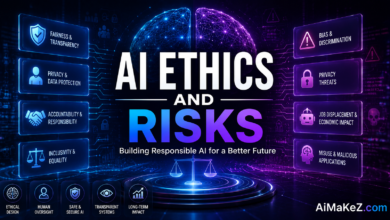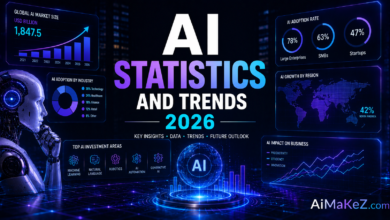
AI Myths spread faster than almost any other topic in technology, and they shape how millions of people in the United States and Europe feel about the tools they use every day. Maybe you have heard that artificial intelligence is about to take every job, that it secretly listens to your conversations, or that it “thinks” exactly like a human brain. These claims sound convincing, but most of them fall apart under scrutiny. This guide separates the loudest AI myths from the verifiable facts, so you can make smarter decisions about how you work with this technology in 2026 instead of reacting to fear or hype. For more, explore our guide to AI ethics and risks.
Table of Contents
What Are AI Myths?
AI myths are widely repeated but inaccurate beliefs about what artificial intelligence is, what it can do, and what it means for society. Some are exaggerations of real capabilities, others are outdated ideas from science fiction, and a few are simply misunderstandings of how machine learning actually works. Because the field moves so quickly, even well-informed people struggle to keep their mental model up to date.
These misconceptions matter because they drive real decisions. A business that believes AI is “plug and play” wastes money on tools it never configures properly. A worker who believes automation will erase their role overnight makes anxious career choices. And a policymaker who confuses a chatbot with a conscious being may write rules that miss the actual risks.
Understanding AI myths versus facts is really about media literacy for the algorithmic age. When you can spot a myth, you can evaluate new AI products, headlines, and workplace changes with a clear head instead of getting swept up in either doom or blind optimism.
Key Features of Persistent AI Myths
The most stubborn myths share recognizable traits. Spotting these patterns is the first step to debunking them.
They Blur the Line Between Fiction and Reality
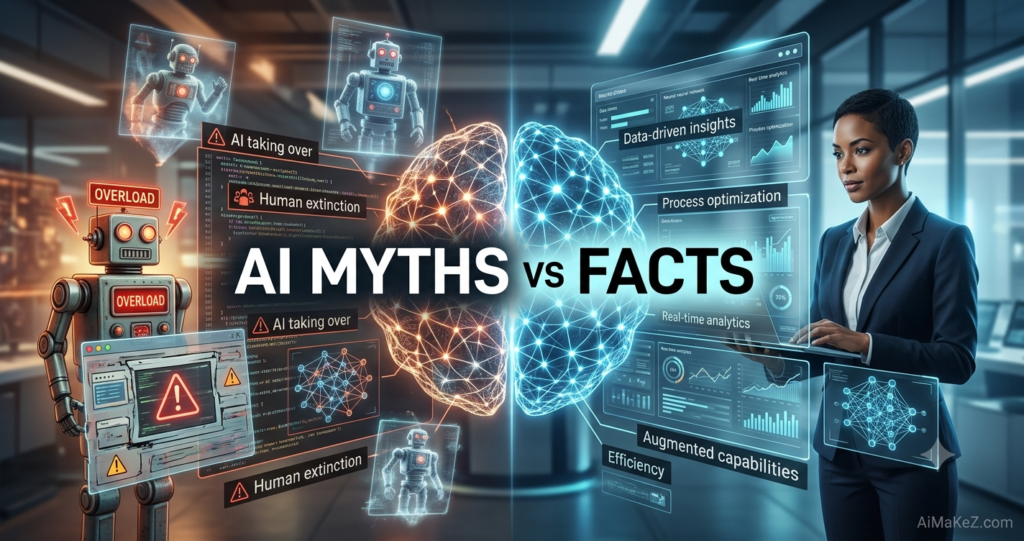
Decades of movies have taught us to picture AI as a self-aware robot with human motives. Today’s systems, including large language models, are sophisticated pattern predictors, not conscious minds. The myth of sentient AI persists because the fiction is far more dramatic than the math behind it.
They Rely on Emotional Extremes
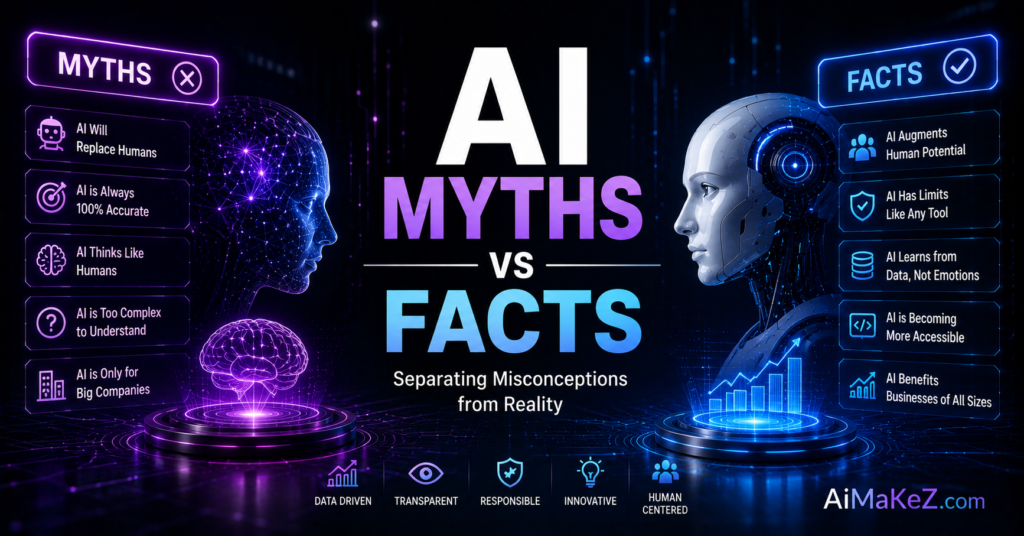
Myths thrive on fear or fantasy. “AI will replace all humans” and “AI will solve every problem” are both emotionally charged and both wrong. Reality usually sits in a nuanced middle ground that headlines rarely capture.
They Ignore Human Involvement
A common myth is that AI operates entirely on its own. In practice, humans curate the training data, set the objectives, review outputs, and correct errors. Machine learning is a collaboration, not an autonomous takeover.
They Assume the Technology Is Static
Many myths are simply outdated. Claims that “AI can’t be creative” or “AI can’t understand images” were reasonable years ago but no longer match what modern generative and multimodal models can do. Facts have a shelf life in this field.
They Spread Through Repetition
Many AI myths survive not because they are convincing but because they are repeated so often that they start to feel like common knowledge. A claim mentioned in a viral post, echoed by a well-known commentator, and then quoted in dozens of follow-up articles gains an air of authority it never earned. Psychologists call this the illusory truth effect: the more we encounter a statement, the more likely we are to accept it, regardless of whether anyone ever verified it. Recognizing this pattern is powerful, because it teaches you to ask who checked this instead of how many times have I heard it. Popularity is not evidence, and the loudest AI myths are frequently the least examined.
Benefits of Separating Myth From Fact
Getting past the noise pays off in concrete ways. First, you make better buying decisions. When you understand what AI genuinely does well, you invest in tools that solve real problems instead of chasing marketing promises.
Second, you reduce anxiety and resistance. Employees who understand that AI mostly augments tasks rather than eliminating whole jobs tend to adopt new tools more confidently and productively.
Third, clear thinking improves safety and ethics. When you know the real limitations of a model, such as its tendency to “hallucinate” false information, you build in the human checks that prevent costly mistakes. Finally, fact-based understanding future-proofs your skills, letting you adapt as the technology evolves rather than clinging to outdated fears.
How AI Myths Spread and How to Check Them
Debunking is a skill you can practice. Here is a step-by-step method for testing any AI claim you encounter.
- Trace the source. Ask where the claim originated. A viral social post, a vendor’s ad, and a peer-reviewed study carry very different weight.
- Separate capability from speculation. Distinguish what a system does today from what someone predicts it might do someday.
- Look for the human role. Nearly every “autonomous” AI story hides significant human design, oversight, or data labeling behind the scenes.
- Check the date. AI capabilities shift fast, so a confident claim from a few years ago may already be obsolete.
- Test it yourself. Where possible, try the tool. Hands-on experience quickly reveals both the impressive strengths and the obvious limits.
- Consult trusted references. Cross-check against reputable research institutions and standards bodies rather than sensational headlines.
This process mirrors how respected technology journalists and researchers evaluate bold claims before repeating them.
Consistency is what makes this method reliable. If you apply the same checks to every claim, you stop being swayed by whichever source is loudest on a given day and start building a stable mental model of the technology. Over time, you will notice the same AI myths resurfacing in slightly new clothing, and recognizing the pattern lets you dismiss them in seconds instead of getting drawn into another round of hype or panic. The goal is not to memorize a list of true and false statements, but to develop instincts that keep serving you as the tools continue to evolve.
Real-World Use Cases: Common AI Myths Debunked
Let us apply myth-busting to the situations people actually face across industries.
Business and Productivity
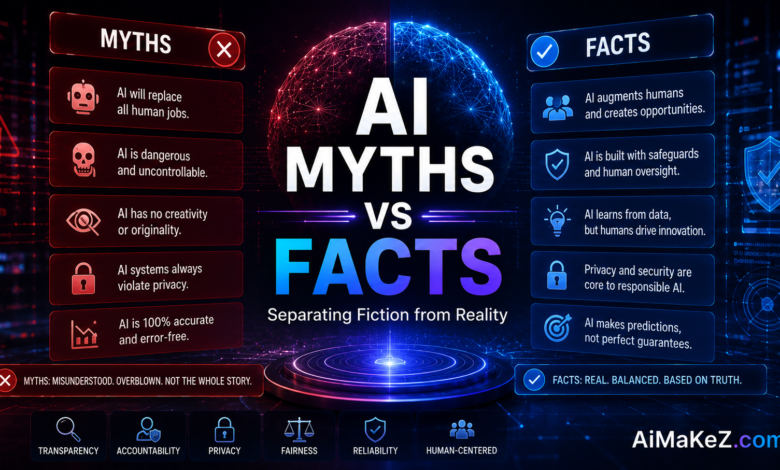
Myth: “AI will replace all our employees.” Fact: Studies consistently show AI automates specific tasks, not entire roles. Most jobs are reshaped, with people handing repetitive work to software and focusing on judgment, strategy, and relationships. Businesses that treat AI as a productivity partner outperform those that expect it to run itself.
Marketing and Advertising
Myth: “AI content ranks poorly and always sounds robotic.” Fact: Search engines reward helpful, accurate content regardless of how it was produced, provided a human ensures quality and originality. Skilled marketers use AI to draft and brainstorm, then edit for brand voice and factual accuracy.
Content Creation
Myth: “AI is either perfectly accurate or completely useless.” Fact: Generative models can produce brilliant drafts and also confidently invent false details, known as hallucinations. The truth is that AI is a powerful assistant that still requires human fact-checking.
Education
Myth: “AI will make students stop thinking.” Fact: Used well, AI tutors offer personalized practice and instant feedback that can deepen learning. The risk lies in misuse, not the tool itself, which is why schools focus on teaching critical AI literacy.
Automation and Everyday Tech
Myth: “My smart speaker records everything I say and sells it.” Fact: Most assistants listen only for a wake word and process commands, though privacy practices vary by company. The sensible response is to read privacy settings, not to believe every viral claim.
Finance and Money
Myth: “AI trading bots guarantee profits and remove all the risk from investing.” Fact: Algorithms can process market data quickly and follow rules without emotion, but they cannot predict the future or eliminate uncertainty. Markets are shaped by events no model has seen before, and a system that performed well in the past can fail badly when conditions change. Believing this particular myth has cost people real money, because it encourages them to hand over decisions to software they do not understand. AI can inform financial analysis, but it is a tool for better-informed humans, not a crystal ball.
Healthcare and Wellness
Myth: “AI can diagnose any illness better than a doctor, so human physicians are becoming obsolete.” Fact: AI tools can flag patterns in scans and lab data with impressive speed, and they genuinely help clinicians catch problems earlier. However, they are decision-support systems, not replacements for medical judgment. A model may spot an anomaly, but a trained professional still interprets the full context, weighs the patient history, and takes responsibility for the diagnosis. Treating an app output as a final verdict is one of the more dangerous AI myths circulating today, because it can lead people to ignore symptoms or skip professional care.
Security and Privacy
Myth: “Any tool built on artificial intelligence is automatically spying on me and stealing my data.” Fact: Data practices depend entirely on the company and the product, not on whether AI is involved. Some services process information locally on your device, others anonymize it, and many let you opt out of data collection. The responsible move is to read the privacy policy and adjust the settings rather than assuming the worst. Blanket fear is one of the AI myths that stops people from using genuinely helpful tools, while blind trust is the opposite mistake. The accurate position, as always, sits between the two extremes.
Pros and Cons of Myth-Busting
Actively challenging AI myths brings clear upsides and a few honest challenges. The table below summarizes both.
| Pros | Cons |
|---|---|
| Smarter, evidence-based technology decisions | Requires ongoing effort to stay current |
| Less fear-driven resistance to helpful tools | Facts change as the technology evolves |
| Better risk awareness and ethical use | Nuance is harder to communicate than hype |
| Stronger, more adaptable career skills | Debunking can feel like swimming upstream |
| Improved trust in genuinely useful AI | Some claims are genuinely uncertain |
Pricing and the Cost of Getting It Wrong
Learning to separate AI myths from facts costs nothing but attention, yet believing the wrong things can be expensive. Consider the real-world price tags.
- Free literacy resources: Reputable courses, research summaries, and explainer sites let anyone build accurate AI understanding at no cost.
- Wasted software spend: Companies that buy AI tools based on hype often pay for licenses they never operationalize, burning thousands of dollars.
- Reputational damage: Publishing AI-hallucinated facts without checking can cost far more than the time a quick review would have taken.
- Missed opportunity: Overestimating AI risks and avoiding it entirely can leave a business behind more informed competitors.
In short, accurate knowledge is the cheapest insurance you can buy against costly AI decisions.
It also helps to think about cost in terms of time, not just money. Chasing a myth, whether it is the fear that AI will instantly replace your team or the fantasy that it will run your business without supervision, quietly drains hours into the wrong projects. Teams that believe accurate facts about AI spend their budgets on realistic goals, train their people properly, and build workflows that combine human judgment with machine speed. The real price of an AI myth is rarely a single bad purchase; it is the slow accumulation of misplaced effort that competitors avoid simply because they took the time to separate hype from reality.
Comparison With Alternatives
People handle AI uncertainty in different ways. Here is how a fact-based approach compares with the common alternatives.
| Mindset | Strength | Weakness |
|---|---|---|
| Fact-based myth-busting | Balanced, adaptable, decision-ready | Requires continuous learning |
| Blind AI optimism (hype) | Fast adoption, high energy | Overspending and disappointment |
| AI doomerism (fear) | Cautious about real risks | Missed opportunities, paralysis |
| Total avoidance | No learning curve required | Falls behind, loses competitiveness |
For readers in the U.S. and Europe navigating fast-moving regulation and innovation, the fact-based middle path consistently delivers the best outcomes.
Best Practices for Navigating AI Myths
These expert habits will keep your understanding accurate as the field changes.
- Follow primary sources. Read model documentation and research from institutions like Stanford HAI rather than relying on secondhand summaries.
- Update your beliefs regularly. Treat AI facts as living knowledge and revisit assumptions every few months.
- Test claims hands-on. Personal experimentation beats speculation every time.
- Distinguish marketing from capability. Vendor language often describes the ideal case, not the average result.
- Verify AI outputs. Always fact-check anything a model tells you before you act on it.
- Discuss with peers. Comparing notes across your team surfaces blind spots quickly.
Common Mistakes to Avoid
Even careful people slip into these traps when thinking about AI myths and facts.
- Anthropomorphizing the technology. Assuming AI “wants” or “understands” like a person leads to bad predictions and misplaced trust.
- Trusting outputs blindly. Treating AI as infallible invites hallucinated errors into your work.
- Dismissing AI entirely. Rejecting the technology because of exaggerated fears means missing real productivity gains.
- Believing one headline. A single dramatic story rarely captures the nuance of what a system can actually do.
- Ignoring privacy settings. Assuming either total surveillance or total safety, instead of reading the actual policy, leaves you exposed.
- Forgetting facts expire. Repeating an outdated limitation as if it still applies undermines your credibility.
Frequently Asked Questions
What are the most common AI myths in 2026?
The most common AI myths include the belief that AI is conscious or sentient, that it will replace all human jobs, that its outputs are always accurate, that it is completely autonomous, and that AI-generated content is automatically penalized by search engines. Each of these overstates or misunderstands how the technology actually works.
Is it true that AI will take over all jobs?
No. This is one of the most persistent AI myths. Evidence shows AI automates specific tasks and reshapes roles rather than eliminating entire professions. New jobs also emerge around building, managing, and overseeing AI systems, so the picture is one of transformation, not wholesale replacement.
Can artificial intelligence actually think like a human?
Not in the way people imagine. Modern AI predicts patterns from data and can produce impressively human-like text, but it has no consciousness, understanding, or intent. It simulates aspects of reasoning without genuinely experiencing or comprehending anything.
Why do AI myths spread so easily?
AI myths spread because the technology is complex, evolving quickly, and heavily dramatized in fiction and marketing. Emotional headlines about fear or fantasy get more clicks than nuanced facts, and outdated information lingers online long after the technology has moved on.
How can I tell if an AI claim is a myth or a fact?
Trace the source, check the date, separate current capability from speculation, look for the human role behind the scenes, test the tool yourself when possible, and cross-check against reputable research. If a claim relies on emotional extremes and ignores nuance, it is likely a myth.
Do AI myths actually affect real business decisions?
Yes, and often more than people realize. Leaders who believe the hype may overspend on tools that promise full automation and then feel disappointed when human oversight is still required. Others who believe the doom-laden myths freeze entirely and fall behind competitors who adopted the technology sensibly. In both cases, AI myths translate directly into wasted budgets, missed opportunities, and poor hiring plans, which is why separating fact from fiction has become a practical business skill rather than a purely academic exercise.
Will AI myths eventually disappear as the technology matures?
Some will fade as people gain hands-on experience, but new AI myths tend to replace the old ones with each wave of innovation. As capabilities grow, fresh misunderstandings appear about what the latest systems can and cannot do. The realistic expectation is not a myth-free future but an ongoing need for critical thinking. The people who thrive are those who keep updating their knowledge and treat every dramatic claim, whether hopeful or fearful, with steady, informed skepticism.
Final Verdict
AI Myths are not harmless entertainment. They shape budgets, careers, classrooms, and policy across the United States and Europe, and believing the wrong ones carries real costs. The good news is that separating myth from fact is a learnable skill that requires curiosity rather than technical expertise.
My recommendation is simple: approach every bold AI claim with calm skepticism, trace it to a credible source, and test it against your own experience. Reject both the doom-laden headlines and the too-good-to-be-true promises, and settle into the accurate, nuanced middle where good decisions live. If you keep updating your understanding as the technology evolves, you will use AI more effectively, protect yourself from its genuine risks, and stay a step ahead of the crowd still arguing over myths. In a world flooded with hype, clear-eyed truth is your greatest advantage.