If you have ever stared at a blank screen wondering how to write a compelling ad, a punchy email subject line, or a month of social posts in one sitting, you are not alone. Marketers everywhere are drowning in content demands while budgets and timelines keep shrinking. The good news is that the right ChatGPT prompts for marketing can turn that pressure into a repeatable, scalable workflow that saves hours every single week.
This guide to ChatGPT prompts for marketing is built from hands-on experience running campaigns across email, paid social, SEO, and content marketing. Instead of vague tips, you get 100 battle-tested prompts you can copy, paste, and adapt today. Whether you run a solo Shopify store in Ohio or lead a growth team in Berlin, these prompts are designed to help you produce better copy faster, understand your audience more deeply, and automate the boring parts of your job.
By the end of this article, you will understand what makes the best ChatGPT prompts for marketing work, how to structure it for consistently strong output, and exactly which prompts to reach for in every stage of your funnel. Let’s dive in.
Table of Contents
What Are ChatGPT Prompts for Marketing?
ChatGPT prompts for marketing are carefully written instructions you give to an AI language model like ChatGPT to generate marketing assets on demand. One of these ChatGPT prompts for marketing can be as simple as “Write five Instagram captions for a coffee brand” or as detailed as a multi-paragraph brief that specifies your audience, tone, offer, and desired format. The quality of your output is directly tied to how well you craft your ChatGPT prompts for marketing.
Think of each of these ChatGPT prompts for marketing as a creative brief for a very fast, very literal junior copywriter, which is exactly why ChatGPT prompts for marketing scale so well. It never gets tired, works around the clock, and can produce dozens of variations in seconds. But like any junior team member, it needs clear direction. The more context you provide about your brand voice, customer, and goal, the sharper and more usable the result becomes.
In practice, marketers use these ChatGPT prompts for marketing across the entire funnel, from awareness content and lead magnets to nurture emails and retention campaigns. A well-crafted prompt library becomes a reusable asset that standardizes quality across your whole team, ensuring a freelancer in Lisbon and an in-house writer in Chicago produce copy that sounds like the same brand.
Key Features of Effective Marketing Prompts
Not all ChatGPT prompts for marketing are created equal. The prompts that consistently deliver publish-ready copy share a handful of defining features. Understanding these features helps you write your own ChatGPT prompts for marketing instead of relying only on templates.
Clear Role and Context
Strong prompts assign the AI a role, such as “Act as a senior email marketer for a SaaS company.” This framing primes the model to draw on the right patterns and vocabulary. Adding context about your product, audience, and industry narrows the output so it feels tailored rather than generic.
Specific Output Format
Great prompts specify exactly what you want back: the number of variations, word count, tone, and structure. Asking for “three subject lines under 45 characters, each with a curiosity hook” produces far more usable results than “write some subject lines.”
Audience and Tone Controls
The best marketing prompts define the target reader and the emotional register. Whether you want a playful Gen Z tone or a measured B2B voice, stating it explicitly keeps the copy on-brand and reduces heavy editing.
Built-in Constraints
Constraints spark creativity and precision. Limits on length, banned buzzwords, required keywords, or a mandatory call to action guide the model toward output that fits your channel and compliance needs.

Benefits for Marketers and Business Owners
The reason marketing teams have adopted ChatGPT prompts for marketing so quickly is simple: the return on time invested is enormous. Here are the practical advantages you can expect when you build a solid prompt workflow.
Speed at scale. With the right ChatGPT prompts for marketing, tasks that once took an afternoon, like drafting a five-email welcome sequence, can be knocked out in minutes. That frees your team to focus on strategy, testing, and relationship building instead of first drafts.
Beating the blank page. Even seasoned copywriters hit creative walls, and the right ChatGPT prompts for marketing break the logjam fast. A well-designed prompt instantly generates angles, hooks, and headlines you can refine, which keeps momentum high and deadlines intact.
Consistency across channels. When your brand voice lives inside reusable ChatGPT prompts for marketing, every touchpoint feels cohesive. Your landing page, your ads, and your newsletter all speak in one recognizable tone.
Lower costs. Small businesses and startups can produce agency-quality content without a large retainer. A founder in Manchester can draft a full campaign for the price of a monthly subscription rather than thousands in freelance fees.
Rapid experimentation. Because ChatGPT prompts for marketing generate ten variations for almost nothing, you can A/B test more aggressively. More tests mean faster learning and better conversion rates over time.
How ChatGPT Prompts for Marketing Work
Using ChatGPT prompts for marketing effectively follows a simple, repeatable loop. Once you internalize this process, you can adapt any of these ChatGPT prompts for marketing to your exact needs. Here is the step-by-step approach that consistently produces strong results.
- Define your goal. Decide the single outcome you want, such as more email signups, higher ad click-through, or a blog outline. Clarity here shapes everything downstream.
- Set the role and context. Tell ChatGPT who to be and give it the essentials: your product, audience, and brand voice. A short context block dramatically improves relevance.
- Write a specific instruction. State the format, quantity, tone, and any constraints. Ambiguity is the enemy of great output.
- Generate and review. Read the first draft critically. Look for factual accuracy, on-brand voice, and whether it actually serves your goal.
- Refine with follow-ups. Ask for revisions like “make it punchier,” “cut it to 50 words,” or “give me three bolder alternatives.” Iteration is where good becomes great.
- Edit and fact-check. Always add a human pass for accuracy, compliance, and that final layer of polish before publishing.
This loop turns AI from a novelty into a dependable production line. The prompts below plug directly into steps two and three, giving you a proven starting point for nearly any marketing task.
100 Best ChatGPT Prompts for Marketing
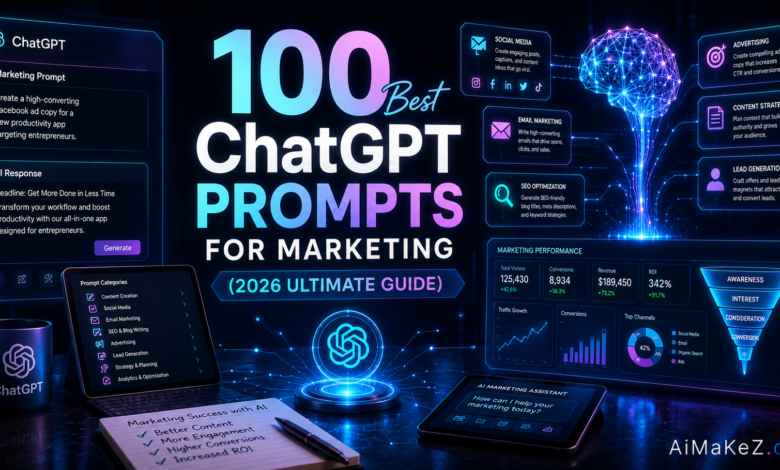
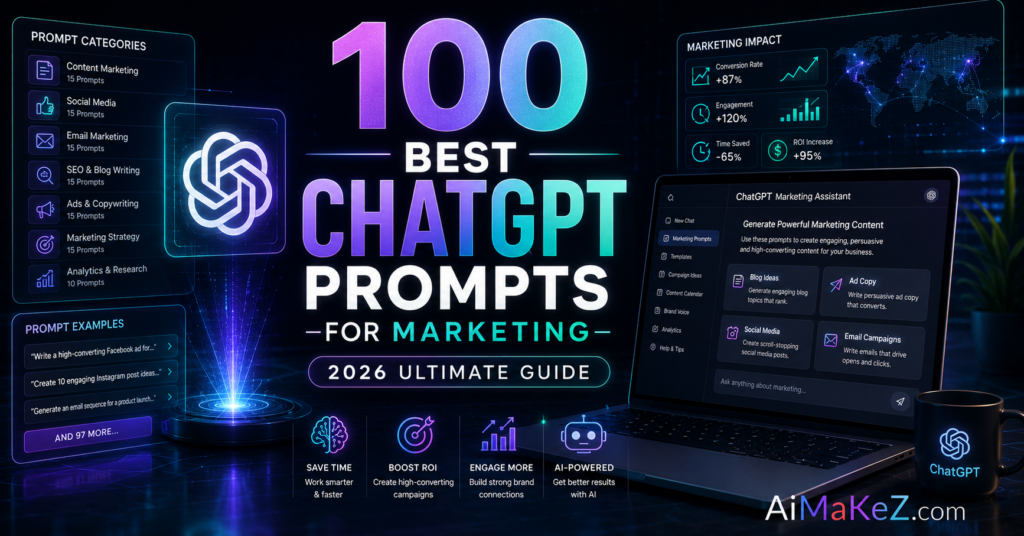
Below are the 100 best ChatGPT prompts for marketing, carefully grouped into ten practical categories so you can jump straight to what you need. Copy each of these ChatGPT prompts for marketing, then replace the bracketed placeholders with your own details. Combine and remix them freely to fit your brand and campaign.
Content Marketing and Blogging Prompts (1–10)
- Act as a content strategist and generate 10 blog post titles about [topic] that target [audience] and include a curiosity hook.
- Write a detailed blog outline for the article “[title]” with an intro, 6 H2 sections, and 3 FAQ questions.
- Draft a 150-word introduction for a blog post on [topic] that opens with a relatable problem and previews the solution.
- Turn these bullet points into a clear, engaging blog section: [paste notes].
- Repurpose this blog post into a LinkedIn article with a professional tone: [paste post].
- Suggest 15 long-tail keywords a US audience might search when looking for [product or service].
- Write a compelling meta title (under 60 characters) and meta description (under 155 characters) for a post about [topic].
- Create a content calendar with 12 blog topics for a [industry] brand targeting [audience].
- Rewrite this paragraph to improve readability for a 7th-grade reading level: [paste text].
- Generate 5 internal linking ideas for a blog post about [topic] on a website that also covers [related topics].
Social Media Marketing Prompts (11–20)
- Write 5 Instagram captions for [product] aimed at [audience], each with a hook, value, and a call to action.
- Create a week of daily Twitter/X posts promoting [offer] in a witty, concise tone.
- Draft a LinkedIn post sharing a lesson learned about [topic] using a personal storytelling style.
- Generate 10 short-form video hooks for TikTok or Reels about [topic] that stop the scroll in 3 seconds.
- Write 3 Facebook post variations announcing [event or launch] with an RSVP call to action.
- Suggest 20 relevant, non-spammy hashtags for a post about [topic] in the [niche] space.
- Turn this blog post into 5 carousel slides with a headline and one line of copy per slide: [paste post].
- Create a 30-day social media content plan mixing educational, promotional, and engagement posts for [brand].
- Write a Pinterest pin description for [product] optimized for search and click-throughs.
- Draft a poll question and three engaging reply prompts to boost comments for a [niche] audience.
Email Marketing Prompts (21–30)
- Write a 5-email welcome sequence for new subscribers of a [industry] brand, with one clear goal per email.
- Generate 10 email subject lines under 45 characters for a promotion about [offer], each with a different angle.
- Draft a re-engagement email for subscribers who have not opened an email in 90 days, with a friendly win-back tone.
- Write a product launch announcement email for [product], including benefits, social proof, and a strong call to action.
- Create an abandoned cart email sequence of 3 messages for an ecommerce store selling [product].
- Rewrite this email to sound more conversational and less salesy: [paste email].
- Write a monthly newsletter template for a [industry] audience with sections for news, tips, and a featured resource.
- Generate 5 preview text lines that complement this subject line: [paste subject line].
- Draft a post-purchase thank-you email that upsells a complementary product to [product].
- Write a webinar invitation email that clearly states the value, date, and how to register for [webinar topic].
Email Marketing Prompts (21–30)
- Write a 5-email welcome sequence for new subscribers of a [industry] brand, with one clear goal per email.
- Generate 10 email subject lines under 45 characters for a promotion about [offer], each with a different angle.
- Draft a re-engagement email for subscribers who have not opened an email in 90 days, with a friendly win-back tone.
- Write a product launch announcement email for [product], including benefits, social proof, and a strong call to action.
- Create an abandoned cart email sequence of 3 messages for an ecommerce store selling [product].
- Rewrite this email to sound more conversational and less salesy: [paste email].
- Write a monthly newsletter template for a [industry] audience with sections for news, tips, and a featured resource.
- Generate 5 preview text lines that complement this subject line: [paste subject line].
- Draft a post-purchase thank-you email that upsells a complementary product to [product].
- Write a webinar invitation email that clearly states the value, date, and how to register for [webinar topic].
Paid Advertising and Copywriting Prompts (31–40)
- Write 5 Google Search ad headlines (under 30 characters) and 2 descriptions for [product or service].
- Create 3 Facebook ad variations for [offer] using the Problem-Agitate-Solve framework.
- Draft ad copy for a retargeting campaign aimed at people who visited [page] but did not convert.
- Write a compelling value proposition for [product] in one sentence a 10-year-old could understand.
- Generate 10 hook lines for a video ad promoting [product] to [audience].
- Write ad copy using the AIDA framework for a [industry] service targeting [audience].
- Create 3 short LinkedIn ad variations for a B2B [product] focused on ROI and time savings.
- Draft a landing page hero headline and subheadline for [offer] with a benefit-driven angle.
- Write 5 call-to-action button variations for a checkout page selling [product].
- Generate a list of 10 objections customers have about [product] and a persuasive rebuttal for each.
SEO and Keyword Research Prompts (41–50)
- Generate a list of 20 semantic keywords and related entities for the topic [primary keyword].
- Create a content cluster plan with one pillar page and 8 supporting articles around [topic].
- Write an SEO-optimized product description for [product] that naturally includes the keyword [keyword].
- Suggest 10 featured-snippet-friendly questions I should answer in an article about [topic].
- Analyze this paragraph and suggest ways to improve on-page SEO without keyword stuffing: [paste text].
- Generate 15 FAQ questions people ask about [topic] for a schema-ready FAQ section.
- Write optimized alt text for an image showing [describe image] in an article about [topic].
- Create an outline for a comparison article between [product A] and [product B] targeting buyers.
- Suggest 10 blog topics with low competition and high intent for a [niche] website.
- Rewrite this title tag to improve click-through rate while keeping the keyword [keyword]: [paste title].
SEO and Keyword Research Prompts (41–50)
- Generate a list of 20 semantic keywords and related entities for the topic [primary keyword].
- Create a content cluster plan with one pillar page and 8 supporting articles around [topic].
- Write an SEO-optimized product description for [product] that naturally includes the keyword [keyword].
- Suggest 10 featured-snippet-friendly questions I should answer in an article about [topic].
- Analyze this paragraph and suggest ways to improve on-page SEO without keyword stuffing: [paste text].
- Generate 15 FAQ questions people ask about [topic] for a schema-ready FAQ section.
- Write optimized alt text for an image showing [describe image] in an article about [topic].
- Create an outline for a comparison article between [product A] and [product B] targeting buyers.
- Suggest 10 blog topics with low competition and high intent for a [niche] website.
- Rewrite this title tag to improve click-through rate while keeping the keyword [keyword]: [paste title].
Branding and Strategy Prompts (51–60)
- Create a brand voice guide for [brand], including tone, personality traits, and words to avoid.
- Write a positioning statement for [product] that differentiates it from [competitor].
- Generate 10 tagline options for [brand] that capture its core promise.
- Develop a detailed buyer persona for a [product] including goals, pain points, and objections.
- Draft a mission and vision statement for a [industry] startup focused on [value].
- Suggest 5 brand story angles that connect emotionally with [audience].
- Create a SWOT analysis for launching [product] in the [region] market.
- Write an elevator pitch for [product] that lasts 30 seconds and ends with a hook.
- Generate 10 unique selling propositions for a [industry] business competing on [attribute].
- Draft a one-page marketing strategy for launching [product] in the next 90 days.
Video and Script Writing Prompts (61–70)
- Write a 60-second YouTube video script explaining the benefits of [product] to [audience].
- Create a hook, three talking points, and a call to action for a Reel about [topic].
- Draft a webinar script outline for a 30-minute session on [topic] with clear segments.
- Write a product demo script that highlights three key features of [product] and a closing offer.
- Generate 5 YouTube video titles and descriptions optimized for search around [topic].
- Write a testimonial-style video script based on this customer feedback: [paste feedback].
- Create a storyboard outline for a 15-second ad promoting [offer].
- Draft an explainer video script that simplifies [complex concept] for beginners.
- Write a podcast episode intro and three discussion questions about [topic].
- Generate a call-to-action script for the end of a video encouraging viewers to [desired action].
Video and Script Writing Prompts (61–70)
- Write a 60-second YouTube video script explaining the benefits of [product] to [audience].
- Create a hook, three talking points, and a call to action for a Reel about [topic].
- Draft a webinar script outline for a 30-minute session on [topic] with clear segments.
- Write a product demo script that highlights three key features of [product] and a closing offer.
- Generate 5 YouTube video titles and descriptions optimized for search around [topic].
- Write a testimonial-style video script based on this customer feedback: [paste feedback].
- Create a storyboard outline for a 15-second ad promoting [offer].
- Draft an explainer video script that simplifies [complex concept] for beginners.
- Write a podcast episode intro and three discussion questions about [topic].
- Generate a call-to-action script for the end of a video encouraging viewers to [desired action].
Market Research and Analysis Prompts (71–80)
- Summarize the main pain points of [audience] when trying to solve [problem].
- List 10 trending topics in the [industry] space that marketers should watch this year.
- Analyze this customer review and extract actionable insights: [paste review].
- Create a competitive analysis template comparing [brand] with three rivals on key marketing factors.
- Generate 10 survey questions to understand why customers choose [product] over alternatives.
- Suggest 5 emerging marketing channels worth testing for a [niche] brand.
- Identify 8 common objections in the [industry] buying process and how to address them.
- Summarize the key differences between [audience segment A] and [audience segment B].
- Draft a customer feedback form with 7 questions to improve [product or service].
- List 10 metrics I should track to measure the success of a [campaign type] campaign.
Ecommerce and Sales Prompts (81–90)
- Write 3 persuasive product descriptions for [product] highlighting benefits over features.
- Create a bundle offer and a compelling reason for customers to buy [products] together.
- Draft a sales page outline for [product] using a proven long-form copy structure.
- Write 5 urgency-driven promotional lines for a limited-time sale on [product].
- Generate a list of 10 upsell and cross-sell ideas for a store selling [product].
- Write a cold outreach message to a potential B2B client for [service] that feels personal, not spammy.
- Create a follow-up sequence of 3 sales messages for leads who requested a demo of [product].
- Draft a discount announcement that maintains brand value and avoids sounding desperate.
- Write a FAQ section for a product page answering the top 6 buyer concerns about [product].
- Generate a referral program invitation that motivates customers to share [product].
Ecommerce and Sales Prompts (81–90)
- Write 3 persuasive product descriptions for [product] highlighting benefits over features.
- Create a bundle offer and a compelling reason for customers to buy [products] together.
- Draft a sales page outline for [product] using a proven long-form copy structure.
- Write 5 urgency-driven promotional lines for a limited-time sale on [product].
- Generate a list of 10 upsell and cross-sell ideas for a store selling [product].
- Write a cold outreach message to a potential B2B client for [service] that feels personal, not spammy.
- Create a follow-up sequence of 3 sales messages for leads who requested a demo of [product].
- Draft a discount announcement that maintains brand value and avoids sounding desperate.
- Write a FAQ section for a product page answering the top 6 buyer concerns about [product].
- Generate a referral program invitation that motivates customers to share [product].
Automation and Productivity Prompts (91–100)
- Create a reusable prompt template I can fill in for weekly social media content.
- Turn this long report into a 5-bullet executive summary for stakeholders: [paste report].
- Draft a standard operating procedure for our team’s content publishing workflow.
- Generate a checklist for launching a new email campaign from draft to send.
- Write a weekly marketing standup agenda that keeps meetings under 15 minutes.
- Summarize the key action items from these meeting notes: [paste notes].
- Create a prompt library structure to organize marketing prompts by funnel stage.
- Draft an onboarding document that teaches new hires how to use AI prompts responsibly.
- Convert this data into a clear, plain-English insight for a non-technical audience: [paste data].
- Build a repeatable monthly marketing report template with sections for wins, metrics, and next steps.
Real-World Use Cases
These ChatGPT prompts for marketing are not just theoretical. Here is how real teams across different fields put them to work every day.
Small Business and Ecommerce
A boutique candle brand in Portland used these ChatGPT prompts for marketing across product descriptions and email to launch a holiday collection. In a single afternoon, the owner generated ten product descriptions, an abandoned cart sequence, and a week of Instagram captions, cutting what used to be a two-week content sprint down to hours.
Content Creation and Publishing
A niche finance blog used the SEO and content cluster ChatGPT prompts for marketing to map out a pillar page with eight supporting articles. By feeding the model target keywords and audience intent, the editor built a three-month editorial calendar that steadily grew organic traffic.
Agency and Freelance Marketing
A freelance marketer in Amsterdam manages five clients with wildly different voices. By saving a brand voice prompt for each client, they switch tones instantly, delivering on-brand copy without confusing one client’s playful style with another’s corporate tone.
Education and Training
A course creator used the explainer and script ChatGPT prompts for marketing to turn dense lesson material into short, digestible video scripts. Students reported higher completion rates because the simplified language made complex topics approachable.
Productivity and Automation
An in-house team standardized its workflow with the automation ChatGPT prompts for marketing, building reusable templates for reports and standups. This reduced meeting time and created a shared prompt library that new hires could use from day one.
Pros and Cons
Like any tool, AI marketing prompts come with real strengths and honest limitations. Here is a balanced look before you commit your workflow to them.
| Pros | Cons |
|---|---|
| Generates first drafts in seconds, saving hours weekly | Output can sound generic without strong prompts and editing |
| Scales content production without added headcount | May produce factual errors that require human fact-checking |
| Keeps brand voice consistent through reusable prompts | Overuse can dilute originality if left unedited |
| Makes A/B testing cheap and fast | Requires a skilled editor to reach publish-ready quality |
| Affordable compared with hiring extra copywriters | Knowledge cutoffs mean recent data must be verified |
Pros and Cons
Like any tool, AI marketing prompts come with real strengths and honest limitations. Here is a balanced look before you commit your workflow to them.
| Pros | Cons |
|---|---|
| Generates first drafts in seconds, saving hours weekly | Output can sound generic without strong prompts and editing |
| Scales content production without added headcount | May produce factual errors that require human fact-checking |
| Keeps brand voice consistent through reusable prompts | Overuse can dilute originality if left unedited |
| Makes A/B testing cheap and fast | Requires a skilled editor to reach publish-ready quality |
| Affordable compared with hiring extra copywriters | Knowledge cutoffs mean recent data must be verified |
Pricing
The ChatGPT prompts for marketing shared here are free to use, but you will need access to ChatGPT to run them. Pricing tiers have evolved, so always confirm current rates on OpenAI’s official site before subscribing. As a general guide, here is how the plans typically break down.
| Plan | Best For | Typical Price |
|---|---|---|
| Free | Casual use and testing prompts | $0 / month |
| Plus | Solo marketers and freelancers | Around $20 / month |
| Team | Small marketing teams collaborating | Per-user monthly billing |
| Enterprise | Larger organizations needing security and admin controls | Custom pricing |
For most independent marketers and small businesses, a paid individual plan pays for itself quickly once you factor in the time saved on drafting and ideation. Teams that need shared workspaces and stronger data controls usually find the collaborative tiers worth the upgrade.
Comparison With Alternatives
ChatGPT is not the only AI writing assistant marketers rely on. Understanding how it stacks up against popular alternatives helps you choose the right tool, or combine several, for your workflow.
| Tool | Strengths | Best For |
|---|---|---|
| ChatGPT | Versatile, conversational, strong reasoning and editing | All-purpose marketing content and ideation |
| Jasper | Marketing-specific templates and brand voice features | Teams wanting a purpose-built marketing suite |
| Copy.ai | Quick short-form copy and workflow automation | Fast ad and social copy generation |
| Google Gemini | Real-time information and tight Google ecosystem integration | Research and up-to-date content |
| Claude | Long-context handling and nuanced, natural writing | Long-form content and detailed briefs |
The honest takeaway is that ChatGPT remains the most flexible starting point because its prompts transfer easily to other tools. Many marketers use ChatGPT for ideation and drafting, then lean on specialized platforms for templated bulk output or fact-checked research.
Comparison With Alternatives
ChatGPT is not the only AI writing assistant marketers rely on. Understanding how it stacks up against popular alternatives helps you choose the right tool, or combine several, for your workflow.
| Tool | Strengths | Best For |
|---|---|---|
| ChatGPT | Versatile, conversational, strong reasoning and editing | All-purpose marketing content and ideation |
| Jasper | Marketing-specific templates and brand voice features | Teams wanting a purpose-built marketing suite |
| Copy.ai | Quick short-form copy and workflow automation | Fast ad and social copy generation |
| Google Gemini | Real-time information and tight Google ecosystem integration | Research and up-to-date content |
| Claude | Long-context handling and nuanced, natural writing | Long-form content and detailed briefs |
The honest takeaway is that ChatGPT remains the most flexible starting point because its prompts transfer easily to other tools. Many marketers use ChatGPT for ideation and drafting, then lean on specialized platforms for templated bulk output or fact-checked research.
Best Practices for Using ChatGPT Prompts for Marketing
Getting reliably great results from ChatGPT prompts for marketing comes down to discipline and a few habits the best AI-assisted marketers follow. Apply these and your output quality will jump immediately.
Feed it context first. Before running your ChatGPT prompts for marketing, paste a short brand brief describing your voice, audience, and offer. This single habit removes most of the generic feel from AI output.
Iterate instead of accepting the first draft. The first response is a starting point, not the finish line. Ask for punchier hooks, tighter length, or bolder angles until it clicks.
Always add a human edit. No matter how strong your ChatGPT prompts for marketing are, fact-check claims, adjust tone, and inject a genuine perspective or story. This is what keeps your content trustworthy and aligned with EEAT standards.
Save your best prompts. Build a personal library of ChatGPT prompts for marketing organized by funnel stage. Reusing proven prompts compounds your efficiency over months.
Test and measure. Treat output from ChatGPT prompts for marketing like any other asset: run A/B tests, track conversions, and double down on what your audience actually responds to.
Common Mistakes to Avoid
- Being too vague. Prompts like “write marketing copy” produce forgettable results. Specify audience, format, tone, and goal every time.
- Publishing without editing. Raw AI output often contains repetition, filler, or subtle inaccuracies. Skipping the human pass damages credibility.
- Ignoring your brand voice. If you never define your tone, everything sounds the same as your competitors who use the same tool.
- Trusting facts blindly. Statistics, dates, and product claims must be verified against reliable sources before you hit publish.
- Over-relying on AI for strategy. Prompts are excellent for execution, but the human marketer should still own positioning, judgment, and creative direction.
- Keyword stuffing. Cramming keywords into your ChatGPT prompts for marketing to please search engines hurts readability and rankings. Aim for natural, helpful language.
Frequently Asked Questions
Are ChatGPT prompts for marketing suitable for beginners?
Absolutely. The ChatGPT prompts for marketing in this guide are written in plain language and use bracketed placeholders you simply fill in. Even if you have never used AI before, you can copy a prompt, add your product and audience details, and get a usable draft on your first try.
Will content written with ChatGPT hurt my SEO?
Not when it is done well. Content built with ChatGPT prompts for marketing can rank strongly when edited thoughtfully. Search engines reward helpful, original, people-first content regardless of how it was created. The key is to edit AI drafts for accuracy, add unique insights and experience, and avoid publishing generic, unedited text at scale.
How do I keep AI copy on-brand?
When using ChatGPT prompts for marketing, create a brand voice prompt that describes your tone, personality, and words to avoid, then include it at the start of every request. Feeding the model this context consistently produces copy that sounds like your brand rather than a template.
Can these prompts replace a professional copywriter?
ChatGPT prompts for marketing can replace a lot of the repetitive drafting work, but not the strategic thinking, brand judgment, and emotional nuance a skilled marketer brings. The best results come from pairing strong ChatGPT prompts for marketing with an experienced human editor.
How often should I update my marketing prompts?
Review your library of ChatGPT prompts for marketing every quarter. Update prompts as your offers, audience, and brand voice evolve, and prune the ones that consistently underperform. A living library stays far more effective than a static one.
To go deeper on writing high-performing ChatGPT prompts for marketing, it helps to study prompt structure from the source. You can review official guidance in the OpenAI prompt engineering documentation and keep an eye on measurement standards from Google Search Central so your AI-assisted content stays helpful and people-first.
If you are building a broader AI toolkit, explore our related guides on the AiMaKeZ blog for more prompt libraries, tool reviews, and marketing automation tutorials that pair perfectly with these ChatGPT prompts for marketing.
Final Verdict
Mastering the right ChatGPT prompts for marketing is one of the highest-leverage skills a modern marketer can develop. The 100 prompts in this guide cover every corner of the funnel, from blog outlines and social captions to sales pages and automation templates, giving you a plug-and-play toolkit you can start using in minutes.
The teams winning with ChatGPT prompts for marketing are not the ones that publish the most machine-written text. They are the ones that use prompts to move faster on first drafts, then apply human judgment, real experience, and brand personality to make the work genuinely great. Use these prompts as a launchpad, not a replacement, and pair them with the best practices above.
Our recommendation is simple: pick five prompts that match your most pressing tasks this week, save them, and refine them into your own reusable templates. Do that consistently and you will turn these ChatGPT prompts for marketing into a marketing engine that produces more, tests faster, and frees you to focus on the strategy that only a human can own. Bookmark this page, and revisit it whenever you need fresh inspiration for your next campaign.