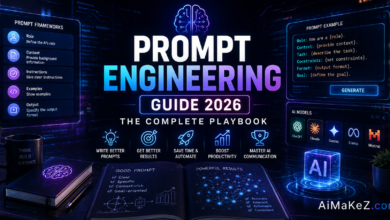
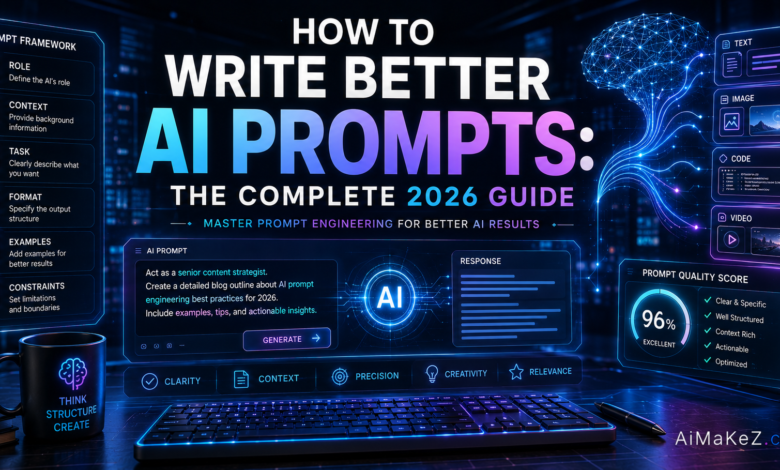
Learning how to write better AI prompts is the single highest-leverage skill you can pick up in 2026. Whether you use ChatGPT, Claude, or Gemini, the quality of what you get out is almost entirely determined by the quality of what you put in. A vague, one-line request produces generic, forgettable output. A well-structured prompt—with a clear role, context, task, and format—produces work that rivals a trained professional, which is the whole point of learning how to write better AI prompts. This guide walks you through the exact frameworks, techniques, and 100+ ready-to-use prompts that turn average results into exceptional ones.
By the end of this article, you’ll understand how large language models actually interpret your words, which prompting frameworks the pros rely on, and how to adapt any prompt for marketing, coding, SEO, blogging, education, and business. In short, you’ll learn how to write better AI prompts for any task. Let’s get into it.
Table of Contents
What Are AI Prompts?
An AI prompt is the instruction, question, or input you give to a generative AI model to produce a response. In plain terms, it’s the conversation starter—the set of words that tells the model what you want, how you want it, and in what shape. Prompts can be a single sentence (“Summarize this article”) or a detailed brief spanning several paragraphs with a defined role, constraints, examples, and an output format. Knowing how to write better AI prompts simply means choosing the right level of detail for the job.
Featured definition: An AI prompt is the text input that guides a large language model to generate a specific, relevant output. Put differently, how to write better AI prompts comes down to giving the model exactly what it needs. Better prompts include a clear role, rich context, a precise task, and a defined format, which dramatically improves accuracy, tone, and usefulness.
Modern AI Prompt Writing has grown into a discipline of its own—often called prompt engineering—because the difference between a mediocre and a masterful prompt, and mastering how to write better AI prompts is what bridges that gap—and closing that gap is what how to write better AI prompts is all about, since the difference between a mediocre and a masterful prompt can be the difference between a throwaway paragraph and a publish-ready deliverable. That gap is exactly what how to write better AI prompts closes.
Why Prompt Quality Matters
Generative AI models are extraordinarily capable, but they are not mind readers Mastering how to write better AI prompts starts with accepting that fact.. They respond to patterns in your input. Learning how to write better AI prompts starts with shaping those patterns deliberately. When your input is thin, the model fills gaps with the most statistically average response, so knowing how to write better AI prompts changes everything—which is exactly why so many people complain that AI output sounds “generic.” The fix isn’t a better model; it’s a better prompt.
| Factor | Weak Prompt Result | Strong Prompt Result |
|---|---|---|
| Relevance | Generic, off-target | Precisely on-brief |
| Tone | Robotic, flat | Matches your brand voice |
| Accuracy | Frequent guessing | Grounded and specific |
| Editing time | Heavy rewriting | Light polish only |
| Reusability | One-off | Template you reuse forever |
💡 Expert Tip #1: Treat every prompt like a brief you’d hand to a freelancer. If a human contractor would need more detail to do the job well, so does the AI.
How Large Language Models Understand Prompts
Large language models (LLMs) like GPT, Claude, and Gemini don’t “understand” language the way humans do. They predict the next most likely token (a word or word fragment) based on the patterns learned during training. Your prompt sets the trajectory of that prediction (see this overview of large language models for background). The richer and more specific your prompt. Learning how to write better AI prompts means being specific, because the richer and more specific your prompt, the narrower and more accurate the model’s predictions become.
- Tokens: Models read your prompt as tokens, not whole words. Concise, well-ordered prompts use the context window efficiently.
- Context window: This is the model’s short-term memory. Front-load the most important instructions.
- Attention: Models weigh certain parts of your prompt more heavily. Clear structure (roles, headers, numbered steps) guides that attention.
- Probability: Ambiguity increases randomness. Specificity reduces it.
⚠️ Warning: Because models predict rather than “know,” they can produce confident but incorrect answers (hallucinations). Always ask for sources or verify facts for high-stakes work.
The Anatomy of a Great Prompt
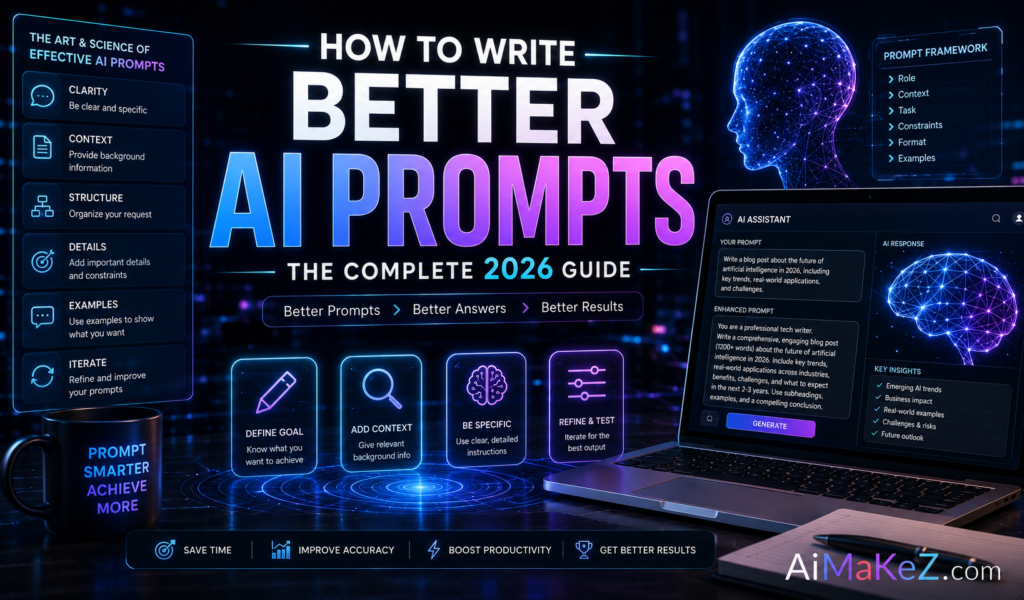
When you study how to write better AI prompts, you’ll notice that nearly every high-performing prompt contains the same building blocks. Master these six components They are the foundation of how to write better AI prompts. and you can construct a strong prompt for any task.
| Component | What It Does | Example |
|---|---|---|
| Role | Sets the persona and expertise level | “You are a senior SEO strategist.” |
| Context | Provides background and constraints | “Our audience is B2B SaaS founders.” |
| Task | The specific action to perform | “Write a 600-word blog intro.” |
| Format | Defines the output structure | “Use H2s, bullet lists, and a CTA.” |
| Tone | Controls the voice and style | “Confident, friendly, no jargon.” |
| Examples | Shows the model what “good” looks like | “Match the style of this sample: …” |
The CLEAR Prompt Framework
The CLEAR framework is a beginner-friendly formula for how to write better AI prompts that guarantees you cover the essentials every time.
- C – Context: Give the model the background it needs.
- L – Length: Specify word count or scope.
- E – Examples: Provide samples or references.
- A – Audience: Define who the output is for.
- R – Role/Result: Set the persona and the desired outcome.
The RACE Prompt Framework
RACE is another proven approach to how to write better AI prompts, and it’s a favorite among marketers and consultants because it maps neatly onto real deliverables.
| Letter | Element | Prompt Snippet |
|---|---|---|
| R | Role | “Act as a conversion copywriter.” |
| A | Action | “Write 5 email subject lines.” |
| C | Context | “For a Black Friday SaaS launch.” |
| E | Expectation | “Under 9 words, curiosity-driven.” |
💡 Expert Tip #2: Use CLEAR when you’re learning and RACE when you’re producing marketing assets. Both prevent the #1 mistake: under-specifying the task.
Core Prompting Techniques Every Pro Uses
Frameworks give you structure; techniques give you power—and together they define how to write better AI prompts. Below are the essential prompting techniques that separate casual users from prompt engineers. Combine them freely—most great prompts stack two or three at once That layering is the essence of how to write better AI prompts..
1. Role Prompting
Assign the model an expert persona Role prompting is a cornerstone of how to write better AI prompts.. This anchors vocabulary, depth, and perspective. Example: “You are a veteran financial analyst with 20 years in venture capital.” The model instantly shifts to the appropriate expertise level.
2. Context Prompting
Supply background details—audience, goals, brand voice, constraints. The more relevant context you provide, the less the model has to guess. This is central to how to write better AI prompts. Context is the highest-ROI addition If you want to know how to write better AI prompts, start with context. you can make to any prompt.
3. Chain-of-Thought Prompting
Ask the model to “think step by step” or “show your reasoning.” This dramatically improves performance on math, logic, and multi-step problems and is a key part of how to write better AI prompts, because it forces the model to reason before answering rather than jumping to a conclusion.
4. Few-Shot Prompting
Give the model 2–5 examples of the input-output pattern you want. Few-shot prompting is the fastest way to lock in a specific style, format, or classification behavior. Few-shot examples are essential to how to write better AI prompts.
5. Zero-Shot Prompting
Ask the model to perform a task with no examples—relying purely on its training. Great for simple, well-known tasks, and it still relies on how to write better AI prompts; less reliable for niche or highly formatted output. Even so, zero-shot is part of how to write better AI prompts.
6. Structured Output Prompting
Request output in a specific format—JSON, tables, markdown, bullet points, or a numbered list. Structured output makes AI results easy to reuse, and it is a practical example of how to write better AI prompts in apps, spreadsheets, and content workflows.
7. Prompt Chaining
Break a big task into a sequence of smaller prompts. This is one of the smartest tactics in how to write better AI prompts, feeding each output into the next. For example: outline → draft → edit → SEO polish. Chaining produces far higher quality than a single mega-prompt. Chaining is an advanced way of how to write better AI prompts.
8. Iterative Prompting: How to Write Better AI Prompts Through Refinement
Rarely is the first output perfect. Refine with follow-ups like “make it shorter,” “add data,” or “rewrite in a warmer tone.” Iteration is where the real magic happens—treat it as a conversation, not a vending machine. Iteration is how to write better AI prompts in practice.
| Technique | Best For | Difficulty |
|---|---|---|
| Role Prompting | Tone & expertise | Easy |
| Context Prompting | Relevance | Easy |
| Chain-of-Thought | Reasoning tasks | Medium |
| Few-Shot | Consistent formatting | Medium |
| Zero-Shot | Quick, simple tasks | Easy |
| Structured Output | Data & automation | Medium |
| Prompt Chaining | Long-form projects | Advanced |
| Iterative Refinement | Polishing output | Easy |
💡 Expert Tip #3: Stack techniques. A single prompt can use Role + Context + Chain-of-Thought + Structured Output. That combination alone will beat 90% of the prompts people write. That is how to write better AI prompts in one move.
Bad Prompt vs Good Prompt
Seeing the contrast side by side is the fastest way to internalize how to write better AI prompts and what makes a prompt effective. Notice how each “good” version adds role, context, task specificity, and format.
| Bad Prompt | Good Prompt |
|---|---|
| “Write about coffee.” | “You are a food writer. Write a 400-word blog intro on single-origin coffee for home baristas. Warm, sensory tone. End with a question.” |
| “Give me marketing ideas.” | “Act as a growth marketer. List 10 low-budget acquisition ideas for a B2B SaaS with a $50 CAC target. Format as a table with effort and impact ratings.” |
| “Fix my code.” | “You are a senior Python developer. Debug this function, explain the bug in one sentence, and return the corrected code with comments. [paste code]” |
| “Write an email.” | “Write a follow-up sales email to a prospect who ghosted after a demo. Friendly, 90 words, one clear CTA to rebook.” |
Prompt Examples by Tool and Use Case
Different tools and jobs call for slightly different prompting styles, yet the rules of how to write better AI prompts stay the same. Below are practical, copy-ready examples organized by platform and by use case. Adapt the bracketed placeholders to your situation.
Prompt Examples for ChatGPT
- “Act as a productivity coach. Build me a realistic daily schedule around these 5 priorities: [list]. Include buffer time.”
- “Summarize this transcript into 5 key takeaways and 3 action items. [paste]”
- “Rewrite this paragraph to be 30% shorter without losing meaning. [paste]”
Prompt Examples for Claude
- “You are an expert editor. Review this 2,000-word draft for clarity, flow, and tone. Return a marked-up list of specific edits. [paste]”
- “Analyze this contract and flag any clauses that are unusual or risky for the buyer. Explain each in plain English. [paste]”
- “Turn these messy notes into a clean, structured project brief with objectives, scope, and milestones. [paste]”
Prompt Examples for Gemini
- “Research current best practices for [topic] and give me a sourced summary with links.”
- “Compare these three products across price, features, and reviews in a table. [list]”
- “Draft a 7-day content calendar for my [niche] YouTube channel with hooks for each video.”
Prompt Examples for Midjourney & AI Image Generators
- “A cozy Scandinavian home office, morning light, wooden desk, plants, minimalist, cinematic, 35mm, soft shadows –ar 16:9 –v 6”
- “Product photo of a matte black water bottle on marble, studio lighting, high detail, commercial photography –ar 1:1”
- “Isometric illustration of a smart city, pastel palette, flat design, clean vector style –ar 3:2”
💡 Expert Tip #4: For image models, lead with the subject, then style, then technical parameters (aspect ratio, version). Order matters more than length, a subtle rule in how to write better AI prompts.
Prompt Examples for Coding
- “You are a senior JavaScript engineer. Write a debounce function with TypeScript types and JSDoc comments.”
- “Refactor this function for readability and add unit tests using Jest. [paste]”
- “Explain this error and give me the fix: [paste stack trace]”
Prompt Examples for Marketing
- “Act as a brand strategist. Create a positioning statement for [product] targeting [audience].”
- “Write 10 ad hooks for a Meta campaign selling [product]. Keep each under 12 words.”
- “Build a customer persona for [product] including goals, pain points, and objections.”
Prompt Examples for Blogging
- “Generate 15 blog title ideas for the keyword ‘[keyword]’ that balance SEO and click appeal.”
- “Write a detailed outline for a 2,000-word post on [topic] with H2s and H3s.”
- “Draft an engaging intro for a blog on [topic] using a surprising statistic.”
Prompt Examples for SEO
- “Create a semantic keyword cluster for ‘[primary keyword]’ with search intent labels.”
- “Write an SEO title under 60 characters and a meta description under 155 characters for [topic].”
- “Suggest 10 internal linking opportunities for a post about [topic].”
Prompt Examples for Students & Teachers
- “Explain [concept] to me like I’m 15, then give a real-world analogy and a 3-question quiz.”
- “Create a study plan for my [subject] exam in 14 days with daily goals.”
- “Act as a teacher. Generate a lesson plan on [topic] for a 45-minute class with objectives and activities.”
Prompt Examples for Business & Customer Support
- “Draft a professional response to this refund request that keeps the customer happy. [paste]”
- “Write an SOP for onboarding a new customer support agent.”
- “Turn this negative review into a calm, empathetic public reply. [paste]”
Prompt Examples for Social Media, Email & Product Descriptions
- “Write 5 LinkedIn hooks about [topic] that stop the scroll.”
- “Write a cold email to [persona] offering [service]. 100 words, one CTA.”
- “Write a persuasive product description for [product] highlighting 3 benefits and a guarantee.”
100 Ready-to-Use AI Prompts
Below are 100 tested prompts organized by category. They put everything you’ve learned about how to write better AI prompts into practice. Copy, swap the brackets for your details, and paste into ChatGPT, Claude, or Gemini. Bookmark this section—it’s the fastest prompt library on AiMaKeZ. Use it whenever you practice how to write better AI prompts.
Writing & Content (1–15)
- Act as a professional copywriter and rewrite this to be clearer and punchier: [text].
- Write a 500-word blog intro on [topic] that opens with a bold claim.
- Summarize this article in 5 bullet points a busy executive would appreciate: [text].
- Turn these bullet points into a flowing narrative paragraph: [bullets].
- Generate 20 catchy headlines for [topic], mixing curiosity and clarity.
- Rewrite this in a friendly, conversational tone: [text].
- Create a compelling call-to-action for [product/offer].
- Write a 300-word “About Us” page for [company] with a warm, human voice.
- Expand this outline into a full first draft: [outline].
- Proofread and improve grammar without changing my voice: [text].
- Write a persuasive landing page hero section for [product].
- Give me 10 metaphors to explain [complex concept] simply.
- Draft a press release announcing [news] in AP style.
- Write three versions of this sentence: formal, casual, and witty: [sentence].
- Create a content brief for a writer covering [topic], including tone and key points.
Marketing & Sales (16–30)
- Create a full marketing funnel for [product] from awareness to purchase.
- Write 10 Facebook ad variations for [offer] under 15 words each.
- Draft a 5-email nurture sequence for new [product] leads.
- Build a customer persona for [audience] with goals, pains, and buying triggers.
- Write a value proposition for [product] in one sentence.
- Generate 15 hooks for short-form video ads about [product].
- Create a competitor comparison table for [product] vs [competitor].
- Write a webinar promotion email that drives sign-ups.
- Suggest 10 lead magnet ideas for a [niche] audience.
- Draft a referral program pitch to send to existing customers.
- Write ad copy targeting three different awareness stages for [product].
- Create a 30-day social media content plan for [brand].
- Write a discount campaign message that creates urgency without sounding spammy.
- Generate objection-handling responses for [common sales objection].
- Write a case-study outline showing how [customer] succeeded with [product].
SEO & Blogging (31–45)
- Build a keyword cluster around ‘[keyword]’ grouped by search intent.
- Write an SEO title and meta description for a post on [topic].
- Suggest 10 long-tail keyword ideas for [topic].
- Create an outline optimized to rank for ‘[keyword]’.
- Write an FAQ section targeting People Also Ask questions for [topic].
- Identify content gaps between my post and top-ranking competitors: [paste].
- Rewrite this paragraph to naturally include ‘[keyword]’.
- Generate schema-friendly FAQ questions and 40-word answers for [topic].
- Suggest internal and external linking opportunities for [topic].
- Write a compelling featured-snippet answer for ‘[question]’ in under 50 words.
- Audit this content for readability and suggest improvements: [text].
- Create 5 blog post ideas that target commercial-intent keywords in [niche].
- Write alt text for an image showing [description].
- Draft a pillar-page structure for [broad topic] with supporting subtopics.
- Rewrite this title to improve CTR while keeping the keyword: [title].
Coding & Tech (46–60)
- Explain this code line by line: [paste].
- Write a function that [does X] in [language] with comments.
- Refactor this for performance and explain your changes: [paste].
- Write unit tests covering edge cases for this function: [paste].
- Convert this code from [language A] to [language B]: [paste].
- Debug this and tell me the root cause: [paste error].
- Generate a regex that matches [pattern] with an explanation.
- Write a SQL query to [goal] from tables [describe].
- Create a README for this project: [describe].
- Suggest a scalable architecture for [app idea].
- Write a Dockerfile for a [stack] application.
- Review this code for security vulnerabilities: [paste].
- Generate sample API documentation for this endpoint: [describe].
- Write a Git commit message following conventional commits for: [change].
- Create a step-by-step tutorial teaching a beginner to [task].
Business & Productivity (61–75)
- Draft a one-page business plan for [idea].
- Create a SWOT analysis for [company/idea].
- Write a professional meeting agenda for [meeting purpose].
- Summarize these meeting notes into decisions and action items: [paste].
- Draft a project timeline with milestones for [project].
- Write a job description for a [role] at a [company type].
- Create interview questions to assess [skill] for a [role].
- Write a performance review template with growth-oriented feedback.
- Draft an SOP for [recurring process].
- Prioritize this task list using the Eisenhower Matrix: [list].
- Write a persuasive proposal for [client] offering [service].
- Create an onboarding checklist for new [role] hires.
- Draft a polite email declining [request] while keeping the relationship.
- Turn this rough idea into a clear elevator pitch: [idea].
- Write a weekly status update email to stakeholders about [project].
Education & Learning (76–90)
- Explain [concept] at three levels: child, student, and expert.
- Create a 30-day learning roadmap for mastering [skill].
- Generate 10 practice questions on [topic] with answer explanations.
- Turn this chapter into flashcards (Q&A format): [paste].
- Give me a mnemonic to remember [list of items].
- Design a lesson plan on [topic] for a 60-minute class.
- Quiz me on [topic] and adapt difficulty to my answers.
- Summarize this research paper for a non-expert: [paste].
- Compare [concept A] and [concept B] in a table.
- Create a debate: give the strongest arguments for and against [topic].
- Explain the most common misconceptions about [topic].
- Build a spaced-repetition study schedule for [exam].
- Write real-world examples that illustrate [abstract concept].
- Act as a Socratic tutor and guide me to understand [topic] through questions.
- Simplify this dense passage into plain language: [paste].
Creative & Personal (91–100)
- Brainstorm 20 unique names for [project/brand/product].
- Write a short story in the style of [genre] about [premise].
- Plan a 7-day itinerary for a trip to [destination] on a [budget].
- Create a personalized weekly meal plan for [dietary goal].
- Write a heartfelt thank-you message for [occasion].
- Generate 10 creative gift ideas for [person] who loves [interest].
- Draft a motivational morning routine tailored to my goals: [list].
- Write journal prompts to help me reflect on [theme].
- Turn my rough thoughts into a clear, confident message: [paste].
- Act as a brainstorming partner and help me generate ideas for [challenge].
Downloadable Prompt Templates
Copy these reusable templates into your notes app. Fill in the brackets and you have a strong prompt every time.
ROLE-CONTEXT-TASK-FORMAT TEMPLATE

Role: You are a [expert role] with [experience].
Context: My audience is [audience]. My goal is [goal]. Constraints: [constraints].
Task: [Exactly what you want done].
Format: [Length, structure, tone, output type].
Examples: [Optional sample of desired style].
CLEAR FRAMEWORK TEMPLATE
Context: [background]
Length: [word count / scope]
Examples: [reference samples]
Audience: [who it's for]
Role/Result: [persona + desired outcome]REFINEMENT TEMPLATE (follow-up prompts)
- "Make it 30% shorter."
- "Add a real statistic and cite it."
- "Rewrite in a [tone] voice."
- "Give me 3 alternative versions."
- "Now format the final result as a table."10 Common Prompt Mistakes
- Being too vague. “Write something good” gives the model nothing to work with.
- Skipping context. No audience, no goal, no constraints means generic output.
- No defined format. If you don’t specify structure, you’ll get an unpredictable wall of text.
- Overloading a single prompt. Ten tasks in one prompt dilutes quality—chain them instead.
- Forgetting the role. Without a persona, the model defaults to a bland, average voice.
- Not iterating. Accepting the first draft leaves 80% of the value on the table.
- Ambiguous instructions. “Make it better” is subjective; say exactly what “better” means.
- Ignoring examples. Few-shot examples fix style problems instantly.
- Trusting facts blindly. Always verify statistics, quotes, and citations.
- Writing walls of instructions. Use headers, numbers, and structure so the model can parse your intent.
⚠️ Warning: Never paste confidential, financial, or personally identifiable information into public AI tools unless you’ve confirmed the platform’s data policy.
Best Practices for How to Write Better AI Prompts
These field-tested tips will instantly upgrade your AI Prompt Writing. Save them as a checklist.
- Tip 5: Front-load the most important instruction in the first sentence.
- Tip 6: Specify what to avoid, not just what to include (“no clichés, no filler”).
- Tip 7: Ask the model to ask you clarifying questions before answering complex tasks.
- Tip 8: Use delimiters (quotes, triple backticks) to separate instructions from source text.
- Tip 9: Request a specific word count—models honor numeric targets well.
- Tip 10: For reasoning tasks, add “think step by step” to unlock chain-of-thought.
- Tip 11: Provide a “gold standard” example and say “match this quality.”
- Tip 12: Save your best prompts as reusable templates—build a personal prompt library so how to write better AI prompts becomes second nature.
- Tip 13: Assign a persona and an audience for maximum tone control.
- Tip 14: When output drifts, restate the goal instead of piling on corrections.
- Tip 15: Test the same prompt across ChatGPT, Claude, and Gemini—each has strengths.
Great prompt engineering is iterative and evidence-based. For deeper research, resources like OpenAI’s prompt engineering guide are worth exploring. The professionals who get the most from generative AI aren’t using secret tools—they’re simply more deliberate about structure, context, and refinement. That deliberateness is the entire skill. And that deliberateness is exactly what how to write better AI prompts requires.

The Future of Prompt Engineering
As models grow more capable, how to write better AI prompts is evolving from clever wording toward clear thinking. Newer models handle vague requests better, but they still reward structure, context, and intent. The future belongs to people who can define problems precisely—because a well-framed problem is a well-answered one That mindset is the future of how to write better AI prompts..
- Multimodal prompting: Combining text, images, audio, and data in a single request.
- Agentic workflows: Prompts that trigger multi-step, tool-using AI agents.
- Reusable prompt libraries: Teams sharing tested prompts like code snippets.
- Prompt + system design: Blending prompts with retrieval and structured data for accuracy.
To go deeper, explore related AiMaKeZ guides such as the Prompt Engineering Guide 2026, the Best AI Tools in 2026, and our reviews of ChatGPT, Claude AI, and Gemini. If you create content, see Best AI Writing Tools, Best AI Image Generators, and Best AI Video Generators. For applied workflows, check ChatGPT for Blogging, ChatGPT for Marketing, ChatGPT for SEO, Claude for Content Writing, Gemini Effectively, How to Generate AI Images, and How to Create AI Videos.
Frequently Asked Questions
What is the best way to write better AI prompts?
The best way to write better AI prompts is to include a clear role, relevant context, a specific task, and a defined output format. Add examples for style, then refine iteratively. This four-part structure consistently produces accurate, on-brand results across ChatGPT, Claude, and Gemini.
What is prompt engineering?
Prompt engineering is the practice of designing and refining inputs to get the best possible output from AI language models. It combines clear communication, structured formatting, and techniques like role prompting and chain-of-thought reasoning. In practice, it’s the discipline behind how to write better AI prompts.
Do longer prompts always work better?
Not always. Length helps only when it adds relevant context and specificity. A focused, well-structured prompt beats a long, rambling one. Aim for clarity over word count. Clarity, not length, is the real key to how to write better AI prompts.
What is chain-of-thought prompting?
Chain-of-thought prompting asks the model to reason step by step before giving a final answer. It significantly improves accuracy on math, logic, and multi-step problems.
What is few-shot prompting?
Few-shot prompting provides the model with a handful of examples showing the desired input-output pattern. It’s the fastest way to lock in a specific style, tone, or format.
Are prompts different for ChatGPT, Claude, and Gemini?
The core principles are identical, but each model has strengths. Claude excels at long-form analysis and editing, ChatGPT is highly versatile, and Gemini integrates well with research and Google’s ecosystem. Test your prompt across all three.
How do I write prompts for AI image generators?
Lead with the subject, then describe style, mood, lighting, and composition, and finish with technical parameters like aspect ratio. Order matters more than length for image models.
Why does AI give me generic answers?
Generic answers usually mean your prompt lacks context, a role, or a specific format. Add who it’s for, what expertise the model should adopt, and how you want the output structured.
Can I reuse prompts as templates?
Absolutely. Turning your best prompts into bracketed templates is one of the highest-leverage habits in AI productivity. Build a personal or team prompt library and reuse it endlessly. Reusable templates make how to write better AI prompts effortless over time.
Is prompt engineering still relevant in 2026?
Yes. Even as models improve, they reward clear thinking, structure, and intent. Prompt engineering is shifting from clever wording toward precise problem definition—a skill that only grows in value.
Final Verdict
Knowing how to write better AI prompts is no longer optional—it’s the core competency of the AI era. The frameworks (CLEAR, RACE), the techniques (role, context, chain-of-thought, few-shot, structured output, chaining, and iteration), and the 100 ready-to-use prompts in this guide give you everything you need to get professional-grade output from any model. Start with the Role-Context-Task-Format template, iterate relentlessly, and save what works Keep refining how to write better AI prompts, and. Do that consistently, and you’ll produce results most people can only get from an expert. Bookmark this guide, put these prompts to work today, and keep refining—the better your prompts, the better your future.