Table of Contents
Introduction
Marketing teams are drowning in work: dozens of blog posts, endless social captions, email sequences, ad variations, and product descriptions, all expected yesterday and all expected to convert. If you have ever stared at a blank document at 9 a.m. wondering how to fill an entire content calendar by Friday, you already understand why learning ChatGPT for marketing has become a survival skill rather than a nice-to-have. The pressure to publish more, personalize faster, and prove ROI has never been higher, and the budgets rarely grow to match.
This is where ChatGPT for marketing changes the math. Instead of replacing marketers, it removes the friction that slows them down, from ideation and outlining to drafting, editing, and repurposing. In this guide you will learn exactly how to use ChatGPT for marketing in 2026, with practical prompts, real-world examples, workflows, pricing, comparisons, and the mistakes that quietly ruin results. Whether you run a solo Shopify store in Ohio or lead a demand-generation team in Berlin, these ChatGPT for marketing tactics are built to be copied and used today.
What Is ChatGPT for Marketing?
ChatGPT is a conversational AI tool built by OpenAI on top of large language models (LLMs) such as GPT-4o and the newer GPT-5 family. Using ChatGPT for marketing simply means applying this generative AI to marketing tasks: brainstorming campaign angles, writing copy, analyzing customer feedback, drafting SEO content, and automating repetitive communication. It understands natural language, so you brief it the same way you would brief a junior copywriter, and it responds instantly.
Unlike a rigid template tool, ChatGPT adapts to context. Feed it your brand voice, target audience, and offer, and it produces tailored output rather than generic filler. Marketers use it across the full funnel, from top-of-funnel blog ideas and social media content to bottom-of-funnel sales emails and retention messaging. In short, ChatGPT for marketing is a flexible digital assistant that turns rough ideas into publishable assets in minutes. Think of it less as a content vending machine and more as a tireless collaborator that never runs out of energy, never gets writer\u2019s block, and is always ready for the next iteration at two in the afternoon or two in the morning.
Key Features
ChatGPT ships with a growing toolkit that goes far beyond simple text generation. The features below are the ones teams using ChatGPT for marketing lean on most.
Natural Language Content Generation
The core engine writes human-like copy for blogs, landing pages, ads, and emails. You can specify tone, length, reading level, and format, then iterate until the draft fits your brand. This makes it a fast first-draft machine for content marketing.
Custom GPTs and Memory
You can build a Custom GPT trained on your style guide, past campaigns, and product data so it consistently writes on-brand. With memory enabled, it remembers preferences across sessions, reducing repetitive briefing.
Data Analysis and File Uploads
Upload spreadsheets, survey exports, or ad reports and ask ChatGPT to summarize trends, cluster feedback, or surface winning subject lines. This turns raw marketing data into readable insight without a spreadsheet formula in sight.
Web Browsing and Image Generation
Modern versions can browse the live web for current statistics and generate images for social posts or ad concepts, keeping campaigns timely and visual.
API and Integrations
The OpenAI API lets teams plug ChatGPT into CRMs, help desks, and automation platforms like Zapier or Make, powering marketing automation at scale. This is where individual productivity turns into systemic advantage: instead of one marketer prompting the tool, your entire funnel can call on it automatically to draft replies, score leads, and personalize follow-ups the moment a trigger fires.
Benefits
The practical advantages of using ChatGPT for marketing show up quickly in both speed and quality, and they compound as your team gets better at prompting. Unlike a one-off tool you learn and forget, prompting is a skill that keeps paying dividends: the sharper your briefs become, the less editing you do, and the more the assistant feels like a genuine extension of your team rather than a novelty.
- Speed: A first draft that once took two hours can take ten minutes, freeing marketers for strategy.
- Cost efficiency: Small teams produce agency-level output without agency-level retainers.
- Consistency: A Custom GPT keeps tone and messaging uniform across every channel.
- Scalable personalization: Generate dozens of audience-specific variations for email segments and ad sets.
- Fewer creative blocks: With ChatGPT for marketing, endless ideation means the blank-page problem effectively disappears.
- Multilingual reach: Instantly adapt campaigns for US and European audiences in native-sounding language.
Proven ChatGPT Prompts for Marketing
A great prompt is the difference between forgettable filler and copy that actually converts. The templates below are field-tested across dozens of campaigns. Copy them, swap in your own details, and refine the output until it matches your brand voice and offer.
Blog and SEO Prompt
“Act as an SEO content strategist. My target keyword is [keyword] and my audience is [audience]. Give me a blog outline with an H1, eight H2 sections, three FAQ questions, and a meta description under 155 characters. Keep the tone helpful and authoritative.” This single prompt replaces an hour of manual outlining and hands editors a structured, search-ready starting point.
Email Campaign Prompt
“Write a three-email nurture sequence for [product] aimed at [segment]. Email one educates, email two handles objections, and email three drives a limited-time offer. Give me two subject lines per email and keep each under 150 words.” You instantly get a testable sequence instead of a blinking cursor and a blank inbox.
Ad Copy Prompt
“Generate ten Google Ads headlines (max 30 characters each) and four descriptions (max 90 characters) for [offer]. Focus on the core benefit, add urgency, and vary the angles between price, outcome, and social proof.” Performance marketers get a full test matrix in seconds, which fuels faster optimization cycles and lower cost per click.
Repurposing Prompt
“Turn this blog post into five LinkedIn posts, ten X posts, and one short newsletter intro. Preserve the key statistics and match each platform’s native tone.” Repurposing is where ChatGPT for marketing quietly saves the most time, stretching one strong asset across an entire content calendar without extra research.
How It Works
Getting value from ChatGPT for marketing is less about the tool and more about how you brief it. Follow these steps to move from idea to published asset.
- Set the context: Tell ChatGPT its role, your brand, your audience, and the goal. Example: “You are a B2B SaaS copywriter. Our audience is HR managers at mid-sized US firms.”
- Give a clear task: Specify the format, length, and tone. “Write a 120-word LinkedIn post announcing our new onboarding feature in a confident, friendly voice.”
- Add constraints and examples: Paste a past post you liked or a list of keywords to guide the style.
- Generate and review: Read the output critically for accuracy, brand fit, and claims that need fact-checking.
- Iterate: Ask for revisions, “make it shorter,” “add a stronger hook,” or “give me three variations.”
- Fact-check and finalize: Verify statistics and add your human perspective before publishing.
The quality of your prompt determines the quality of the result. Treat prompting like briefing a talented freelancer who needs specifics to shine. The best marketers keep a personal library of prompts that work, version them like code, and share the winners across the team so nobody starts from scratch twice.
Real-World Use Cases
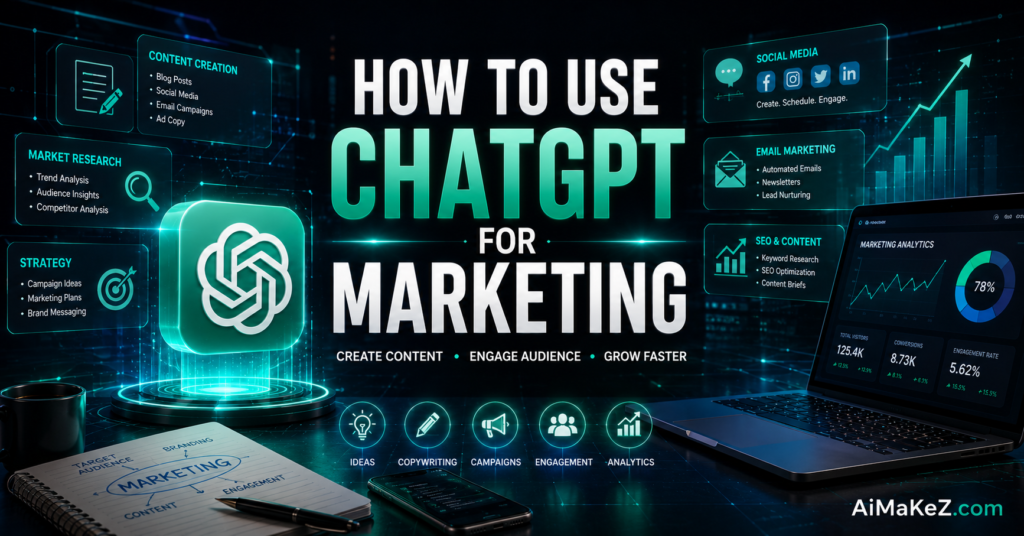
Here is how different teams apply ChatGPT for marketing across everyday work, from lean startups to global brands.
Content Marketing and SEO
A content team uses ChatGPT for marketing to cluster keywords into topic pillars, draft SEO outlines, and write meta descriptions. One US-based agency reduced its blog turnaround from five days to two by using AI for first drafts while editors focused on originality and expertise.
Email Marketing
An e-commerce brand feeds ChatGPT for marketing its customer segments and asks for tailored welcome sequences, abandoned-cart emails, and re-engagement campaigns, then A/B tests the subject lines it suggests.
Social Media
A solo founder generates a month of platform-specific captions in one sitting, adapting the same message for LinkedIn, Instagram, and X in seconds. Because ChatGPT can mirror a brand voice once it is trained on past posts, the output feels consistent rather than copy-pasted, and the founder spends their saved time engaging with comments instead of staring at a content calendar.
Paid Advertising
Performance marketers request 15 headline variations and five ad descriptions for Google Ads, giving them more creative to test without extra copywriting hours. More variations mean faster statistical significance in A/B tests, which translates into lower acquisition costs and campaigns that improve week over week rather than stalling on a single tired headline.
Education and Enablement
Marketing educators use it to build course outlines and quizzes, while enablement teams turn feature docs into digestible sales training.
Productivity and Automation
Connected through the API and Zapier, ChatGPT for marketing auto-drafts responses to inbound leads, summarizes weekly analytics, and tags customer feedback, freeing hours every week for higher-value strategy.
Pros and Cons
| Pros | Cons |
|---|---|
| Fast, high-volume content creation | Can produce generic copy without strong prompts |
| Affordable for small teams | May state outdated or inaccurate facts |
| Flexible across the full funnel | Requires human editing for brand voice and EEAT |
| Scales personalization easily | Data privacy considerations for sensitive inputs |
| Improves productivity and ideation | Risk of over-reliance and sameness across brands |
Pricing
ChatGPT for marketing offers tiered plans suited to different needs, from curious beginners to enterprise teams running always-on automations. Pricing can change frequently as new models launch, so confirm current rates on OpenAI’s official pricing page before budgeting.
- Free plan: Access to a capable model with basic features, ideal for testing and light use.
- ChatGPT Plus (around $20/month): Faster responses, advanced models, browsing, image generation, and Custom GPTs, the sweet spot for most marketers and freelancers.
- ChatGPT Team (per-seat pricing): Collaboration features and a shared workspace for small marketing teams, with higher usage limits.
- ChatGPT Enterprise: Advanced security, admin controls, and priority access for larger organizations, priced on request.
- API usage: Pay-as-you-go pricing based on tokens, best for building custom marketing automations.
Comparison With Alternatives
ChatGPT is not the only AI marketing assistant, and each competitor has a niche. If you are weighing options, our guide to the best AI alternatives to ChatGPT goes deeper on the trade-offs.
| Tool | Best For | Key Difference |
|---|---|---|
| ChatGPT | All-round marketing tasks | Most flexible, strong reasoning and Custom GPTs |
| Jasper | Marketing-specific templates | Built for brand voice and team workflows |
| Google Gemini | Research and Google ecosystem | Deep integration with Google Workspace |
| Claude | Long-form, nuanced writing | Large context and careful, natural tone |
| Copy.ai | Short-form sales copy | Streamlined for quick ad and email copy |
For most marketers, ChatGPT for marketing wins on versatility, while dedicated tools like Jasper may appeal to teams wanting rigid brand controls out of the box.
Best Practices
To get professional results, treat ChatGPT for marketing as a collaborator, not an autopilot. Pairing it with the right AI tools can multiply your output even further.
- Build a brand-voice prompt you reuse for every task to keep messaging consistent.
- Always fact-check statistics, quotes, and claims before publishing.
- Add human experience and original examples to satisfy Google’s EEAT expectations.
- Use it for drafts, not final copy, and edit for rhythm and personality.
- Create Custom GPTs for repeatable ChatGPT for marketing workflows like blog outlines or ad copy.
- Protect sensitive data by avoiding confidential customer information in prompts.

ChatGPT for Marketing Across Industries
The tactics change depending on who you serve. Here is how ChatGPT for marketing adapts to the realities of different sectors, whether you sell software in San Francisco or run a boutique in Barcelona.
E-commerce and Retail
Online stores live or die by product descriptions and seasonal campaigns. ChatGPT can write hundreds of unique, benefit-driven product descriptions from a simple spec sheet, draft holiday promotions, and generate size-guide FAQs. A mid-sized retailer can refresh its entire catalog copy before a sale rather than leaving half the listings untouched.
B2B and SaaS
Longer sales cycles demand educational content and precise messaging. Marketers use ChatGPT to turn dense feature documentation into clear landing pages, build comparison tables against competitors, and draft case-study narratives from raw customer interviews. It shortens the distance between product updates and the sales enablement material that supports them.
Local Services and Agencies
A dentist, plumber, or law firm rarely has a full marketing team. ChatGPT becomes a virtual assistant that writes Google Business posts, responds to reviews in a professional tone, and produces locally relevant blog content that helps with map-pack visibility. Agencies, meanwhile, use it to service more clients without proportionally growing headcount.
Nonprofits and Education
Organizations with tight budgets get the most obvious lift. Nonprofits draft grant summaries, donor emails, and social appeals, while educators build course descriptions and outreach campaigns. The tool democratizes professional-grade marketing for teams that could never afford an agency.
Common Mistakes to Avoid
Even skilled marketers stumble when they lean on ChatGPT for marketing the wrong way.
- Publishing unedited output: Raw AI text often sounds generic and can contain errors.
- Vague prompts: Without context, you get bland, forgettable copy.
- Ignoring fact-checking: AI can confidently state wrong figures, harming trust.
- Over-optimizing for keywords: Stuffing keywords hurts readability and rankings.
- Losing your brand voice: Relying entirely on defaults makes every brand sound identical.
- Skipping strategy: AI speeds execution but cannot replace a clear marketing plan.
Frequently Asked Questions
Is ChatGPT good for marketing in 2026?
Yes. In 2026, ChatGPT for marketing is one of the most capable AI assistants available, handling everything from SEO content and email campaigns to social media and ad copy. It works best when paired with human editing and a clear strategy.
Can ChatGPT replace marketers?
No. ChatGPT accelerates execution but cannot replace strategic thinking, brand judgment, and real customer relationships. It is a productivity multiplier that makes marketers more effective, not a substitute for them.
How do I write better ChatGPT prompts for marketing?
Give it a role, your audience, the goal, the format, and the tone. Add examples of copy you like and specify constraints. Clear, detailed prompts consistently produce sharper, more on-brand results.
Is content from ChatGPT bad for SEO?
Not inherently. Google rewards helpful, original content regardless of how it is produced. Problems arise only when AI content is unedited, inaccurate, or thin. Add expertise, examples, and human review to rank well.
Is ChatGPT free for marketing use?
There is a capable free tier, but the paid Plus plan unlocks advanced models, browsing, image generation, and Custom GPTs that most marketers find worth the modest monthly cost.
Measuring the ROI of ChatGPT in Marketing
Adopting an AI assistant is easy; proving it pays off is what convinces leadership to invest further. The good news is that the return on ChatGPT for marketing is measurable if you track the right signals rather than vanity metrics, and the numbers usually speak for themselves within the first month of serious use.
Start with time saved. Log how long a task took before AI and after, then multiply the hours reclaimed by your team’s hourly cost. Many teams recover ten to fifteen hours a week on drafting, repurposing, and first-pass editing alone, which often covers the subscription many times over. Those reclaimed hours rarely disappear into idle time; instead, they get reinvested into higher-value work such as strategy, creative testing, and building real relationships with customers, the parts of marketing that no algorithm can replicate.
Next, watch output and quality together. More blog posts or ad variations only matter if they perform, so pair volume metrics with conversion rate, organic traffic, email open rate, and click-through rate. If AI-assisted content matches or beats your baseline while costing less to produce, the ROI is real.
Finally, factor in speed to market. Launching a campaign two days sooner can be the difference between catching a trend and missing it entirely. When you combine reclaimed hours, steady quality, and faster launches, the business case for ChatGPT for marketing in your stack becomes hard to argue with.
Final Verdict
Learning to use ChatGPT for marketing is one of the highest-leverage skills a modern marketer can develop. It compresses the time between idea and execution, scales personalization, and removes the creative bottlenecks that slow teams down, all while keeping costs remarkably low. The marketers who win with it are not the ones who paste raw output, but the ones who brief it well, fact-check rigorously, and layer in genuine human experience and brand voice. In other words, the tool rewards taste and judgment rather than replacing them, which is exactly why skilled marketers have little to fear and everything to gain from adopting it early.
Our recommendation is simple: start with the free plan to build prompting confidence, upgrade to ChatGPT Plus once it becomes part of your daily workflow, and create Custom GPTs for your most repetitive tasks. Treat it as a talented teammate rather than a magic button, and you will produce more, better, and faster than ever, giving your marketing an edge that compounds every single week in 2026 and beyond.
If you are just getting started, pick one repetitive task this week, perhaps drafting social captions or product descriptions, and hand it to ChatGPT with a detailed brief. Measure the time you save and the quality you get, then expand from there. Small, consistent wins are how the best teams turn ChatGPT for marketing from a curiosity into a core part of their engine, and there is no better moment to begin than today.