Table of Contents
Introduction
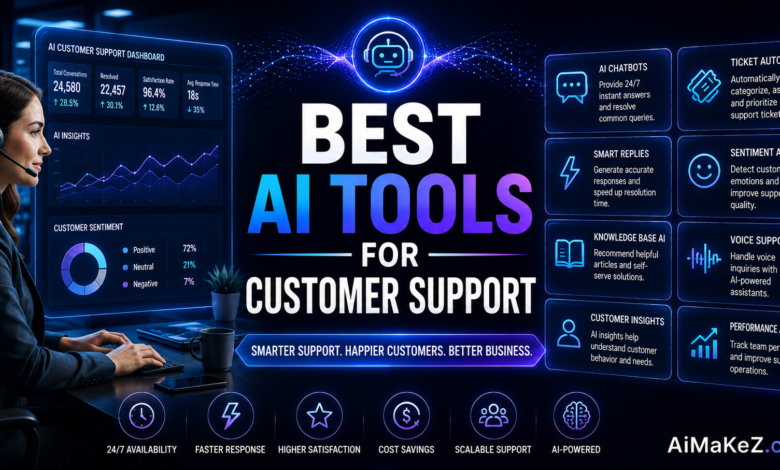
Waiting on hold. Repeating your order number for the third time. Getting bounced between departments. If you have ever been a frustrated customer, you already understand the problem that AI customer support tools were built to solve. Slow, disconnected service costs companies loyalty, revenue, and reputation, and in 2026 buyers simply expect faster answers than a purely human team can deliver around the clock.
Support leaders in the United States and Europe face a hard equation: rising ticket volumes, tighter budgets, and customers who want instant, accurate help on whatever channel they prefer. The modern generation of AI customer support tools closes that gap by resolving routine questions automatically, guiding human agents with real-time context, and turning conversation data into insight you can act on.
Having tested and implemented these platforms across e-commerce, SaaS, and services teams, we have seen the difference firsthand: deflection rates climb, response times fall, and agents finally get time back for the conversations that need a human touch. This guide draws on that hands-on experience to break down what these platforms do, how they work, the features that matter, honest pros and cons, realistic pricing, and how the leading options compare.
Whether you run a lean startup or a global contact center, you will leave with a practical framework for choosing the right stack. For more AI tool reviews and workflow ideas, explore the guides on AiMaKeZ.
What Are AI Customer Support Tools?
AI customer support tools are software platforms that use artificial intelligence, natural language processing, and machine learning to automate, assist, and improve how businesses respond to customer questions. Instead of relying only on human agents, these systems can understand a request in plain language, find the right answer, and either resolve the issue directly or route it to the best person.
At their core, these platforms combine several technologies. Conversational AI interprets what a customer means, not just the words they type. A connected knowledge base supplies verified answers. Automation handles repetitive workflows such as password resets, order tracking, and refund status. And analytics measure everything so teams keep improving.
It helps to separate two layers. Customer-facing automation includes AI chatbots, virtual agents, and self-service portals that talk directly to your audience. Agent-facing intelligence includes reply suggestions, summarization, sentiment analysis, and knowledge surfacing that make human agents faster and more consistent. The best AI customer support tools blend both layers so nothing falls through the cracks. This blend is a natural evolution of traditional customer service, updated for a real-time, always-on world.
Why AI Customer Support Tools Matter in 2026
Customer expectations have shifted permanently. Shoppers compare your response speed not to your direct competitor but to the fastest experience they had all week, whether that was a bank app or a food delivery service. Meeting that bar with humans alone is financially impossible for most teams, which is exactly why AI customer support tools have moved from experimental to essential.
Generative AI has also matured. The chatbots that once looped customers in circles now understand nuance, handle multi-step requests, and admit when they are unsure. Combined with stronger privacy controls and deeper integrations, this reliability is what finally makes automation trustworthy enough for frontline use across regulated markets in Europe and North America.
Key Features
Not every platform is created equal, but the strongest AI customer support tools share a recognizable set of capabilities. Here are the features that separate a genuine solution from a basic chat widget.
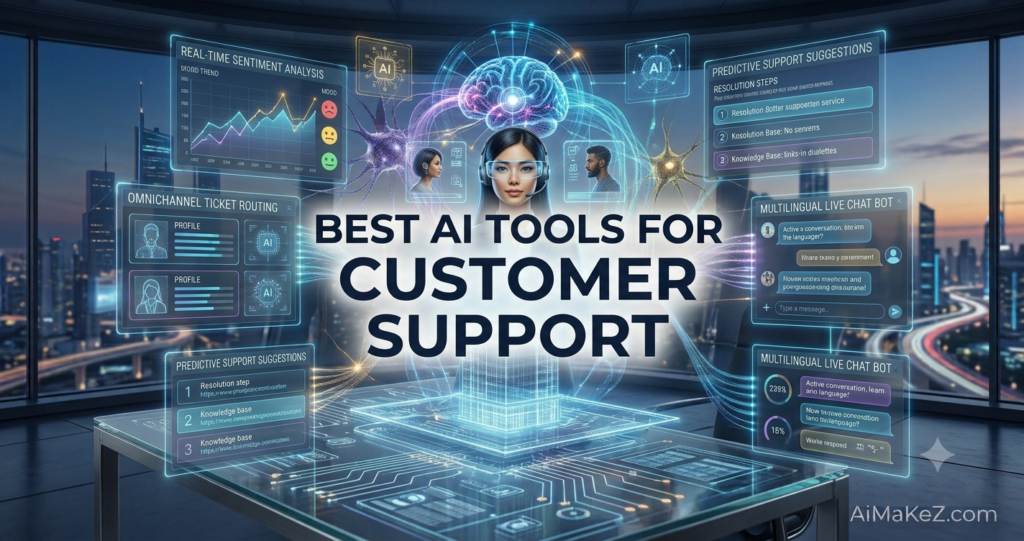
Omnichannel Automation
Customers move between email, live chat, WhatsApp, social media, and voice without a second thought. Omnichannel support means every conversation lands in one unified inbox with full history, so context is never lost when a shopper switches from Instagram to email.
AI Chatbots and Virtual Agents
Modern AI chatbots for customer service go far beyond scripted menus. Powered by generative AI, they hold natural conversations, pull answers from your documentation, and complete tasks like booking, tracking, and rescheduling. A well-tuned virtual support agent can resolve a large share of tickets before a human ever sees them.
Sentiment and Intent Detection
Intent detection identifies what the customer actually wants, while sentiment analysis flags frustration or urgency. Together they let the system escalate an angry VIP instantly instead of leaving them in a queue, which protects both revenue and reputation.
Seamless Human Handoff
Automation should know its limits. When a query is too complex, quality AI customer support tools pass the conversation to a live agent along with a full summary and suggested next steps, so the customer never has to repeat themselves.
Analytics and Reporting Dashboards
You cannot improve what you do not measure. Robust dashboards track resolution rate, response time, CSAT, deflection rate, and cost per ticket, turning raw conversations into a roadmap for continuous improvement.
Benefits
The business case for AI customer support tools is straightforward once you see the numbers behind everyday operations. The advantages compound as ticket volume grows.
24/7 availability. AI never sleeps, so customers in different time zones get instant answers at 3 a.m. without you staffing a night shift. For a European brand selling into North America, this alone can transform satisfaction scores.
Faster resolution. Routine questions are answered in seconds rather than hours. This customer service automation frees human agents to focus on the complex, high-value conversations where empathy and judgment truly matter.
Lower costs at scale. Because automation deflects a large slice of repetitive tickets, teams handle rising demand without proportionally rising headcount. That efficiency is why so many companies now treat AI customer support tools as core infrastructure, not a luxury.
Consistency and accuracy. A grounded AI assistant gives the same correct answer every time, reducing the human error that creeps in during busy periods.
Actionable insight. Every interaction becomes data. You quickly spot recurring problems, product friction, and knowledge gaps, which feeds better documentation and even product decisions.
Happier agents. When the repetitive work disappears, burnout drops and retention improves. Support becomes a career people want to stay in, not a revolving door.
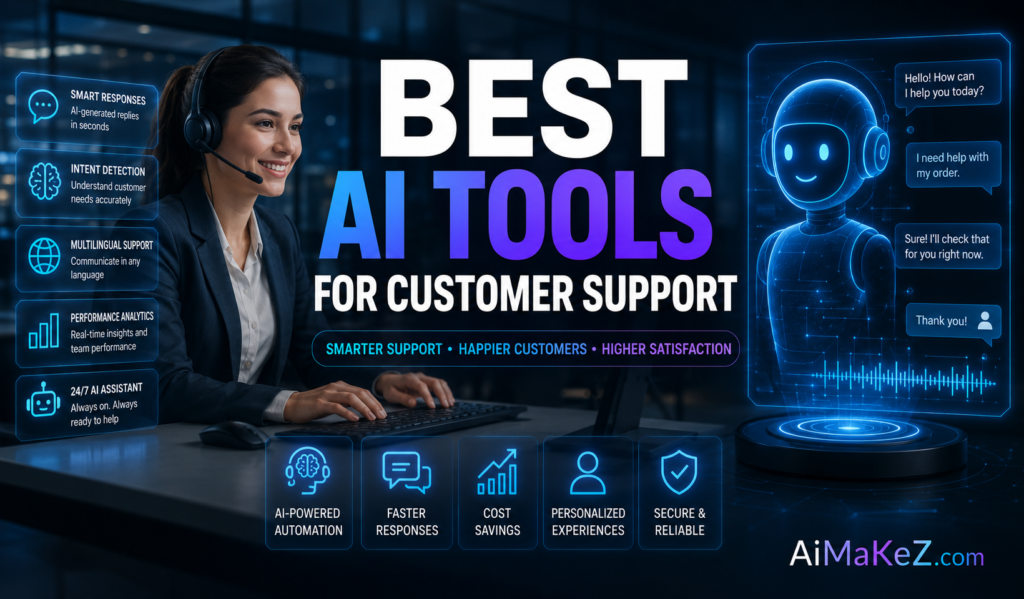
How AI Customer Support Tools Work
Understanding the mechanics helps you set realistic expectations. Here is the workflow behind most AI customer support tools, step by step.
Step 1 – Ingestion. You connect your knowledge sources: help center articles, FAQs, past tickets, and product docs. The platform indexes this content so the AI answers from your verified material rather than guessing.
Step 2 – Understanding. When a customer sends a message, natural language processing interprets intent, language, and sentiment, even with typos or slang.
Step 3 – Retrieval and generation. The system retrieves the most relevant information and uses generative AI to craft a clear, on-brand response, often citing the source so the answer stays trustworthy.
Step 4 – Action. For transactional requests, the tool triggers workflows through integrations, such as checking an order in your commerce platform or updating a CRM record.
Step 5 – Escalation. If confidence is low or the customer asks for a human, the conversation is handed off with a summary and context.
Step 6 – Learning. Feedback loops and analytics reveal where the AI struggled, so you refine content and rules. This continuous learning is what makes AI customer support tools smarter month after month.
Crucially, this loop is never truly finished. The teams that win treat their AI like a new hire that keeps growing: they coach it, correct it, and expand its responsibilities as trust builds. That mindset separates a chatbot that quietly frustrates customers from an assistant that earns their confidence.
Real-World Use Cases
The value becomes concrete when you see how different teams deploy AI customer support tools day to day.
Business and E-commerce
An online retailer in Germany uses a virtual agent to handle order tracking, returns, and sizing questions. During peak sales the bot deflects thousands of “where is my order” messages, while human agents focus on disputes and high-value shoppers.
Marketing and Sales
A SaaS company routes website chat through conversational AI that qualifies leads, answers pricing questions, and books demos automatically. Marketing gains cleaner data on what prospects ask most, sharpening campaigns and landing page copy.
Content Creation
Support teams turn recurring questions into a living help center. AI drafts new knowledge base articles from resolved tickets, so documentation improves continuously and self-service deflection climbs.
Education
A university help desk deploys AI to answer enrollment, financial aid, and scheduling questions for students across time zones, reducing wait times during the chaotic start of each semester.
Productivity
Internal IT and HR teams use the same technology as an employee help desk, resolving password resets, benefits questions, and software requests instantly so staff stay focused on their real work.
Automation and Workflows
By connecting to CRMs, billing systems, and ticketing tools, AI customer support tools trigger multi-step workflows, such as issuing a refund, updating a subscription, and sending a confirmation, all from a single conversation.
Pros and Cons
| Pros | Cons |
|---|---|
| 24/7 instant responses across every channel | Setup and knowledge base tuning take time |
| Lower cost per ticket as volume scales | Complex or emotional issues still need humans |
| Consistent, accurate, on-brand answers | Poorly configured bots can frustrate customers |
| Rich analytics and customer insight | Premium AI plans can get expensive at scale |
| Frees agents for high-value work | Data privacy and compliance require oversight |
Pricing
Pricing for AI customer support tools varies widely by vendor, and figures below are approximate 2026 benchmarks; always confirm on the provider’s official site since plans change often.
Free and starter tiers. Several platforms, such as Tidio and Zoho Desk, offer free plans or entry tiers from roughly $15 to $25 per agent per month, ideal for small teams testing automation.
Mid-market plans. Growth plans generally land between $40 and $100 per agent per month, unlocking richer automation, integrations, and reporting.
AI add-ons. Many vendors price the advanced AI agent separately, often per resolution (for example, a fixed fee for each automatically resolved conversation) rather than per seat. This usage-based model rewards you when automation works well.
Enterprise. Custom pricing covers advanced security, compliance, dedicated support, and high-volume automation, typically requiring a sales conversation.
Comparison With Alternatives
To choose wisely, it helps to compare how the leading AI customer support tools differ in focus and strength.
Zendesk AI
A mature, enterprise-ready help desk with deep AI features, strong reporting, and a huge integration marketplace. Best for larger teams that want an established, all-in-one platform, though it can feel heavy and pricey for tiny businesses.
Intercom Fin
Known for its polished AI agent that resolves conversations with impressive accuracy and a modern messenger experience. Its per-resolution pricing appeals to teams that want to pay for outcomes, not seats.
Freshdesk (Freddy AI)
A strong balance of price and capability, with intuitive setup and solid automation. A popular choice for growing mid-market companies that want value without complexity.
Tidio
Lightweight and affordable, ideal for small e-commerce stores that need quick live chat plus AI automation without a steep learning curve.
Gorgias
Purpose-built for e-commerce with tight Shopify integration, making it a favorite for online retailers who want support and revenue in one view.
Best Practices
Getting real value from AI customer support tools depends less on the vendor and more on how you deploy them. These expert recommendations consistently separate winners from disappointments.
Start with your best content. Feed the AI clean, accurate, well-structured documentation. Garbage in, garbage out applies directly to answer quality.
Automate the top ten questions first. Identify your highest-volume, lowest-complexity tickets and automate those. Quick wins build trust with both customers and your team.
Design a graceful handoff. Make it easy for customers to reach a human, and pass full context when they do. Never trap someone in a loop.
Keep a human in the loop. Review AI conversations regularly, especially early on, to catch mistakes and refine responses.
Monitor the right metrics. Track resolution rate, CSAT, and deflection together. A high deflection rate means nothing if satisfaction drops.
Protect customer data. Choose vendors with strong compliance credentials and be transparent with customers about when they are talking to AI.
Localize thoughtfully. For audiences across the United States and Europe, test tone and language per market. A translation that reads naturally in one region can feel robotic in another.
Common Mistakes to Avoid
Even great AI customer support tools can disappoint when implemented carelessly. Watch for these frequent pitfalls.
Hiding the human option. Forcing customers through endless bot menus with no escape is the fastest way to erode trust.
Deploying and forgetting. AI is not “set and forget.” Skipping ongoing tuning leaves outdated or wrong answers in circulation.
Ignoring edge cases. Automating everything, including sensitive or emotional situations, backfires. Some conversations belong with people.
Overlooking analytics. Failing to review data means missing the exact insights that justify your investment.
Choosing on price alone. The cheapest option often costs more in lost customers. Match the tool to your channels, volume, and integration needs.
Frequently Asked Questions
What are AI customer support tools?
AI customer support tools are platforms that use artificial intelligence and natural language processing to automate answers, assist human agents, and analyze conversations, helping businesses respond faster and more consistently across channels.
Can AI replace human customer service agents?
No. AI handles repetitive, high-volume questions efficiently, but complex, sensitive, and emotional issues still need human judgment. The best results come from AI and agents working together.
Are AI customer support tools worth it for small businesses?
Yes. Affordable and free tiers let small teams offer 24/7 support and deflect routine tickets, delivering an experience that once required a much larger staff.
How accurate are AI chatbots for customer service?
Accuracy depends on the quality of your knowledge base. When grounded in clean, up-to-date documentation, modern AI agents resolve a large share of queries reliably and cite their sources.
How do I choose the right AI customer support platform?
Match the tool to your channels, ticket volume, integrations, and budget. Start with a trial, automate your top questions first, and measure resolution rate and CSAT before scaling.
Final Verdict
The question in 2026 is no longer whether to adopt AI customer support tools, but which ones and how well you deploy them. Customers now expect instant, accurate, always-on help, and the platforms above make that achievable for teams of every size in the United States and across Europe.
For enterprises, Zendesk AI and Intercom Fin offer depth and outcome-based value. Growing mid-market teams get an excellent balance from Freshdesk, while small e-commerce stores thrive with Tidio or Gorgias. Whatever you choose, remember that success comes from clean content, thoughtful handoffs, and constant measurement, not from switching on a bot and walking away. Approached that way, AI customer support tools become one of the highest-return investments your support organization can make.