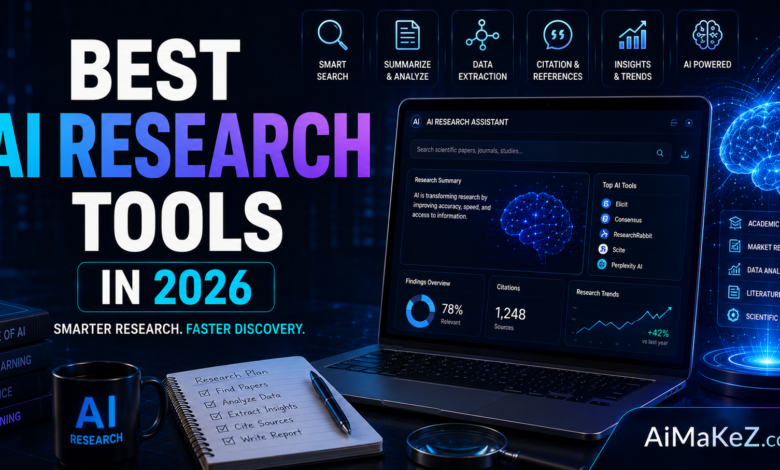
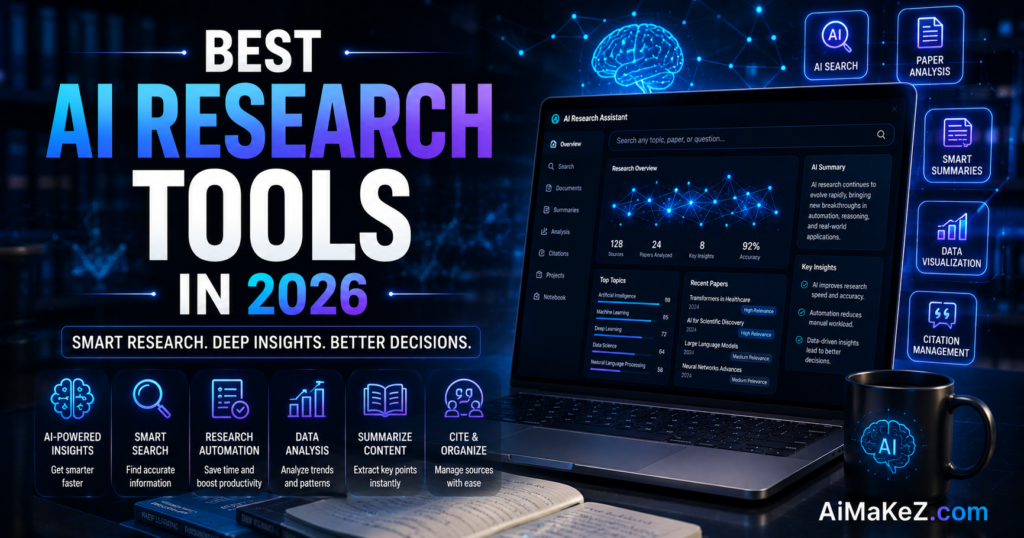
If you’ve ever spent hours digging through academic databases, chasing down citations, or trying to make sense of a mountain of PDFs — you already know the problem. Research is time-consuming, fragmented, and mentally exhausting. That’s exactly where AI research tools are changing the game in 2026. These intelligent platforms don’t just speed up your workflow — they fundamentally transform how you discover, analyze, and apply information. Whether you’re a graduate student, a data scientist, a market analyst, or a content strategist, the right AI-powered research tool can cut your work time in half while dramatically improving the quality of your output.
This guide covers the best AI research tools available right now, what makes them worth your time, and how to pick the one that fits your specific needs.
Table of Contents
What Are AI Research Tools?
AI research tools are software applications powered by artificial intelligence — typically large language models (LLMs), natural language processing (NLP), and machine learning algorithms — that assist users in gathering, organizing, summarizing, and synthesizing information from multiple sources.
Unlike a traditional search engine that returns a list of links, AI research tools actively process content, extract key insights, highlight patterns, and often generate readable summaries or reports. They can scan thousands of research papers, news articles, market reports, or web pages in seconds and surface only what’s most relevant to your query.
In 2026, these tools have matured significantly. They now support multimodal inputs (text, images, tables, PDFs), offer real-time web access, and integrate directly into popular platforms like Notion, Google Docs, Slack, and Microsoft 365. The best ones don’t just retrieve — they reason.

Key Features of the Best AI Research Tools
Not every AI research tool is built the same. When evaluating your options, here are the core features that separate genuinely useful platforms from overhyped ones:
1. Semantic Search Capability
Top-tier AI research tools go beyond keyword matching. They understand the meaning and intent behind your query, surfacing results that are contextually relevant even if they don’t contain the exact words you typed. This is essential for exploratory research where you’re not sure exactly what you’re looking for yet.
2. Automated Summarization
Reading 50-page research papers in full is rarely practical. AI summarization tools distill long documents into concise, accurate overviews — often in bullet points or structured paragraphs — so you can quickly assess relevance before committing more time.
3. Citation and Reference Management
Academic users especially benefit from automated citation generation in APA, MLA, Chicago, and other formats. The best tools also flag unreliable sources or alert you when a cited paper has been retracted.
4. Multi-Source Data Aggregation
The strongest AI research platforms pull from a wide range of sources — peer-reviewed journals, preprint servers like arXiv, industry reports, news databases, patent filings, and the open web — all within a single interface.
5. Knowledge Graph and Entity Recognition
Advanced tools build structured knowledge graphs that map relationships between concepts, authors, institutions, and publications. This is particularly valuable when you’re doing systematic literature reviews or competitive intelligence research.
6. Real-Time Web Access
Static training data has its limits. In 2026, the best AI research tools offer live web browsing, meaning they can pull in the latest studies, breaking news, and freshly published reports that weren’t available when the model was trained.
7. Collaborative Workspaces
Research rarely happens in isolation. Platforms that allow teams to share notes, annotate sources, and co-author reports are especially valuable for enterprise research teams and academic groups.
Benefits of Using AI Research Tools
The advantages of adopting AI-powered research tools extend well beyond saving time — though that alone is compelling enough for most users.
Speed and efficiency: Tasks that once took days can now be completed in hours or even minutes. Literature reviews that required weeks of manual reading can be drafted with AI assistance in an afternoon.
Depth and breadth: No human researcher can keep up with the volume of content published daily across scientific journals, news outlets, and industry publications. AI tools don’t sleep, don’t miss papers, and don’t have access limitations the way a single human researcher does.
Reduced cognitive load: By handling the mechanical parts of research — sorting, tagging, summarizing — AI tools free you to focus on higher-order thinking: forming arguments, testing hypotheses, and drawing conclusions.
Consistency: AI doesn’t get tired. It applies the same rigor to the 500th document it reviews as it did to the first, something human researchers genuinely struggle to match during marathon reading sessions.
Accessibility: Researchers in under-resourced institutions or countries without access to expensive journal subscriptions can use AI tools to access and synthesize publicly available research that would otherwise be difficult to aggregate manually.
How AI Research Tools Work
Understanding the mechanics behind these tools helps you use them more effectively and evaluate their outputs more critically.
Step 1 — Input and Query Processing: You enter a research question, topic, or document. The AI parses your input using NLP to extract intent, key concepts, and relevant entities.
Step 2 — Source Retrieval: The tool searches its indexed database (and, in real-time tools, the live web) to locate documents, papers, or data that match your query. Vector embeddings and semantic search algorithms rank results by relevance, not just keyword frequency.
Step 3 — Content Analysis: Retrieved documents are processed by the AI, which extracts key arguments, data points, methodologies, and conclusions. Some tools use RAG (Retrieval-Augmented Generation) to ground their outputs in verified source material.
Step 4 — Synthesis and Output Generation: The AI generates a structured summary, comparison table, or research brief. It typically cites its sources inline so you can verify claims independently.
Step 5 — Iteration and Refinement: You can ask follow-up questions, request deeper dives into specific subtopics, adjust the scope or tone, and export findings in your preferred format.
Real-World Use Cases for AI Research Tools
Academic Research and Literature Reviews
PhD candidates at universities like MIT and Oxford are using tools like Elicit and Consensus to run systematic literature reviews in days rather than months. These platforms can screen thousands of papers, extract methodology details, and highlight conflicting findings — exactly the kind of groundwork that used to require a research assistant team.
Market Research and Competitive Intelligence
Startups and Fortune 500 companies alike use AI research tools to monitor competitor activity, track emerging trends, and analyze customer sentiment at scale. Tools like Perplexity Pro and ChatGPT with web access allow analysts to query real-time market data and synthesize insights that would otherwise take a team of analysts days to compile.
Content Creation and Journalism
Investigative journalists and content creators use AI research tools to quickly fact-check claims, trace the origins of statistics, and identify source material for complex stories. Instead of spending hours on background research, they can brief themselves in minutes and spend their time on analysis and storytelling.
Legal and Regulatory Research
Law firms and compliance teams use specialized AI tools to search case law, regulatory filings, and statutory databases. Tools like Harvey AI have reduced the time lawyers spend on preliminary research by as much as 60%, allowing them to focus on strategy and client counsel.
Medical and Clinical Research
Healthcare professionals and pharmaceutical researchers use AI tools to stay current with clinical trial results, drug interaction studies, and treatment guidelines. Platforms that index PubMed and ClinicalTrials.gov can surface relevant findings faster than any manual review process.
Education and Student Research
Students from high school through graduate programs use AI research tools to understand complex subjects, find credible sources for essays, and explore topics beyond what their textbooks cover. When used ethically — for understanding, not ghostwriting — these tools accelerate genuine learning.
Top AI Research Tools in 2026 — Pros and Cons
Here’s a detailed comparison of the leading AI research tools currently available:
| Tool | Best For | Pros | Cons |
|---|---|---|---|
| Perplexity AI | Real-time web research | Live web access, cited sources, fast, clean UI | Limited document upload on free tier, Pro plan needed for best results |
| Elicit | Academic literature reviews | Extracts data from papers, summarizes studies, free tier available | Focuses mainly on empirical research, limited general-purpose use |
| Consensus | Evidence-based research | Aggregates scientific consensus, great for health and science topics | Limited to published papers, no real-time web data |
| Semantic Scholar | Deep academic search | 180M+ papers indexed, influence mapping, completely free | No generative AI layer, more of a discovery tool than a synthesis engine |
| ChatGPT (GPT-4o) | General-purpose research and writing | Versatile, file uploads, code interpreter, real-time search | Can hallucinate, requires critical fact-checking |
| Claude (Anthropic) | Long-document analysis | 200K token context, excellent reasoning, handles large PDFs | Web search limited to certain plans |
| Gemini Advanced | Integrated Google Workspace research | Deep Google integration, multimodal, strong coding support | Less specialized for academic research workflows |
| Scite.ai | Citation analysis | Shows how papers are cited (supporting vs. contradicting), highly reliable | Premium features require subscription, steep for individuals |
| Research Rabbit | Research network visualization | Visual paper discovery, completely free, Zotero integration | No AI summarization, primarily a discovery and mapping tool |
| Iris.ai | Enterprise R&D research | Deep technical document analysis, patent search, enterprise-grade | Steep learning curve, expensive for individual researchers |
Pricing Overview
Pricing across AI research tools varies widely, from completely free to enterprise contracts worth thousands per year. Here’s what you can expect in 2026:
Perplexity AI offers a free tier with limited daily searches and a Pro plan at approximately $20/month, which unlocks unlimited searches, file uploads, and access to multiple AI models including GPT-4o and Claude.
Elicit has a generous free plan that allows a limited number of paper analyses per month. Its paid plans start around $10–$12/month for individuals and scale for teams and institutions.
Consensus offers a free plan with limited daily searches. The Premium plan is priced around $9.99/month when billed annually and unlocks unlimited searches, AI-generated summaries, and citation exports.
ChatGPT Plus (which includes GPT-4o and web search) is priced at $20/month, while the ChatGPT Team plan runs approximately $25–$30/user/month with additional collaboration features.
Claude Pro from Anthropic is priced at $20/month and offers expanded context windows, priority access, and access to Projects for organizing research sessions.
Scite.ai offers individual plans starting around $20/month, with institutional pricing available for universities and research organizations.
Semantic Scholar and Research Rabbit remain free as of 2026, making them outstanding options for students and researchers on a budget.
Iris.ai is positioned as an enterprise tool and typically requires a custom quote, with annual contracts commonly running into thousands of dollars for teams.
How AI Research Tools Compare to Traditional Research Methods
Traditional research workflows rely heavily on manual database searches (Google Scholar, PubMed, JSTOR), note-taking in Word or Excel, and citation management in tools like Zotero or EndNote. These approaches work — but they scale poorly.
With AI research tools, a single researcher can process the equivalent of what used to require a team. The tradeoff is that AI-generated summaries and insights require critical evaluation; they can miss nuance, misrepresent complex arguments, or occasionally fabricate citations. The savvy researcher uses AI as a powerful first-pass filter and synthesis engine — not as a replacement for expert judgment.
Compared to traditional tools, AI research platforms also offer far superior discoverability. Semantic search surfaces connections between ideas that keyword-based searches would never find — which is especially valuable in interdisciplinary research where insights often live at the intersection of fields.

Best Practices for Using AI Research Tools
Always Verify Sources Independently
Even the best AI research tools can hallucinate citations or misattribute findings. Always click through to the original source and verify that the paper says what the AI claims it says. This is non-negotiable in academic and legal contexts.
Use Multiple Tools in Combination
No single tool does everything well. A productive workflow might use Semantic Scholar or Research Rabbit to discover relevant papers, Elicit to extract methodology data, and Perplexity to contextualize findings with current news and developments. Layer your tools strategically.
Refine Your Prompts
Vague queries produce vague results. The more specific and structured your research question, the more useful the AI’s output will be. Include context, specify the type of source you’re looking for, and indicate any constraints such as date range, methodology, or geographic focus.
Maintain a Research Trail
Use your AI tool’s export and notes features — or pair it with a reference manager like Zotero — to keep a clear record of what sources informed your conclusions. This is essential for academic integrity and reproducibility.
Stay Current With Updates
AI research tools are improving rapidly. Features that were missing six months ago may now be standard. Revisit your tool choices periodically to ensure you’re using the best available option for your workflow.
Common Mistakes to Avoid
Treating AI output as ground truth: The biggest mistake new users make is accepting AI-generated research summaries without verification. LLMs can confidently state incorrect facts. Always cross-check critical claims against primary sources.
Relying on a single tool for all research needs: Different tools have different strengths. Using only ChatGPT for everything, for instance, means missing the depth of specialized academic tools like Elicit or Scite.ai.
Ignoring publication dates and source freshness: Some AI tools prioritize highly cited older papers. In fast-moving fields like AI itself, medicine, or climate science, a 2020 paper may already be outdated. Always check publication dates and look for more recent developments.
Skipping the original documents: AI summaries are useful starting points, not endpoints. For anything important, read the original source — even if just the abstract and conclusion. Context matters, and AI summaries often flatten nuance.
Not understanding data privacy implications: When uploading proprietary research, unpublished manuscripts, or confidential business documents to AI platforms, check the privacy policy carefully. Not all platforms guarantee that your data won’t be used for model training.
Frequently Asked Questions About AI Research Tools
1. What are the best AI research tools for academic research in 2026?
For academic research, the top choices are Elicit, Consensus, and Semantic Scholar. Elicit is particularly strong for systematic literature reviews, allowing you to extract structured data from hundreds of papers simultaneously. Consensus is excellent for understanding the scientific consensus on specific questions. Semantic Scholar offers the largest index of academic papers and is completely free. Combining these with Claude or ChatGPT for synthesis gives you a powerful end-to-end academic research workflow.
2. Are AI research tools reliable enough to use in professional or academic work?
They are reliable as research aids, but not as autonomous replacements for expert judgment. AI research tools significantly accelerate discovery and synthesis, but outputs must always be verified against primary sources. In academic contexts, all citations should be traced back to their original documents. In professional contexts, any AI-generated insight that will inform a major decision should be validated through independent analysis. Used with appropriate critical thinking, these tools are genuinely transformative.
3. Can AI research tools access paywalled or subscription-only academic journals?
Most AI research tools can only access the full text of open-access papers. For paywalled content, they typically work with abstracts and metadata. Tools like Elicit and Semantic Scholar have agreements with some publishers that allow limited full-text access. For comprehensive access to paywalled literature, researchers typically need institutional library access or personal journal subscriptions alongside their AI tools.
4. How do AI research tools differ from regular AI chatbots like ChatGPT?
General-purpose AI chatbots like ChatGPT are trained on broad internet text and respond based on that training data. Specialized AI research tools, by contrast, are designed to search and retrieve from curated, high-quality source databases — academic journals, patent databases, clinical trials registries — and ground their responses in those specific sources. This makes specialized tools far more reliable for research purposes, especially when citation accuracy and source credibility are critical. That said, ChatGPT with web search and file-upload capabilities has significantly closed this gap in 2026.
5. What is the most affordable AI research tool for students?
For students on a budget, Semantic Scholar and Research Rabbit are both completely free and genuinely powerful. Elicit’s free tier allows a meaningful number of paper analyses per month, which is often sufficient for coursework and thesis research. Consensus also has a free plan with daily search limits. For general-purpose research assistance, the free tiers of Perplexity AI and the base version of ChatGPT offer significant value at no cost. A smart strategy for students is to combine two or three free tools rather than paying for a single premium subscription.
Final Verdict: Which AI Research Tool Should You Choose?
The landscape of AI research tools in 2026 is richer and more capable than ever before. There is genuinely no one-size-fits-all answer — the best tool for you depends on your specific use case, budget, and the depth of research you need.
If you need real-time web research with cited sources, Perplexity AI Pro is hard to beat. For systematic academic literature reviews, Elicit remains the specialist’s choice. If you want to understand the scientific consensus on health, science, or policy questions, Consensus is purpose-built for that task. For long-document analysis and complex reasoning, Claude leads the pack. And if you need a flexible, all-around AI assistant that can handle research, writing, and data analysis in one place, ChatGPT (GPT-4o) remains a top-tier option.
The smartest approach in 2026 is to build a small stack of complementary tools — typically one for discovery, one for deep analysis, and one for synthesis and writing. Used together, these platforms can genuinely transform what’s possible for a solo researcher, a small team, or a large enterprise research department.
Don’t let the volume of options paralyze you. Start with a free tool, run a real research query you’re currently working on, and see how the output compares to your usual workflow. The difference will speak for itself.