Selling homes used to mean cold calls, printed flyers, and hours spent writing listing descriptions by hand. That world is disappearing fast. Today, the agents closing the most deals are the ones using AI tools for real estate to automate busywork, find better leads, and respond to buyers before their competitors even see the inquiry.
If you’re a real estate agent, broker, or team leader wondering how artificial intelligence fits into your daily workflow, you’re in the right place. This guide breaks down exactly which AI tools for real estate professionals are worth your time in 2026, how they work, what they cost, and how to avoid the common mistakes agents make when adopting new technology.
Table of Contents
What is AI Tools for Real Estate?
AI tools for real estate refer to software applications that use machine learning, natural language processing, and computer vision to help agents, brokers, and property managers work more efficiently. Instead of manually researching comparable properties or writing every email from scratch, agents can rely on algorithms trained on millions of data points.
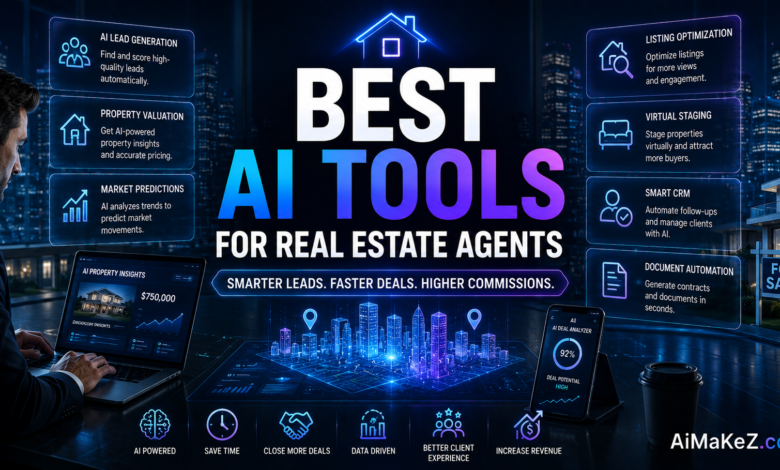
These platforms cover a wide range of tasks. Some focus on lead generation and scoring, identifying which contacts are most likely to buy or sell in the next six months. Others handle content creation, generating listing descriptions, social media captions, or email sequences in seconds. A growing category, virtual staging AI, transforms empty rooms into beautifully furnished spaces without hiring a stager or moving a single couch.
In short, AI tools for real estate agents are not a replacement for the human relationship-building that closes deals. They’re a force multiplier that removes repetitive, low-value tasks so agents can focus on clients, negotiations, and local market expertise.
Key Features of AI Tools for Real Estate
Most modern real estate AI software shares a set of core capabilities, even though individual platforms specialize in different areas.
Predictive lead scoring. Tools like SmartZip and Revaluate analyze public records, demographic shifts, and online behavior to flag homeowners who are statistically likely to sell soon.
Automated content generation. Writing tools built on large language models can draft MLS listing descriptions, blog posts, and neighborhood guides in a fraction of the time it takes a human writer.
Conversational chatbots. AI-powered chat assistants like Structurely and Ylopo’s raiya engage website visitors 24/7, qualify leads, and schedule showings without an agent lifting a finger.
Virtual staging and photo enhancement. Platforms such as REimagineHome and Virtual Staging AI use image recognition to digitally furnish, declutter, or renovate photos of a listing.
CRM automation. Systems like kvCORE, Follow Up Boss, and BoomTown combine contact management with AI-driven follow-up sequences that nurture leads automatically.
Market analysis and valuation. HouseCanary and similar platforms provide automated valuation models (AVMs) that estimate property values using recent sales, tax records, and market trends.
Voice and transcription assistants. Some brokerages now use AI note-takers during client calls to summarize conversations and update the CRM automatically.
Automated video and social media content. Newer AI video generation platforms can turn a set of listing photos into a narrated walkthrough video or a ready-to-post Instagram Reel within minutes, giving agents professional-looking marketing material without hiring a videographer or editor for every single listing. This is especially valuable for agents juggling multiple active listings at once.
Benefits of AI Tools for Real Estate
The practical advantages of adopting AI tools for real estate go well beyond saving time, though that’s often the first thing agents notice.
Faster response times matter enormously in this industry. Studies on buyer behavior consistently show that leads contacted within five minutes convert at dramatically higher rates than those contacted an hour later. AI chatbots solve this by engaging prospects instantly, any time of day.
Better lead prioritization means agents stop wasting hours chasing contacts who were never serious. Predictive scoring models rank leads by likelihood to transact, so your calls go to the right people first.
Consistent marketing output becomes achievable even for solo agents without a marketing team. AI writing assistants can produce a week’s worth of social captions, email newsletters, and listing copy in under an hour.
Reduced staging costs are a major win for listings that need visual appeal but don’t have the budget for physical furniture rental. Virtual staging AI can furnish an entire home for a fraction of traditional staging costs.
Improved client experience results from faster answers, more personalized follow-up, and fewer missed messages. Buyers and sellers notice when an agent’s process feels organized and responsive.

Stronger competitive positioning is another advantage that’s easy to overlook. Agents who respond to inquiries faster, present more polished listings, and follow up more consistently naturally win more listing presentations against competitors who are still relying on manual processes. Sellers and buyers increasingly expect the kind of instant, personalized service that AI-assisted workflows make possible, and agents who deliver it are the ones who get referred to friends and family.
How It Works
Understanding the mechanics behind AI tools for real estate helps agents choose the right platform and set realistic expectations.
Step 1: Data collection. The tool pulls information from sources like MLS feeds, public property records, CRM history, and website analytics.
Step 2: Model training and analysis. Machine learning models process this data to identify patterns, such as which homeowners are showing signs of an upcoming sale or which listing photos generate the most clicks.
Step 3: Output generation. Based on that analysis, the platform produces something actionable: a ranked lead list, a written property description, a staged photo, or a suggested follow-up email.
Step 4: Human review and action. The agent reviews the AI’s output, makes adjustments if needed, and takes the next step, whether that’s calling a lead, publishing a listing, or sending a nurture email.
Step 5: Continuous learning. Many platforms improve over time as they collect more data about what actually converts, refining future recommendations.
This human-in-the-loop approach is important. The best results come from combining AI efficiency with an agent’s local knowledge and negotiation skills, not replacing one with the other.
Real-World Use Cases
Lead generation for a solo agent. A single agent in Austin uses SmartZip to identify likely sellers in a specific zip code, then layers in automated postcards and email drip campaigns, generating consistent listing appointments without cold calling.
Marketing for a small team. A three-person team uses Jasper or ChatGPT to draft listing descriptions and Instagram captions, cutting content creation time from three hours a week to under 30 minutes.
Virtual staging for vacant listings. A luxury listing agent uses REimagineHome to stage five empty rooms digitally, helping buyers visualize the space and shortening the average days-on-market for that listing.
Customer service automation. A brokerage deploys an AI chatbot on its website that answers common buyer questions, schedules tours, and hands off qualified leads to human agents only when necessary.
Education and onboarding. New agents at a brokerage use AI-powered training modules and role-play chatbots to practice objection handling before their first live client calls.
Productivity and CRM management. A busy broker uses an AI note-taking assistant during calls, which automatically logs summaries and next steps into the CRM, eliminating manual data entry.
Property management for a rental portfolio owner. A landlord with a dozen rental units uses an AI-powered tenant screening and pricing tool to automatically flag qualified applicants, forecast optimal rent levels for each unit, and send lease renewal reminders. The system also flags maintenance requests by urgency, helping the owner cut vacancy time nearly in half compared to manual spreadsheet tracking and phone-tag scheduling with contractors.
Pros and Cons
Every AI tool for real estate comes with trade-offs worth weighing before you commit to a subscription. The table below breaks down how the most common advantages, such as faster response times and reduced manual workload, stack up against the most common drawbacks, including setup time, ongoing costs, and the need for human oversight. Weighing these factors honestly, rather than focusing only on marketing claims, helps agents pick a platform that actually fits their budget and daily workflow instead of one that simply looks impressive in a demo.
| Aspect | Pros | Cons |
|---|---|---|
| Time savings | Automates repetitive writing, scheduling, and follow-up tasks | Requires setup time and learning curve initially |
| Lead quality | Predictive scoring surfaces high-intent prospects | Data accuracy depends on the quality of underlying public records |
| Cost | Often cheaper than hiring additional staff | Multiple subscriptions can add up quickly |
| Client experience | Faster response times improve satisfaction | Over-reliance on chatbots can feel impersonal if misused |
| Content creation | Produces drafts in seconds instead of hours | Output still needs human editing for local voice and accuracy |
| Staging | Saves money compared to physical staging | Some buyers prefer to see real, unstaged photos |
Pricing for AI Tools for Real Estate
Pricing for AI tools for real estate agents varies widely depending on the category and the size of your team.
Lead generation and predictive analytics platforms like SmartZip or Revaluate typically start around $300 to $1,000 per month, often with territory exclusivity built into the price.
CRM platforms with built-in AI features, such as kvCORE or BoomTown, generally range from $500 to $1,500 per month for teams, though some offer individual agent plans closer to $100 to $300 monthly.
AI writing assistants like Jasper or Copy.ai often start at $20 to $50 per month for individual users, making them accessible even for new agents on a tight budget.
Virtual staging tools charge per image, usually between $10 and $50 per photo, or offer monthly subscriptions starting around $30 for unlimited staging within certain limits.
Chatbot platforms such as Structurely typically run $300 to $500 per month, reflecting the ongoing conversational AI processing involved.
Many providers offer free trials or freemium tiers, so it’s worth testing a platform for a month before committing to an annual contract.
Is AI Tools for Real Estate Worth the Investment?
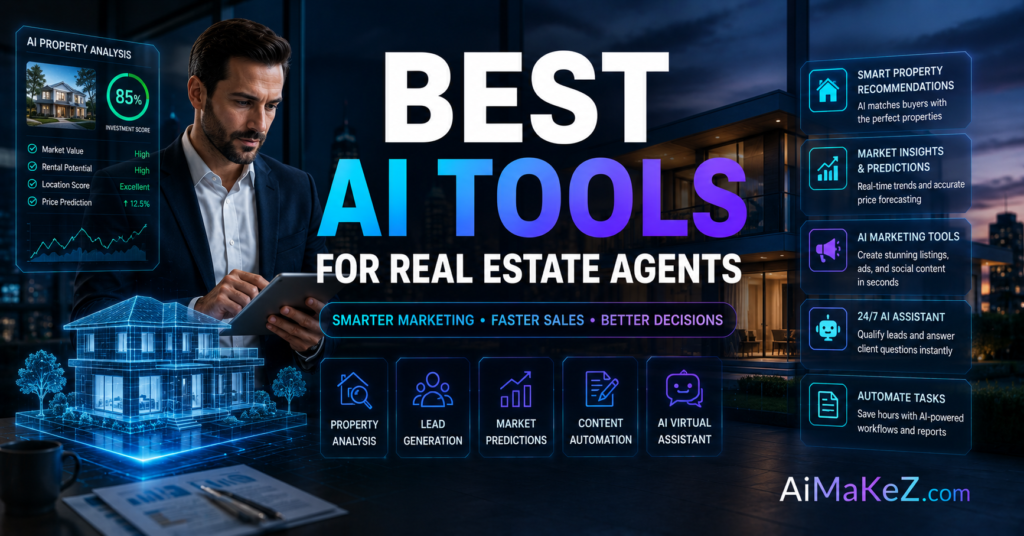
For most agents, yes. Even a modest monthly subscription pays for itself if it helps close a single additional transaction per year. The key is matching the tool to your actual bottleneck, whether that’s lead volume, content creation speed, or follow-up consistency, rather than buying every trendy platform at once.
Comparison With Alternatives
Choosing among the many AI tools for real estate can feel overwhelming, so here’s how the major categories stack up against traditional methods.
AI chatbots vs. hiring a virtual assistant. A human virtual assistant offers more nuance but costs significantly more per month and isn’t available around the clock. AI chatbots handle volume and speed better, though they still benefit from human oversight for complex questions.
AI writing tools vs. freelance copywriters. Freelancers bring local flavor and creativity but charge per project and take days to deliver. AI writing tools produce drafts instantly at a fraction of the cost, though they require editing to sound authentically local.
Virtual staging vs. physical staging. Physical staging remains more convincing for in-person showings, but virtual staging AI wins decisively for online listing photos, where most buyers form their first impression anyway.
Predictive analytics vs. traditional farming. Door-knocking and mailers still work, but predictive lead scoring narrows your target list dramatically, saving time and marketing spend by focusing only on the most promising prospects.
AI-driven CRM vs. traditional spreadsheets. Spreadsheets are free and familiar, but they require constant manual updates and offer no predictive insight into which leads are actually worth pursuing. AI-driven CRM platforms cost more upfront, but they automatically flag which contacts need attention today and surface patterns a busy agent would otherwise miss, saving hours of guesswork every week.
Best Practices for Using AI Tools for Real Estate
Agents who get the most value from AI tools for real estate tend to follow a few consistent habits.
Start with one problem at a time. Don’t try to overhaul your entire tech stack overnight. Pick the single biggest bottleneck, whether it’s lead follow-up or content creation, and solve that first.
Always edit AI-generated content. Listing descriptions and emails drafted by AI should be reviewed for accuracy, local nuance, and compliance with fair housing language before publishing.
Combine tools thoughtfully. A predictive lead-scoring platform paired with an automated CRM follow-up sequence often outperforms either tool used alone.
Track your ROI. Monitor which AI tools actually correlate with more appointments, listings, or closings, and cut the ones that don’t earn their subscription cost.
Keep the human touch visible. Let clients know when they’re speaking with a chatbot, and make sure a real agent steps in for anything emotionally significant, like negotiations or difficult conversations.
Set clear expectations with clients. Let buyers and sellers know upfront which parts of your process are AI-assisted, such as automated showing confirmations or chat-based scheduling, so nothing feels impersonal or deceptive. Being transparent about your use of technology builds trust rather than eroding it, and most clients genuinely appreciate the added convenience once they understand how the workflow benefits them.
Common Mistakes to Avoid With AI Tools for Real Estate
Buying too many tools at once. Stacking five subscriptions in month one leads to confusion and wasted budget. Add tools gradually as you master each one.
Publishing AI content without review. Unedited AI-generated listing descriptions can contain factual errors or language that violates fair housing regulations. Always proofread before it goes live.
Ignoring data privacy. Some AI platforms collect sensitive client information. Read privacy policies carefully and avoid entering confidential financial details into general-purpose AI chat tools.
Letting chatbots replace all human contact. Automation should qualify and warm up leads, not permanently replace personal conversations that build trust.
Neglecting training. Many agents pay for powerful software and never learn its advanced features, leaving significant value on the table.
Forgetting to update your data sources. Predictive models and valuation tools are only as accurate as the information feeding them. Agents who let their CRM data go stale, skip syncing new MLS listings, or ignore integration errors often end up with outdated lead scores and unreliable price estimates, undermining the very benefits the software was meant to provide in the first place.
Frequently Asked Questions
What are the best AI tools for real estate agents in 2026?
Some of the most widely used options include SmartZip and Revaluate for predictive lead generation, kvCORE and BoomTown for AI-enhanced CRM, Structurely for conversational chatbots, and REimagineHome for virtual staging. The right choice depends on whether your priority is leads, marketing, or client communication.
Do AI tools for real estate replace human agents?
No. These tools automate repetitive tasks like data analysis, content drafting, and initial lead qualification, but they cannot replace the trust, negotiation skill, and local expertise that a licensed agent provides throughout a transaction.
How much do AI tools for real estate typically cost?
Pricing ranges from around $20 per month for basic AI writing assistants to $1,500 or more per month for full-featured CRM and predictive analytics platforms designed for teams and brokerages.
Are AI-generated listing descriptions accurate and compliant?
They can be, but only after human review. Agents should always check AI-generated content for factual accuracy and fair housing compliance before publishing it publicly.
Which AI tool is best for a solo agent on a limited budget?
Solo agents often start with an affordable AI writing assistant for marketing content and a basic chatbot or CRM automation feature, since these deliver noticeable time savings without a large monthly investment.
Do I need technical skills to use AI tools for real estate?
Not usually. Most platforms built specifically for the real estate industry are designed for non-technical users, with drag-and-drop dashboards, guided onboarding tutorials, and customer support teams that help with initial setup and integration. Basic computer literacy and a willingness to learn a new dashboard are typically all that’s required to get started.
Can AI tools for real estate help with commercial properties, not just residential?
Yes, though the tool selection differs somewhat. Many valuation, lead generation, and CRM platforms serve both residential and commercial markets, but commercial-focused tools often add specialized features like lease abstraction, tenant mix analysis, and cap rate calculators that residential-only platforms typically don’t include. Agents working across both sectors should check whether a platform supports commercial data sources before subscribing.
Emerging AI Trends to Watch
The real estate AI space is moving quickly, and a few developments are worth watching heading into the second half of 2026. Predictive analytics are getting sharper as more public data sets become available, allowing tools to forecast seller intent months earlier than before.
Voice-based AI assistants are expanding beyond note-taking into full call handling, capable of answering routine buyer questions over the phone. Generative AI for video is also starting to automate listing walkthroughs and social media reels, reducing the need for a dedicated videographer on every listing.
Agents who experiment early with these emerging tools often gain a temporary edge before the broader market catches up. Keeping a close eye on these shifts, and testing new features as they roll out, helps agents stay ahead of competitors who wait until a technology becomes mainstream before giving it a try.
Final Verdict
Artificial intelligence has moved from a buzzword to a genuine competitive advantage in real estate. The agents thriving in 2026 aren’t necessarily working more hours; they’re working smarter with the help of AI tools for real estate that handle lead scoring, content creation, staging, and follow-up automatically.
That said, technology alone won’t close deals. The most successful agents treat AI tools for real estate as an assistant, not a replacement, always adding their own judgment, local knowledge, and personal relationships on top of what the software provides. Start small, choose one or two tools that address your biggest bottleneck, measure the results, and expand from there.