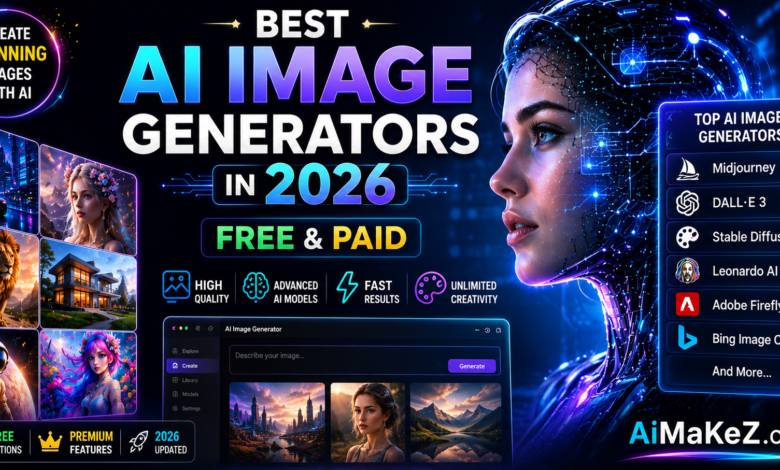
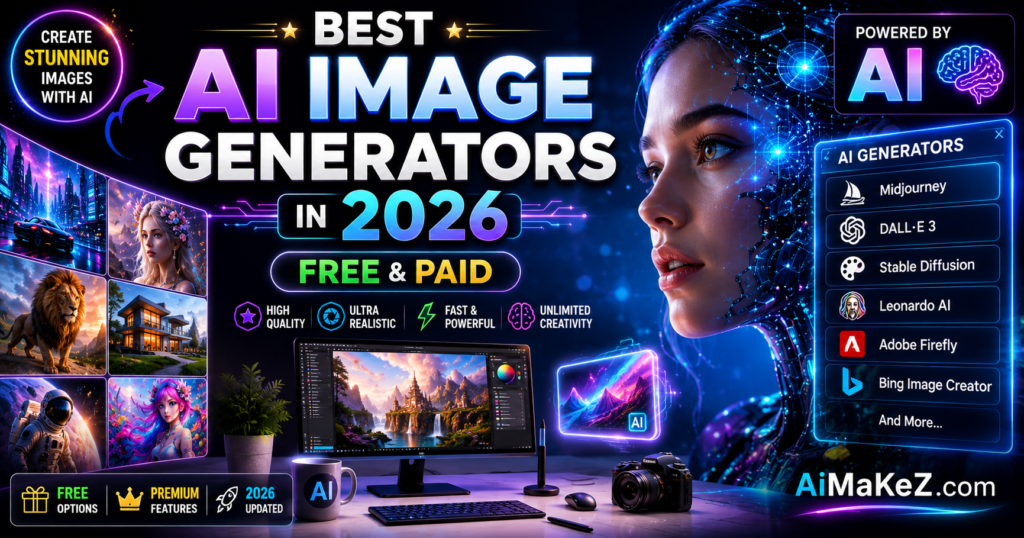
If you’ve ever stared at a blank screen trying to visualize an idea, you already know the struggle. The good news? The best AI image generators in 2026 have completely transformed that experience. Whether you’re a freelance designer, a small business owner, a content creator, or simply someone who wants to bring a creative vision to life — there’s an AI image tool built exactly for you. This guide cuts through the noise, ranks the top tools available today, and tells you exactly which one fits your needs and budget.
In this comprehensive guide to the best AI image generators available in 2026, we evaluate each platform on image quality, pricing, speed, commercial licensing, and ease of use. We’ve personally tested these AI image generator tools across dozens of creative use cases — so you don’t have to. Whether you’re searching for the best AI image generators free options or premium paid solutions, this guide covers everything you need to make an informed decision.
Table of Contents
What Are AI Image Generators?
The best AI image generators are software tools that use deep learning models — most commonly diffusion models and generative adversarial networks (GANs) — to create images from text prompts, reference images, or a combination of both. Instead of requiring years of artistic training or expensive design software, these platforms let anyone type a description like “a futuristic city at sunset, cyberpunk style, ultra-realistic” and receive a stunning, publication-ready image in seconds.
What makes 2026 particularly exciting is the leap in output quality from best AI image generators. The gap between AI-generated images and human-created artwork has narrowed dramatically. Models now handle complex lighting, fine textures, human anatomy, and compositional nuance far better than even two years ago. For businesses, marketers, and creators, this isn’t just a novelty — it’s a genuine productivity revolution.
How AI Image Generators Work
Understanding the technology helps you use best AI image generators more effectively. Here’s a simplified breakdown of the generation process to help you choose the best AI image generators for your workflow.
Step 1: Text-to-Image Encoding
When you enter a prompt, the AI encodes your text into a high-dimensional vector space using a language model (similar to the technology behind ChatGPT). This creates a mathematical representation of your intent.
Step 2: Latent Diffusion Process
Modern tools like Midjourney v7, DALL-E 4, and Stable Diffusion 4.0 rely on latent diffusion models. The AI starts with random noise and gradually refines it, guided by your text encoding, until a coherent image emerges. This iterative denoising process is what produces such detailed results.
Step 3: Output Rendering and Upscaling
Finally, the generated image is decoded from the latent space into pixel format. Premium tools then apply AI upscaling to produce sharp, high-resolution outputs — often up to 4K or beyond — suitable for print and professional publishing.
Key Features to Look For in the Best AI Image Generators
Before you commit to any platform, these are the features that separate the leaders from the also-rans in 2026:
- Prompt Accuracy: How faithfully does the tool translate your text into a visual? The best tools understand nuance, context, and artistic style descriptors.
- Image Resolution and Quality: Can it produce print-ready images? Look for tools that offer 1024×1024 or higher natively, with upscaling options.
- Style Versatility: From photorealistic to anime, oil painting to vector art — versatility matters for varied projects.
- Speed: Generation time can range from 5 seconds to over 2 minutes. Speed matters in professional workflows.
- Editing and Inpainting: The ability to edit specific areas of an image (inpainting) or extend the canvas (outpainting) is essential for advanced users.
- Commercial Licensing: Can you use the images you generate in client work or for sale? Licensing terms vary significantly between platforms.
- API Access: For developers and businesses integrating AI image generation into their products, API availability is critical.
- Privacy and Data Policy: Some platforms train on your prompts or images. Understand the privacy implications before uploading sensitive brand assets.
Best AI Image Generators in 2026 (Ranked and Reviewed)
After extensive hands-on testing across creative briefs — from e-commerce product shots to social media campaigns, editorial illustration, and architectural visualization — here are the top performers among the best AI image generators this year.
1. Midjourney v7 — Best Overall Quality
Midjourney remains the gold standard for artistic quality in 2026. Version 7 introduced a new Personalization Engine that learns your aesthetic preferences over time, delivering increasingly on-brand results with every generation. The platform operates primarily through a dedicated web app (Discord integration is now optional), making it far more accessible than its early days.
What sets it apart: Midjourney’s coherence in complex, multi-element compositions is unmatched. Test it with a prompt like “an award-winning magazine cover featuring a botanist in a greenhouse, golden hour lighting, National Geographic style” and the output will genuinely impress. Character reference flags give professional users granular control over consistency across image sets — a massive upgrade for brand campaigns.
Ideal for: Designers, marketing agencies, brand managers, concept artists, and anyone who prioritizes visual quality above all else.
2. DALL-E 4 by OpenAI — Best for Prompt Accuracy
OpenAI’s DALL-E 4, integrated directly into ChatGPT and available via the OpenAI API, has made a huge leap in prompt adherence. Earlier versions famously struggled with text within images and precise object relationships. DALL-E 4 handles both with remarkable reliability, making it the go-to choice when the brief requires literal, exact visual communication.
Real-world win: Marketing teams at e-commerce brands use DALL-E 4 to prototype product packaging mockups, infographic elements, and promotional banners — all within the same ChatGPT conversation. The iterative editing workflow is fluid and genuinely saves hours.
Ideal for: Marketers, content strategists, ChatGPT power users, and anyone who needs to iterate on concepts quickly through natural language.
3. Adobe Firefly 3 — Best for Creative Professionals
Adobe Firefly 3 stands among the best AI image generators built natively into Adobe’s Creative Cloud ecosystem — Photoshop, Illustrator, InDesign, and Premiere Pro. It’s trained exclusively on licensed Adobe Stock images and public domain content, making it one of the best AI image generators for commercial use.
Standout feature: The Generative Fill tool in Photoshop 2026 lets you select any area of an existing photo and generate new content that seamlessly blends with the original image. This has revolutionized photo retouching and composite work, reducing what used to be hours of manual masking into a 30-second AI-assisted task.
Ideal for: Graphic designers, photographers, video editors, advertising agencies, and anyone with an active Adobe Creative Cloud subscription.
4. Stable Diffusion 4.0 — Best for Power Users and Developers
Stable Diffusion remains the open-source powerhouse for users who want complete control. Version 4.0 brought dramatic improvements in photorealism and coherence while remaining free to run locally on a capable GPU. The ecosystem of custom models (LoRA, Dreambooth), ControlNet, and community plugins makes it the most flexible option on this list.
The trade-off: Setup requires technical knowledge — you’ll need a modern GPU with at least 8GB VRAM (16GB+ recommended), Python environment configuration, and familiarity with model checkpoints. For non-technical users, cloud-hosted frontends like Civitai, RunDiffusion, and Mage.space make SD4 accessible without the setup headaches.
Ideal for: Developers, AI researchers, indie game studios, advanced hobbyists, and anyone who values privacy and customization over convenience.
5. Google Imagen 3 — Best for Photorealism
Google’s Imagen 3, available through ImageFX and the Gemini API, has become the benchmark for photorealistic output in 2026. Trained on a curated dataset with extensive human feedback, it excels at generating images that are nearly indistinguishable from real photographs — skin tones, material textures, atmospheric lighting, and environmental detail are consistently exceptional.
Use case highlight: Interior design firms use Imagen 3 to generate photorealistic room mockups for client presentations, dramatically cutting visualization costs. Real estate marketing teams produce lifestyle images for property listings without a photoshoot. The results are convincing enough to go straight to publication.
Ideal for: Journalists, real estate professionals, product designers, UX teams, and anyone whose work demands photographic realism.
6. Canva AI Image Generator — Best for Non-Designers
Canva’s built-in AI image generator has made professional-quality visual content creation genuinely accessible to people with no design background. Powered by a combination of Stable Diffusion fine-tuning and partnerships with leading AI labs, Canva’s tool integrates directly into its drag-and-drop design environment.
Why it works for beginners: You don’t need to master prompt engineering. Canva offers style presets, topic suggestions, and guided workflows that help users get great results even with minimal input. A small business owner can generate a custom hero image for their website in under three minutes.
Ideal for: Small business owners, solopreneurs, educators, social media managers, and anyone who needs professional visuals without hiring a designer.
7. Leonardo.AI — Best for Game Art and Consistent Characters
Leonardo.AI has carved out a strong niche in the gaming and entertainment industries. It offers a powerful suite of tools including fine-tuned models for game assets, an Image Guidance system for maintaining character consistency across multiple scenes, and motion features for creating short video sequences from still images.
Standout capability: The AI Canvas workspace allows users to stitch together multi-panel scenes, apply consistent character styles, and export assets in formats suitable for game engines like Unity and Unreal Engine 5.
Ideal for: Indie game developers, concept artists, illustrators, comic book creators, and animation studios.
8. Ideogram 2.5 — Best for Text-in-Image
One of the historically weakest areas of AI image generation has been rendering readable text within images. Ideogram 2.5 has solved this almost completely. Logos with text, posters, book covers, social media graphics, and typographic designs — Ideogram handles them all with a degree of accuracy that was unthinkable even 18 months ago.
Practical application: A cafe owner needs a new menu board design. Rather than hiring a graphic designer for a simple update, they generate a beautifully styled menu board image complete with accurate text, brand colors, and a matching aesthetic — all from a single prompt.
Ideal for: Brand designers, content creators who produce text-heavy graphics, marketers, small business owners, and signage designers.
Free vs. Paid AI Image Generators: Which Should You Choose?
The honest answer depends entirely on your use case and volume needs. Free tiers are genuinely useful — tools like Canva Free, Ideogram’s free plan, Microsoft Designer (powered by DALL-E), and Adobe Firefly’s free credits let you generate dozens of images per month without spending a cent. For casual use, personal projects, or initial experimentation, free plans are more than adequate.
However, paid plans unlock critical features for professional use: higher resolution outputs, faster generation queues, more monthly credits, commercial usage rights, priority API access, and advanced editing tools. If your business depends on consistent, high-quality visual content, a paid plan at $10 to $60 per month represents exceptional value compared to the cost of stock photography or custom illustration.
Real-World Use Cases for Best AI Image Generators
The versatility of these tools extends across virtually every industry. Here’s how different sectors are putting the best AI image generators to work right now:
E-Commerce and Product Marketing
Online retailers generate lifestyle product images — showing their products in aspirational settings — without expensive photoshoots. An apparel brand might generate 50 different seasonal background variations for the same product photo in an afternoon, testing which resonates best with their audience before committing to a full campaign.
Content Creation and Social Media
Bloggers, YouTubers, and Instagram creators use AI image tools to produce custom thumbnails, cover images, and featured graphics that stand out in crowded feeds. The ability to generate a unique, on-brand image in seconds — rather than hunting through stock photo libraries — is a genuine competitive advantage for independent creators.
Architecture and Interior Design
Architects and interior designers use AI image generators to rapidly prototype design concepts and present them to clients. Instead of building 3D renders that take hours, a designer can generate a photorealistic concept image in minutes, gather client feedback, and iterate in real time during a meeting.
Education and Training Materials
Educators and instructional designers create custom illustrations, diagrams, and scenario-based images for online courses, presentations, and textbooks. AI tools allow them to generate culturally diverse imagery, specific historical scenarios, and scientific visualizations on demand — without licensing concerns or budget constraints.
Advertising and Campaign Development
Advertising agencies use AI image tools in the concepting phase to rapidly visualize campaign ideas for client approval before committing significant production budgets. This has compressed creative development timelines dramatically — what used to take two weeks now takes two days.
Pros and Cons: Best AI Image Generators Comparison
| Tool | Best For | Free Tier | Starting Price | Commercial License | Key Strength |
|---|---|---|---|---|---|
| Midjourney v7 | Artistic quality | No | $10/mo | Yes (paid plans) | Unmatched aesthetics |
| DALL-E 4 | Prompt accuracy | Limited | $20/mo | Yes | Natural language editing |
| Adobe Firefly 3 | Creative pros | Yes (25 credits) | $4.99/mo | Yes (all outputs) | CC integration |
| Stable Diffusion 4.0 | Power users | Yes (self-hosted) | Free | Yes | Full customization |
| Google Imagen 3 | Photorealism | Yes (ImageFX) | API pricing | Yes | Photographic realism |
| Canva AI | Non-designers | Yes | $15/mo | Yes (Pro plan) | Ease of use |
| Leonardo.AI | Game art | Yes (150/day) | $12/mo | Yes (paid plans) | Character consistency |
| Ideogram 2.5 | Text in images | Yes | $8/mo | Yes | Typography accuracy |
Pricing Overview: What You Get for Your Money
Pricing in the AI image generation space has become increasingly competitive in 2026. Most platforms offer free tiers with limited monthly credits, making it easy to test before committing. Here is a practical breakdown of what each price range delivers:
- Under $15/month: Midjourney Basic ($10), Ideogram Plus ($8), Leonardo Pro ($12), Adobe Firefly Standalone ($4.99). These plans cover most freelance and light business use cases.
- $15 to $30/month: Canva Pro ($15, includes AI credits), Midjourney Standard ($30). Best for regular content creators and small teams.
- $30 to $60/month: Midjourney Pro ($60), Adobe Creative Cloud with AI features included. Appropriate for agencies and high-volume professional work.
- Enterprise and API pricing: OpenAI, Google, and Adobe all offer volume API pricing for businesses integrating AI image generation at scale. Costs vary significantly based on volume and resolution requirements.
One important note: always check whether the plan you’re considering includes commercial usage rights. Some lower-tier plans restrict commercial use, which can create significant legal and business risks if you use generated images in client work or for sale.
Best Practices for Getting the Most Out of AI Image Generators
The quality of your output is directly tied to the quality of your input. Here are expert-level strategies that consistently produce better results with any of the best AI image generators:
Master Prompt Engineering
Great prompts are descriptive, specific, and layered. Instead of “a mountain,” write “a snow-capped mountain at dawn, misty valleys below, golden light hitting the peak, aerial perspective, shot on Sony A7R IV, 8K resolution.” Include the subject, environment, lighting conditions, artistic style, perspective, and technical specifications. Each layer of detail narrows the creative space and increases prompt fidelity.
Use Negative Prompts
Most advanced platforms support negative prompts — descriptors that tell the AI what to exclude. Common exclusions include: blurry, low quality, distorted, watermark, extra limbs, bad anatomy. This simple technique dramatically improves consistency, especially for images featuring people.
Iterate Methodically
Don’t expect perfection on the first generation. Use the output to identify what’s working and what isn’t, then adjust one variable at a time. Change the style, the lighting descriptor, or the aspect ratio — not everything at once. This methodical approach helps you understand what each parameter contributes to the final image.
Leverage Reference Images
Tools that support image-to-image input allow you to upload a reference image and generate variations in your chosen style. This is invaluable for maintaining brand visual consistency — upload your existing marketing imagery as a reference to ensure AI-generated additions match your established aesthetic.
Match the Tool to the Task
No single tool dominates every category. For a logo concept with text, use Ideogram. For a photorealistic product shot, use Google Imagen 3. For an editorial illustration, use Midjourney. Building a small toolkit of two or three specialized platforms will serve you better than forcing every task through a single AI image generator.
Common Mistakes to Avoid When Using AI Image Generators
Even experienced users fall into these traps. Being aware of them upfront will save you time and frustration:
- Vague prompts: “A dog” gives the AI too much creative latitude. Be specific about breed, setting, mood, and visual style to get usable results.
- Ignoring aspect ratio: Using the wrong aspect ratio for your intended use is a common oversight. Use vertical 9:16 for social stories, 16:9 for YouTube thumbnails, square for Instagram feed posts.
- Skipping the free tier test: Most professionals jump straight to a paid plan without thoroughly testing the free tier first. Test the tool with your specific use cases before subscribing.
- Neglecting commercial licensing: Using AI-generated images in commercial work without verifying the licensing terms of the plan you’re on can lead to legal problems. Always read the terms of service carefully.
- Over-relying on AI without human review: AI generators can still produce errors — particularly with human hands, faces at odd angles, and inconsistent backgrounds. Always review outputs before publishing.
- Prompting for real people without consent: Generating images of identifiable real individuals without their consent raises serious ethical and legal issues. Stick to fictional characters or clearly stylized, non-identifiable representations.
- Not saving your prompt history: When you get a great output, save both the image and the exact prompt. This makes it much easier to recreate or refine similar results in the future.
Frequently Asked Questions About the Best AI Image Generators
Are AI-generated images copyright-free?
The legal landscape varies by jurisdiction and continues to evolve rapidly. In the United States, the Copyright Office has consistently ruled that AI-generated images without meaningful human authorship do not qualify for copyright protection. However, your specific prompts and curation choices may create protectable expression. For commercial use, the safest approach is to use platforms like Adobe Firefly that explicitly grant commercial licenses as part of their terms of service, and always consult legal counsel for high-stakes commercial applications.
Which AI image generator produces the most realistic images?
For photorealism specifically, Google Imagen 3 and Midjourney v7 in photorealistic mode produce the most convincingly real outputs as of 2026. Imagen 3 has a slight edge in skin texture, material rendering, and environmental lighting accuracy. For architectural and product visualization, Stable Diffusion 4.0 with specialized fine-tuned models can match or exceed both.
Can I use AI image generators for commercial purposes?
Most paid plans from leading platforms explicitly permit commercial use of generated images. However, terms vary — Midjourney’s basic plan restricts commercial use for businesses earning over $1 million annually, while Adobe Firefly explicitly covers commercial use on all paid plans. Always read the terms of service specific to your plan tier before using AI-generated images in commercial contexts.
What is the best free AI image generator in 2026?
For free use, Google ImageFX (powered by Imagen 3) offers exceptional quality with no subscription required, making it one of the best AI image generators for users who want to explore best AI image generators without upfront costs.
How do I improve the quality of my AI-generated images?
Quality improvement comes from several angles simultaneously. First, craft richer, more specific prompts using style descriptors, lighting conditions, and technical photography terms. Second, use negative prompts to exclude common quality issues. Third, generate multiple variations and select the strongest output. Fourth, apply AI upscaling to boost resolution. Finally, use inpainting to fix specific problem areas — particularly hands, faces, or background inconsistencies — rather than regenerating from scratch.
Final Verdict: Choosing the Best AI Image Generators for Your Needs
Selecting from the best AI image generators in 2026 requires understanding what matters most for your specific workflow. Whether you need commercial-safe assets, photorealistic output, creative freedom, or budget-friendly options, the best AI image generators listed here represent the strongest tools available this year.
If you want the absolute best visual quality and you’re willing to invest time learning the platform, choose Midjourney v7. If you’re a creative professional already in the Adobe ecosystem, Adobe Firefly 3 is the smart, commercially safe choice. If photorealism is your primary requirement, Google Imagen 3 is your best bet. Non-designers and small business owners will find Canva AI the most frictionless path to professional results, while developers and power users should seriously explore Stable Diffusion 4.0 for its unparalleled flexibility.
Whichever platform you choose, commit to learning it deeply. The users who get the most remarkable results from these best AI image generators aren’t those with access to the most expensive tools — they’re the ones who invest in understanding how to communicate their vision clearly and iterate intelligently. The technology is extraordinary; your creative direction is what makes the result unique.
Start with a free tier, experiment broadly, and upgrade when the platform proves its value to your specific workflow. The best AI image generator is, ultimately, the one you actually use consistently and effectively.
Looking to expand your AI toolkit further? Explore our guides to the best AI writing tools in 2026 and our ChatGPT vs Claude 2026 comparison to build the perfect AI-powered creative workflow.