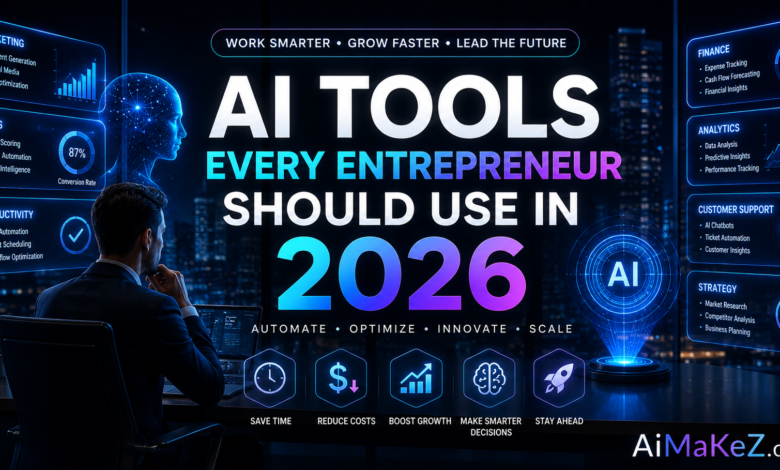
Running a business in 2026 feels like sprinting on a treadmill that keeps speeding up. Customers expect instant replies, competitors publish content daily, and your inbox never stops. If you are trying to do everything manually, you are already behind. That is exactly why the smartest founders now lean on AI tools for entrepreneurs to reclaim their time, cut costs, and scale faster than a small team ever could on its own.
The good news? You do not need a data science degree or a huge budget. The right stack of artificial intelligence software can act like a marketing department, a research assistant, a bookkeeper, and a customer support agent — all working around the clock. In this guide, drawn from years of hands-on experience helping startups adopt automation, we break down the essential platforms, how they work, what they cost, and how to use them without falling into common traps.
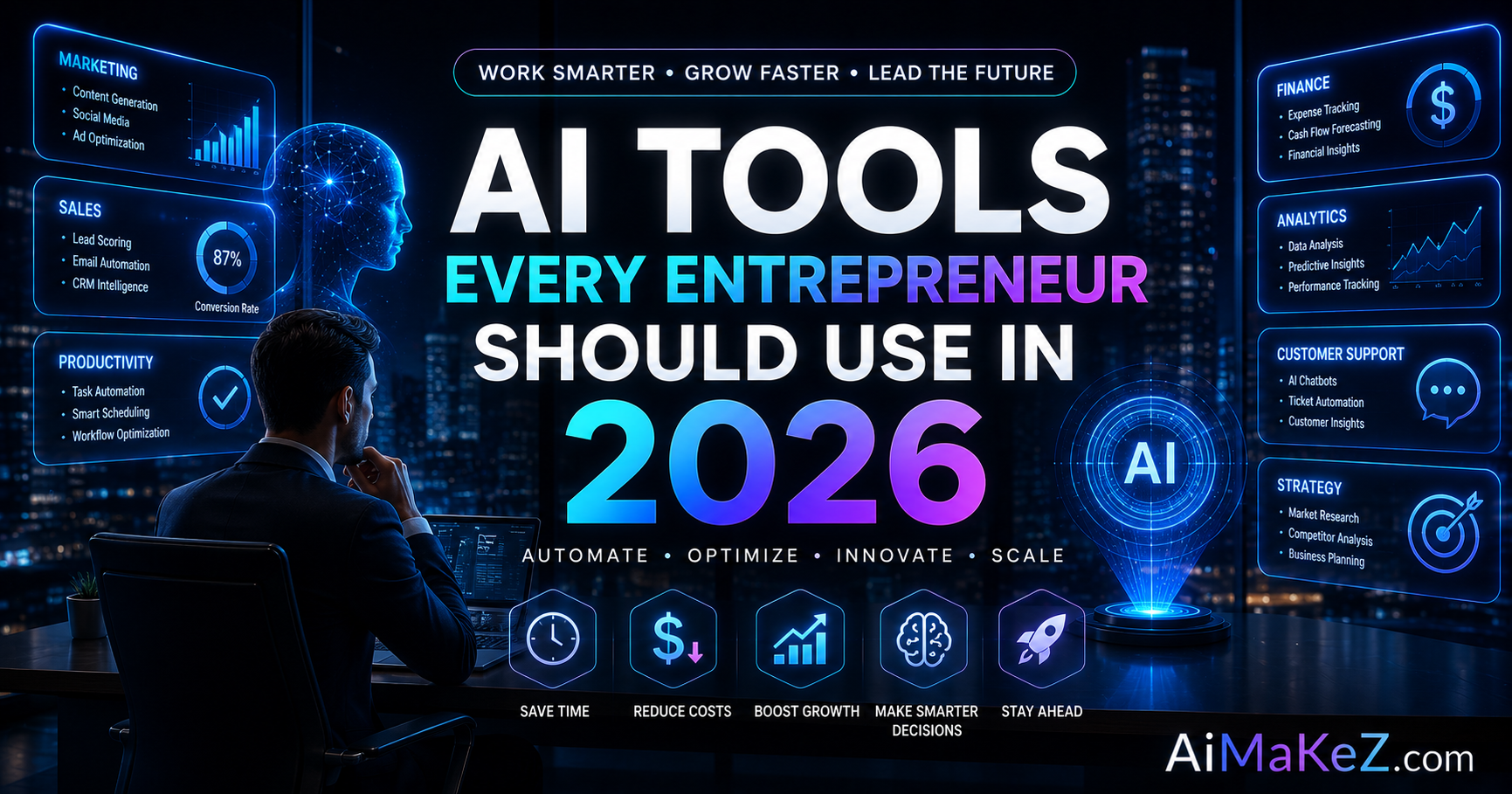
Before diving into the full breakdown, remember that the right AI Tools for Entrepreneurs should fit your specific workflow. If you run a lean operation, our guide to the best AI tools for small businesses pairs perfectly with this list, while founders who rely on messaging can explore the best AI chatbots for support and sales. For deeper context on adoption rates, the latest AI statistics and trends show why these platforms matter more than ever. According to Harvard Business Review, businesses that adopt automation early consistently outperform slower-moving rivals.
Table of Contents
What Are AI Tools for Entrepreneurs?
At their core, AI tools for entrepreneurs are software applications powered by machine learning, large language models, and generative AI that automate or augment the tasks a business owner would normally handle by hand. Think of them as digital teammates. Some write copy, some design graphics, some crunch financial data, and others answer customer questions while you sleep.
A decade ago, this level of capability was locked behind enterprise contracts costing six figures. Today, a solo founder can subscribe to a handful of platforms for less than the price of a monthly gym membership and instantly access natural language processing, predictive analytics, and workflow automation. That shift has leveled the playing field for bootstrapped startups across the United States and Europe.
These platforms generally fall into categories such as content creation, marketing automation, customer relationship management, financial forecasting, and virtual assistance. The best entrepreneurs do not adopt every shiny app they see. Instead, they build a lean, connected stack where each tool solves a specific bottleneck in their business.
Key Features to Look For
Not all business automation software is created equal. When evaluating any platform for your startup, these are the features that separate a genuine productivity multiplier from an expensive distraction.
Core Capabilities That Matter Most
- Natural language understanding: The ability to interpret plain-English prompts so you can delegate tasks conversationally instead of learning complex commands.
- Integrations and APIs: Seamless connections with the apps you already use, such as Slack, Gmail, Shopify, HubSpot, and Zapier.
- Automation workflows: Trigger-based actions that run without human input, like sending a follow-up email when a lead fills a form.
- Data privacy and security: Encryption, GDPR compliance for European users, and clear policies on how your data is stored and used.
- Customization and training: The option to fine-tune outputs on your brand voice, product catalog, or historical data.
- Scalability: Pricing and performance that grow with you, so you are not forced to migrate the moment you hit traction.
A quick tip from experience: prioritize integrations above raw features. A slightly weaker tool that plugs directly into your existing systems will almost always outperform a powerful one that lives in isolation.
Benefits for Founders and Small Teams
The value of adopting AI Tools for Entrepreneurs goes far beyond novelty. When chosen well, AI Tools for Entrepreneurs deliver measurable returns, and here is where founders see the biggest gains.
Time savings that compound. Automating repetitive tasks like scheduling, invoicing, and drafting emails can free up ten to fifteen hours a week. For a founder, that is time redirected toward strategy, sales, and product development — the work only you can do.
Lower operating costs. Instead of hiring a full-time copywriter, designer, and analyst early on, a lean team can cover those functions with a few subscriptions. This keeps your burn rate low and extends your runway, which matters enormously for bootstrapped ventures.
Faster, data-driven decisions. Predictive analytics and reporting dashboards surface patterns a human might miss, helping you spot which products sell, which channels convert, and where money leaks.
Consistent quality and availability. An AI chatbot answers customers at 2 a.m. with the same tone it uses at noon. Content generators never get writer’s block. That reliability builds trust with your audience.
How AI Tools Actually Work
Understanding the mechanics helps you use these platforms more effectively and set realistic expectations. Here is a simplified, step-by-step view of how most generative AI and machine learning tools operate.
- Input: You provide a prompt, upload data, or connect a data source such as your sales records or website analytics.
- Processing: The underlying model — often a large language model or a specialized neural network — analyzes the request against patterns learned from massive training datasets.
- Generation: The tool produces an output, whether that is a blog draft, a forecast, a design, or a customer reply.
- Feedback loop: You review, edit, and rate the result. Many platforms use this feedback to improve future outputs and adapt to your preferences.
- Automation: Once you trust a workflow, you set it to run on triggers, removing yourself from the loop entirely for routine tasks.
The key insight is that these tools amplify your judgment rather than replace it. You remain the editor-in-chief, the strategist, and the final decision-maker.
Real-World Use Cases
Theory is fine, but founders want results. Below are practical examples of how entrepreneurs across different functions put these platforms to work.
Marketing and Content Creation
A Berlin-based e-commerce founder uses ChatGPT and Jasper to draft product descriptions, then Surfer SEO to optimize them for search. Canva’s Magic Studio turns those descriptions into social graphics in minutes. What once took a full day now takes ninety minutes, letting a two-person team publish daily.
Customer Support and Sales
A SaaS startup in Austin deployed an AI chatbot trained on its help documentation. It now resolves roughly 60 percent of tickets automatically and escalates the rest to a human. Response times dropped from hours to seconds, and customer satisfaction scores climbed.
Productivity and Automation
Using Zapier and Make, a consultant connected her contact form, calendar, and invoicing app. When a client books a call, the system creates a project folder, sends a welcome email, and drafts a proposal — all before she even opens her laptop.
Finance and Education
Financial tools like QuickBooks with AI-assisted categorization help freelancers forecast cash flow and flag unusual spending. Meanwhile, education startups use adaptive learning engines to personalize lessons for each student, improving retention and engagement.
Pros and Cons
Every technology involves trade-offs. Here is an honest look at both sides so you can make an informed decision.
| Pros | Cons |
|---|---|
| Saves significant time on repetitive work | Outputs still require human review and editing |
| Reduces early-stage operating costs | Subscription fees add up across multiple tools |
| Available 24/7 with consistent quality | Learning curve to set up workflows properly |
| Scales with your business growth | Data privacy and compliance require attention |
| Democratizes access to advanced capabilities | Over-reliance can dull your own skills |
Pricing Overview
Pricing varies widely, but most business automation software follows a predictable tiered model. Understanding these tiers helps you budget without overspending.
- Free tiers: Many tools, including ChatGPT and Canva, offer capable free plans ideal for testing before you commit.
- Starter plans ($10–$30/month): Suited to solo founders, these unlock higher usage limits and core premium features.
- Professional plans ($40–$100/month): Add team seats, advanced integrations, and priority support for growing startups.
- Business and enterprise plans ($100+/month): Include custom training, dedicated security controls, and service-level agreements.
A practical rule: start on free or starter tiers, prove the return on investment, then upgrade only the tools that consistently save you money or time.
Comparison With Alternatives
How do the leading AI tools for entrepreneurs stack up against one another? The table below compares popular options by primary strength so you can choose the right fit.
| Tool | Best For | Standout Strength |
|---|---|---|
| ChatGPT | Writing, research, brainstorming | Versatile all-purpose assistant |
| Jasper | Marketing copy at scale | Brand-voice templates |
| Canva Magic Studio | Design and visuals | No design skills needed |
| Zapier | Workflow automation | Connects thousands of apps |
| HubSpot AI | CRM and sales | All-in-one growth platform |
There is no single winner. The strongest strategy is to combine a general assistant like ChatGPT with one or two specialized tools that address your specific bottlenecks.
How to Build Your AI Toolkit Step by Step
Assembling a productive stack of AI Tools for Entrepreneurs is a process, not a one-time purchase. The founders who get the most value from AI Tools for Entrepreneurs follow a deliberate sequence rather than signing up for everything at once. This simple framework keeps your setup focused and prevents the tool overload that quietly drains budgets.
- Audit your week. Track where your hours actually go for five business days so you can see which repetitive tasks are the best candidates for automation.
- Pick one anchor tool. Choose a single versatile assistant, then add AI tools for entrepreneurs around it only as clear needs appear.
- Connect before you expand. Wire your first tool into your existing apps and confirm the workflow saves real time before adding another.
- Document your prompts. Save the prompts and settings that work so results stay consistent and your team can reuse them.
- Review monthly. Cancel anything you have not used in the last thirty days to keep your stack lean and your spending honest.
Following this order matters because momentum compounds. Once your first workflow reliably saves you a few hours each week, you gain both the confidence and the free time to layer in the next tool. Within a couple of months, you can move from scattered manual work to a connected system that runs quietly in the background while you focus on customers and growth.
Best Practices
Adopting the technology is easy; using it well is where founders separate themselves. These expert recommendations come from watching hundreds of businesses succeed and stumble.
- Start with one bottleneck. Identify the single task eating most of your time and solve that first before expanding your stack.
- Write clear, specific prompts. The quality of your output mirrors the quality of your input. Give context, examples, and a defined goal.
- Always review before publishing. Treat AI output as a first draft, not a final product, especially for anything customer-facing.
- Protect sensitive data. Never paste confidential customer or financial records into tools without checking their privacy policy and compliance standards.
- Measure the return. Track hours saved and revenue influenced so you keep only the tools that genuinely pay for themselves.
Common Mistakes to Avoid
Learning from others’ errors is cheaper than making your own. Watch out for these frequent missteps.
- Tool overload: Subscribing to a dozen apps you barely use drains both money and focus. Keep your stack lean.
- Publishing unedited content: Generic, unchecked AI text can damage your brand and hurt SEO. Add your voice and verify facts.
- Ignoring integrations: Tools that do not talk to each other create manual busywork that defeats the purpose of automation.
- Neglecting privacy: Overlooking GDPR or data-handling rules can expose you to legal risk, especially with European customers.
- Expecting perfection: Treating AI as infallible leads to costly errors. It is a powerful assistant, not an oracle.
The Future of AI Tools for Entrepreneurs
The pace of innovation is not slowing down. Over the next few years, the AI tools for entrepreneurs that feel cutting-edge today will become baseline expectations, much like email and spreadsheets did decades ago. Understanding where the technology is heading helps you invest your time and money wisely instead of chasing every passing trend.
The clearest shift is toward autonomous agents. Rather than responding to a single prompt, these systems can plan and complete multi-step tasks on their own, such as researching a topic, drafting a report, scheduling its distribution, and following up on the results. For a busy founder, that means delegating entire projects instead of individual tasks.
We are also seeing deeper personalization. Tools are learning your writing style, your customers, and your operating rhythms, so their suggestions feel less generic and more like advice from someone who genuinely knows your business. At the same time, pricing continues to fall as competition intensifies, which keeps powerful capabilities within reach of bootstrapped teams.
The practical takeaway is to stay curious but disciplined. Set aside a small window each month to test one new platform, keep what clearly earns its place, and drop what does not. Founders who treat experimentation as an ongoing habit will always have an edge over those who set up a stack once and forget about it.
Finally, keep an eye on trust and transparency. As these platforms take on more responsibility, knowing how a vendor handles your data, where models are hosted, and how outputs are generated becomes just as important as raw capability. Choosing partners who are open about these details protects both your business and the customers who rely on you.
Frequently Asked Questions
What are the best AI tools for entrepreneurs in 2026?
The best options depend on your needs, but a strong starter stack includes ChatGPT for writing and research, Canva Magic Studio for design, Zapier for automation, and a CRM like HubSpot for sales. Combine a general assistant with one or two specialized tools for the best results.
Are AI tools expensive for small businesses?
Not necessarily. Many platforms offer capable free tiers, and starter plans typically cost between $10 and $30 a month. Most founders spend far less on AI subscriptions than they would on hiring, making these tools highly cost-effective.
Do I need technical skills to use AI tools?
No. Most modern tools are built for non-technical users and respond to plain-English prompts. Automation platforms like Zapier use visual, no-code builders, so you can create powerful workflows without writing a single line of code.
Is my business data safe with AI tools?
Reputable providers use encryption and comply with regulations like GDPR. However, you should always read the privacy policy, avoid entering highly sensitive data unnecessarily, and choose tools with clear data-handling standards, especially if you serve European customers.
Can AI tools replace employees?
AI tools augment rather than fully replace people. They handle repetitive tasks so your team can focus on strategy, creativity, and relationships. Most successful businesses use AI to do more with a lean team rather than to eliminate roles entirely.
To recap, adopting AI Tools for Entrepreneurs is about working smarter, not harder. The most effective AI Tools for Entrepreneurs automate the busywork, surface insights, and free you to focus on growth. As you build your stack, prioritise AI Tools for Entrepreneurs that solve a clear bottleneck and integrate with your existing systems.
One final note on choosing AI Tools for Entrepreneurs: match the tool to your stage of growth. Early-stage founders benefit most from free and starter AI Tools for Entrepreneurs, while scaling teams get more value from premium AI Tools for Entrepreneurs with advanced automation and analytics built in.
In short, the AI Tools for Entrepreneurs featured in this guide were selected for real-world impact, and the right combination of AI Tools for Entrepreneurs can transform how you run and grow your company.
It also helps to think in terms of outcomes rather than features. Before subscribing to any platform, write down the specific result you want, whether that is faster content, cleaner books, or quicker support replies. Judge each tool against that goal after a two-week trial, and you will make sharper decisions than founders who are swayed by long feature lists that never translate into everyday value.
Final Verdict
The verdict is clear: adopting the right AI tools for entrepreneurs is no longer optional in 2026 — it is a competitive necessity. Founders who thoughtfully integrate content generators, automation platforms, and analytics dashboards consistently move faster, spend less, and serve customers better than those clinging to fully manual workflows.
Our recommendation is simple. Start small with a free or starter plan, solve your single biggest bottleneck first, and expand your stack only when each tool proves its worth. Keep a human in the loop, protect your data, and treat these platforms as intelligent teammates rather than magic buttons. Do that, and you will build a leaner, faster, more resilient business ready for whatever the market throws at it next.
Ultimately, the best AI Tools for Entrepreneurs are the ones you actually use every day. Whether you are automating email, generating content, or forecasting cash flow, choosing AI Tools for Entrepreneurs that integrate cleanly with your stack will compound your results over time. Revisit this list of AI Tools for Entrepreneurs each quarter, because the landscape evolves fast and new AI Tools for Entrepreneurs launch constantly.