If you write code for a living — or even just for fun — you already know that AI tools for coding have gone from a novelty to an absolute necessity. In 2026, the gap between developers who use AI-powered coding assistants and those who don’t is wider than ever. Whether you’re debugging a nasty production issue at 2 a.m., spinning up a new project from scratch, or trying to understand a legacy codebase that predates your career, the right AI coding tool can save you hours every single day. This guide breaks down the best options available right now, how they compare, and which one deserves a spot in your workflow.
Table of Contents
What Are AI Tools for Coding?
AI tools for coding are software applications powered by large language models (LLMs) and machine learning algorithms that assist developers throughout the software development lifecycle. They can generate code from natural language prompts, auto-complete lines and entire functions, identify bugs, suggest refactors, explain existing code, write tests, and even help with documentation.
Unlike traditional IDEs or linters, AI tools for coding assistants understand context. They don’t just flag a syntax error — they understand what you’re trying to build and suggest the most logical next step. In 2026, the best tools have evolved to support multi-file context, real-time collaboration, and deep integration with version control systems like GitHub and GitLab.
Think of them as a senior developer sitting next to you 24/7 — one who never gets tired, always remembers the documentation, and has read millions of open-source repositories.
Why Developers Need AI Coding Assistants in 2026
The software industry has never moved faster. Frameworks evolve overnight, security vulnerabilities emerge daily, and teams are expected to ship more with fewer resources. AI tools for coding have become the great equalizer — a solo developer with the right AI stack can now match the output of a small team.
According to industry surveys from early 2026, over 78% of professional developers in the US and Europe use at least one AI tools for coding assistant daily. The adoption isn’t just about speed; it’s about reducing cognitive load, catching errors earlier, and allowing developers to focus on architecture and problem-solving instead of boilerplate.
For junior developers, AI tools for coding accelerate the learning curve dramatically. For seniors, they eliminate the tedious parts of the job. Either way, they’re no longer optional.
Top AI Tools for Coding in 2026
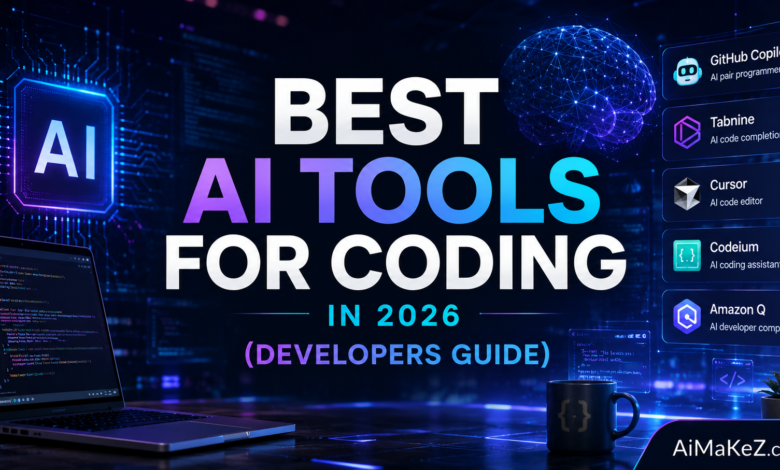
1. GitHub Copilot (with GPT-4o Integration)
GitHub Copilot remains the gold standard for AI-assisted coding in 2026. Powered by OpenAI’s GPT-4o and deeply integrated into VS Code, JetBrains IDEs, and more, GitHub Copilot has become the go-to tool for professional developers worldwide. It handles everything from autocomplete to full function generation, pull request summaries, and now, agentic coding tasks that span multiple files.
What sets Copilot apart from other AI tools for coding in 2026 is its workspace-level awareness. It can scan your entire repository — not just the file you’re editing — and make suggestions based on your actual project structure, naming conventions, and coding style. This context-aware completion is a massive leap from the file-level suggestions of earlier versions.
Best for: Professional developers using GitHub for version control, teams that want seamless enterprise security controls.
2. Cursor — The AI-First IDE
Cursor has taken the developer world by storm and in 2026 it’s arguably the most popular standalone AI coding tool among indie developers and startups. Built on top of VS Code, it feels immediately familiar but supercharges your workflow with deep AI integration at every level.
The standout feature is Cursor’s Composer mode — you can describe what you want to build in plain English, and Cursor will create, edit, and organize multiple files simultaneously to implement your idea. This goes far beyond autocomplete; it’s closer to pair programming with an AI partner who can also execute tasks.
Cursor also allows you to bring your own model (BYOM), meaning you can plug in Claude 3.5 Sonnet, GPT-4o, Gemini 1.5 Pro, or any other frontier model depending on the task at hand.
Best for: Individual developers and small teams who want maximum AI integration in a familiar VS Code-like environment.
3. Tabnine — Privacy-First AI Coding
Tabnine has carved out a strong niche among enterprise teams and security-conscious organizations. Its major differentiator is the ability to run AI models entirely on-premises, meaning your code never leaves your infrastructure. In regulated industries like healthcare, finance, and government, this isn’t a nice-to-have — it’s a requirement.
Tabnine’s team-learning feature makes it unique among AI tools for coding: it trains a custom AI model on your organization’s own codebase, so suggestions align with your internal libraries, code style, and architecture. Over time, it essentially becomes an AI that “speaks your company’s dialect” of code.
Best for: Enterprise teams, regulated industries, and organizations with strict data sovereignty requirements.
4. Amazon CodeWhisperer (Now Amazon Q Developer)
Rebranded as Amazon Q Developer in 2024 and significantly upgraded since, this tool is the obvious choice for teams already working within the AWS ecosystem. It provides real-time code suggestions optimized for AWS services — think IAM policies, CloudFormation templates, Lambda functions, and DynamoDB queries — with a level of specificity no general-purpose tool can match.
Amazon Q Developer stands out among AI tools for coding by including a security scanning feature that automatically checks your code for vulnerabilities against the OWASP Top 10 and AWS security best practices. For cloud-native teams, this built-in security layer adds real value.
Best for: AWS-heavy teams, cloud architects, and developers building serverless applications.
5. Codeium (Now Windsurf)
Rebranded as Windsurf after acquisition, what was previously Codeium has evolved into a full-featured AI tools for coding IDE with an “Agentic” flow that can autonomously complete multi-step tasks. The Cascade feature allows Windsurf to plan and execute complex refactors, migrate code between frameworks, or write end-to-end test suites — all from a single natural language instruction.
Windsurf’s generous free tier makes it exceptionally accessible for students and hobbyists, while its enterprise plan offers the control and compliance features that larger teams need.
Best for: Developers who want an agentic AI coding experience at an accessible price point.
6. Replit AI — Best for Web-Based Development
Replit has always been the go-to for browser-based coding, and its AI tools for coding features in 2026 make it genuinely powerful for rapid prototyping and educational use. Replit AI can generate entire apps from text prompts, complete with a working frontend, backend, and database schema — all deployed instantly in the cloud.
For educators teaching programming or for developers who want to prototype an idea without setting up a local environment, Replit stands out among AI tools for coding by delivering an experience that’s hard to beat.
Best for: Students, educators, rapid prototypers, and anyone who prefers coding in the browser.
7. Devin by Cognition Labs — The Autonomous AI Engineer
Devin represents a fundamentally different category of AI tools for coding. Rather than assisting a developer, Devin is designed to act as an autonomous software engineer. You assign it a task — “build a REST API for user authentication with JWT tokens” — and it researches, codes, tests, and iterates on its own, reporting progress along the way.
In 2026, Devin works best on well-defined, self-contained tasks among AI tools for coding. It’s not a replacement for a senior engineer’s architectural judgment, but for spinning up boilerplate, writing data pipelines, or handling defined sub-tasks, it can work autonomously for hours without needing hand-holding.
Best for: Engineering managers, tech leads, and teams that want to automate well-scoped development tasks.
Key Features to Look For in AI Tools for Coding
Not all AI tools for coding are created equal. When evaluating your options, these are the features that genuinely move the needle:
Context Window Size
A larger context window means AI tools for coding can “see” more of your codebase at once. Tools that only analyze the current file give suggestions that can conflict with code elsewhere in your project. Look for tools that offer at minimum project-level context awareness.
Multi-Language Support
The best AI tools for coding support all major programming languages including Python, JavaScript/TypeScript, Java, C/C++, Go, Rust, PHP, Ruby, and SQL. If you work across a polyglot stack, verify support before committing to a paid plan.
IDE and Editor Integration
Friction kills productivity. The best AI tools for coding integrate natively into the editor you already use — whether that’s VS Code, JetBrains (IntelliJ, PyCharm, WebStorm), Vim/Neovim, Emacs, or a browser-based environment.
Security and Privacy Controls
Understand what happens to your code when you send it to AI tools for coding services. Does the provider train on your data? Can you opt out? For enterprise teams handling proprietary IP, on-premises deployment or a clear data processing agreement is non-negotiable.
Agentic Capabilities
In 2026, the most powerful AI tools for coding have moved beyond single-turn suggestions to multi-step agentic workflows. Look for tools that can execute terminal commands, run tests, read error output, and iterate autonomously until a task is complete.
Benefits of AI Coding Tools for Modern Developers
The productivity gains from AI tools for coding are real and measurable. Here’s what developers consistently report after integrating these tools into their workflow:
Faster development cycles: Studies from major tech companies show that developers using AI coding assistants complete tasks 30–55% faster than those who don’t. This isn’t just about typing speed — it’s about reducing time spent on documentation lookup, debugging, and writing repetitive code patterns.
Reduced cognitive load: When an AI handles boilerplate, syntax, and standard patterns, your mental energy is freed for architecture decisions, user experience thinking, and complex problem solving — the work that actually requires human judgment.
Better code quality: Contrary to early fears, well-configured AI coding tools tend to improve code quality over time. They suggest idiomatic patterns, flag common anti-patterns, and prompt you to write tests for the code they generate.
Faster onboarding: New team members can use AI tools to understand an unfamiliar codebase far more quickly. Instead of spending weeks reading through thousands of lines of legacy code, they can ask the AI to explain specific modules, trace data flows, and understand architectural decisions.
Continuous learning: Every interaction with a good AI coding tool is a micro-learning opportunity. Junior developers in particular absorb better patterns, discover new APIs, and learn language-specific idioms naturally through the suggestion process.
How AI Coding Tools Work
Understanding the technology helps you use it more effectively. Here’s a simplified breakdown of what happens when you type a comment or prompt in your AI tools for coding:
Step 1 — Context collection: The tool gathers relevant context — the file you’re editing, open tabs, imported modules, recent edits, and (in advanced tools) the broader repository structure.
Step 2 — Tokenization: Your code and context are converted into tokens — numerical representations the model can process. Larger context windows mean more tokens, which means more of your project fits in the model’s “working memory.”
Step 3 — Model inference: The tokenized input is sent to an LLM (either hosted in the cloud or running locally), which predicts the most likely and useful continuation or response based on training across billions of lines of code.
Step 4 — Suggestion delivery: The model’s output is decoded and presented as an inline suggestion, a chat response, or an edited file — depending on the tool and the type of interaction.
Step 5 — Feedback loop: When you accept, reject, or modify suggestions, some tools use that signal to fine-tune their behavior for your specific style over time.
Real-World Use Cases
Startup Development Teams
A two-person startup building a SaaS product used Cursor’s Composer to go from zero to a functional MVP in under three weeks. What would have taken a traditional team of five developers several months was dramatically compressed by using AI to handle frontend components, API routes, database migrations, and even the initial CI/CD pipeline configuration.
Enterprise Legacy Code Migration
A European financial services firm used Tabnine’s on-premises deployment to migrate 200,000 lines of legacy Java code to a modern Spring Boot architecture. The AI analyzed patterns across the entire codebase, suggested equivalents in the new framework, and flagged areas where the migration would break existing behavior — all without any of the source code leaving the company’s internal servers.
Solo Developer Building a SaaS Product
An independent developer in Austin, Texas built and launched a full B2B analytics dashboard — complete with Stripe integration, user authentication, multi-tenancy, and a React frontend — in 6 weeks using GitHub Copilot and ChatGPT as their primary coding partners. They described it as having “a senior developer and a Stack Overflow that never sleeps.”
Education and Coding Bootcamps
Bootcamps across the US and UK have integrated Replit AI into their curricula, not to let students skip the learning process, but to give them an always-available tutor that explains errors, suggests fixes, and clarifies concepts on demand. Students who used AI-assisted learning environments showed 40% faster progression through the curriculum in pilot programs.
DevOps and Infrastructure Automation
Amazon Q Developer has become a standard tool among AWS-focused DevOps teams. Engineers use it to generate CloudFormation templates, write Lambda function handlers, and create optimized IAM policy documents. Tasks that once required extensive documentation diving now happen in seconds.
Pros and Cons Comparison
| Tool | Pros | Cons | Best For |
|---|---|---|---|
| GitHub Copilot | Deep GitHub integration, workspace context, enterprise controls | Subscription required, US data centers only for some plans | Professional teams on GitHub |
| Cursor | Multi-file AI, BYOM, excellent UX, fast | Can be resource-heavy, newer product | Individual devs, startups |
| Tabnine | On-premises option, team learning, privacy-first | Less powerful than cloud competitors for complex tasks | Enterprise, regulated industries |
| Amazon Q Developer | AWS-native, built-in security scanning | Limited usefulness outside AWS ecosystem | Cloud architects, AWS teams |
| Windsurf (Codeium) | Generous free tier, agentic Cascade, fast | Newer brand identity may cause confusion | Budget-conscious developers |
| Replit AI | No setup, instant deployment, great for learning | Not suitable for complex local dev environments | Students, rapid prototypers |
| Devin | Fully autonomous, can work overnight | Expensive, best for well-scoped tasks only | Engineering leads, automation |
Pricing Overview (2026)
Pricing across the AI tools for coding market has become more competitive as the space matures. Here is a current overview of what you can expect to pay:
- GitHub Copilot Individual: $10/month or $100/year. Business plan starts at $19/user/month with added policy controls and audit logs. Enterprise plan available with custom pricing.
- Cursor: Free tier available with limited requests. Pro plan at $20/month with unlimited premium model requests. Business plan at $40/user/month.
- Tabnine: Free tier for individuals. Pro plan at $12/user/month. Enterprise pricing available on request with on-premises deployment options.
- Amazon Q Developer: Free tier includes 50 code suggestions and 5 security scans per month. Pro tier at $19/user/month with unlimited usage.
- Windsurf (formerly Codeium): Free tier is genuinely generous. Pro plan at $15/month. Teams plan at $35/user/month.
- Replit AI: Free with limitations. Replit Core plan at $25/month includes expanded AI usage and more powerful compute.
- Devin: Enterprise pricing only — typically starting around $500/month for a limited number of autonomous agent hours, with custom contracts for high-volume teams.
How They Compare: Head-to-Head
Choosing between these tools comes down to your specific situation. Here’s a direct comparison across the factors that matter most:
For raw code completion quality: GitHub Copilot and Cursor are neck and neck at the top. Both leverage frontier models and offer project-wide context. Cursor edges ahead for users who want to actively chat with their codebase, while Copilot wins on stability and GitHub integration depth.
For privacy and security: Tabnine is the clear winner, especially with its on-premises deployment. Amazon Q Developer is a strong second for AWS-native teams who trust the AWS compliance framework.
For agentic capabilities: Devin is in a class of its own for autonomous multi-step tasks. Windsurf’s Cascade and Cursor’s Composer are the best options for agentic workflows without Devin’s price tag.
For free users and beginners: Windsurf and Replit AI offer the most value at no cost. Replit is particularly strong for complete beginners who don’t want to set up a local development environment.
Best Practices for Using AI Tools for Coding
Getting the most out of AI tools for coding requires a thoughtful approach. Here are expert-level recommendations that will dramatically improve your results:
Be specific with your prompts. Vague instructions produce vague code. Instead of “write a function to process data,” try “write a Python function that takes a list of dictionaries representing user records, filters out records where the ‘status’ field is ‘inactive’, and returns a sorted list by ‘last_login’ date in descending order.”
Always review generated code. AI tools make mistakes. They can generate plausible-looking code that contains subtle logical errors, outdated API calls, or security vulnerabilities. Treat every AI suggestion as a first draft that needs your review, not a finished product.
Use AI for tests first. One of the most underrated use cases is generating test suites. Ask your AI tool to write unit tests for a function before you write the function itself — this is a great way to practice test-driven development with an AI accelerator.
Iterate through conversation. The best results come from treating AI coding tools as a dialogue, not a one-shot prompt. Ask it to explain what it generated, suggest improvements, add error handling, optimize for performance, or rewrite using a different approach.
Set up a system prompt or custom instructions. Most tools allow you to set global instructions about your project. Use this to define your tech stack, coding conventions, preferred libraries, and any constraints the AI should always respect.
Keep your secrets out of prompts. Never paste API keys, passwords, or sensitive environment variables into AI prompts. Use placeholder values and replace them manually after the AI has generated the surrounding code.
Common Mistakes Developers Make With AI Coding Tools
Even experienced developers fall into these traps when using AI tools for coding:
Accepting suggestions without understanding them. This is the most dangerous mistake. If you can’t explain what a piece of AI-generated code does, you shouldn’t ship it. You’ll also struggle to debug it when something goes wrong in production.
Over-relying on AI for architecture decisions. AI tools are excellent at the tactical level — functions, modules, components — but weak at the strategic level. Don’t ask AI to design your entire system architecture without applying your own domain expertise and business context.
Ignoring the security implications. AI models are trained on public code, which includes plenty of insecure patterns. Always run generated code through a security linter or dedicated scanning tool, especially for anything handling user data, authentication, or financial transactions.
Using the wrong tool for the job. GitHub Copilot might be your daily driver for general coding, but if you’re writing CloudFormation templates, Amazon Q Developer will outperform it significantly. Match the tool to the task at hand.
Neglecting to update the AI’s context. AI tools can’t read your mind about project changes. If your codebase evolves significantly, revisit how you’ve set up context, custom instructions, and workspace indexing to make sure the AI’s understanding remains accurate.
Using free tiers for sensitive codebases. Free tiers often involve less restrictive data usage policies. If you’re working on proprietary software, review the terms of service carefully and upgrade to a paid plan with explicit data protection guarantees.
Frequently Asked Questions About AI Tools for Coding
Are AI coding tools suitable for complete beginners?
Yes, but with an important caveat. AI coding tools can accelerate learning significantly, but beginners who rely on them exclusively risk developing gaps in their foundational understanding. Check our guide on best AI tools for students to understand how to use AI effectively for learning. The best approach for beginners is to use AI tools as a tutor — ask them to explain what code means, why a certain approach is used, and what alternatives exist. Use Replit AI for its seamless browser-based environment and instant feedback. Avoid copy-pasting code you don’t understand; instead, use the AI to teach you what it’s generating.
Is the code generated by AI tools safe to use in production?
AI-generated code can absolutely be used in production, but it should never bypass your standard code review process. The key risks are subtle logical errors, outdated library usage, and potential security vulnerabilities inherited from insecure patterns in training data. Always review AI-generated code as you would any pull request from a junior developer — with careful attention to edge cases, security implications, and alignment with your system’s expected behavior. Tools like Amazon Q Developer with built-in security scanning add an important extra layer of protection.
Which AI coding tool is best for Python developers?
GitHub Copilot and Cursor are the top choices for Python development in 2026. Both offer excellent Python support across data science, web development (Django, FastAPI, Flask), automation scripting, and machine learning workflows. Cursor has a particular advantage for Python data scientists because of its ability to explain complex ML pipelines and suggest optimizations with Pandas, NumPy, and PyTorch. If you work heavily with AWS Lambda and Python, Amazon Q Developer is worth adding to your toolkit as a complement.
Do AI coding tools work offline?
Most mainstream AI coding tools require an internet connection because model inference happens in the cloud. However, there are solutions for offline use. Tabnine offers a local model option that runs on your machine without sending data externally. Tools like Continue.dev (an open-source alternative) can be configured to run with locally hosted models via Ollama or LM Studio. Offline capability generally comes with a performance trade-off — local models are smaller and less capable than their cloud-hosted counterparts — but they’re a viable option for air-gapped environments or situations with poor connectivity.
Will AI tools eventually replace human developers?
This question comes up constantly, and the honest answer in 2026 is: not in any meaningful timeframe for senior engineering roles. AI tools are transforming the nature of software development work — reducing the time spent on implementation and debugging, and shifting developer focus toward design, architecture, stakeholder communication, and creative problem-solving. The developers most at risk are those doing purely formulaic, low-judgment work. For everyone else, the right mindset is “AI makes me more productive,” not “AI is replacing me.”
Final Verdict: Choosing the Right AI Tools for Coding
The landscape of AI tools for coding in 2026 is rich, mature, and genuinely transformative. There’s no single “best” tool — the right choice depends on your environment, your team size, your security requirements, and the nature of your work.
If you’re a professional developer or part of a team and already use GitHub, GitHub Copilot is the safest starting point. If you want the most powerful individual developer experience with the flexibility to use any frontier model, Cursor is the tool to beat. For enterprise teams where data privacy isn’t negotiable, Tabnine is the responsible choice. AWS-focused teams should strongly consider Amazon Q Developer alongside their primary tool. Budget-conscious developers and students will find exceptional value in Windsurf and Replit AI.
Whatever you choose, the most important thing is to start using AI tools for coding intentionally and thoughtfully. Review what they generate, learn from the suggestions, and use the time they save you to focus on the higher-level thinking that will define your value as a developer in the years ahead.
The developers who thrive in 2026 and beyond won’t be the ones who resist AI — they’ll be the ones who learned to work with it most effectively.