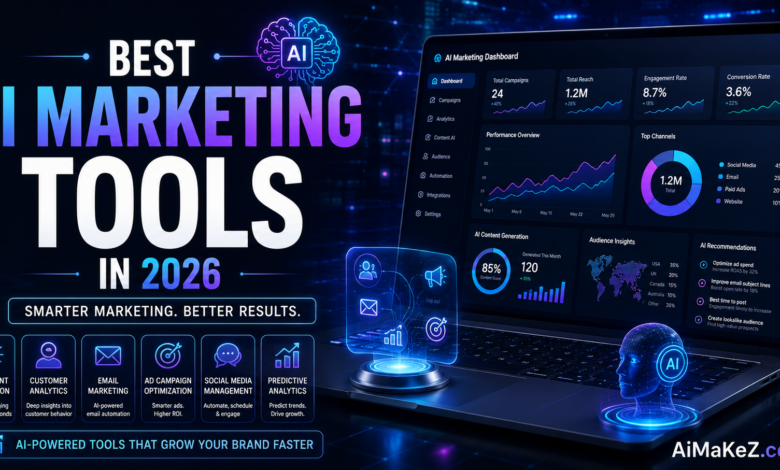
If you’re trying to grow a brand, generate leads, or scale a content strategy in 2026, you already know one thing: doing it manually isn’t an option anymore. The best AI marketing tools have fundamentally changed how businesses attract, engage, and convert customers — and falling behind on this curve means handing the advantage straight to your competitors. This guide cuts through the noise to show you exactly which platforms deserve your attention, how they work, and how to get the most out of them.
Table of Contents
What Are AI Marketing Tools?
AI marketing tools are software platforms that use artificial intelligence technologies — including machine learning, natural language processing (NLP), computer vision, and predictive analytics — to automate, optimize, and personalize marketing activities.
Unlike traditional marketing software that follows rigid rules, AI-powered platforms learn from data. They identify patterns in customer behavior, predict what content will perform best, personalize messaging at scale, and continuously improve based on outcomes. This makes them dramatically more effective than static rule-based systems.
In 2026, the category spans a wide range of functions: AI copywriting assistants, predictive lead scoring tools, automated email personalization engines, social media content generators, SEO optimization platforms, visual ad creators, customer journey mappers, and full-stack marketing automation suites. Some focus on a single discipline; others try to cover the entire funnel.
Key Features to Look For in AI Marketing Tools
Content Generation and Optimization
The ability to generate high-quality written, visual, and video content is arguably the most sought-after feature in modern AI marketing tools. Look for platforms that go beyond generic text generation — the best ones understand brand voice, target audience context, SEO intent, and content performance data. Tools like Jasper, Copy.ai, and Writesonic now offer “brand memory” features that ensure every piece of content stays on-brand.
Predictive Analytics and Lead Scoring
Top-tier platforms don’t just describe what happened — they predict what’s going to happen. Predictive analytics engines analyze CRM data, website behavior, email engagement, and firmographic signals to rank leads by their likelihood to convert. This saves sales teams hours of manual qualification and dramatically improves pipeline efficiency.
Personalization at Scale
Sending the same email to 50,000 people is no longer acceptable in competitive markets. Personalization engines use behavioral data, purchase history, browsing patterns, and demographic information to dynamically tailor emails, landing pages, ad creative, and product recommendations to individual users in real time.
Multimodal AI Capabilities
In 2026, the best platforms handle text, images, audio, and video under one roof. This is a significant leap from the text-only tools that dominated the market in 2023–2024. Platforms like HubSpot’s AI suite, Adobe Firefly integrated into Marketo, and Canva’s Magic Studio all exemplify this shift toward unified multimodal creative production.
Workflow Automation and Integrations
No tool operates in isolation. The strongest AI marketing platforms offer native integrations with CRMs (Salesforce, HubSpot), ad platforms (Google Ads, Meta), ecommerce systems (Shopify, WooCommerce), and communication tools (Slack, Intercom). Robust API access and Zapier/Make compatibility are essential for building seamless automation workflows.
Reporting, Attribution, and ROI Tracking
You can’t improve what you don’t measure. Look for AI marketing tools that offer multi-touch attribution modeling, cohort analysis, funnel visualization, and cross-channel performance dashboards. The ability to tie marketing spend directly to revenue — not just vanity metrics — is what separates serious platforms from flashy demos.
Benefits of Using AI Marketing Tools
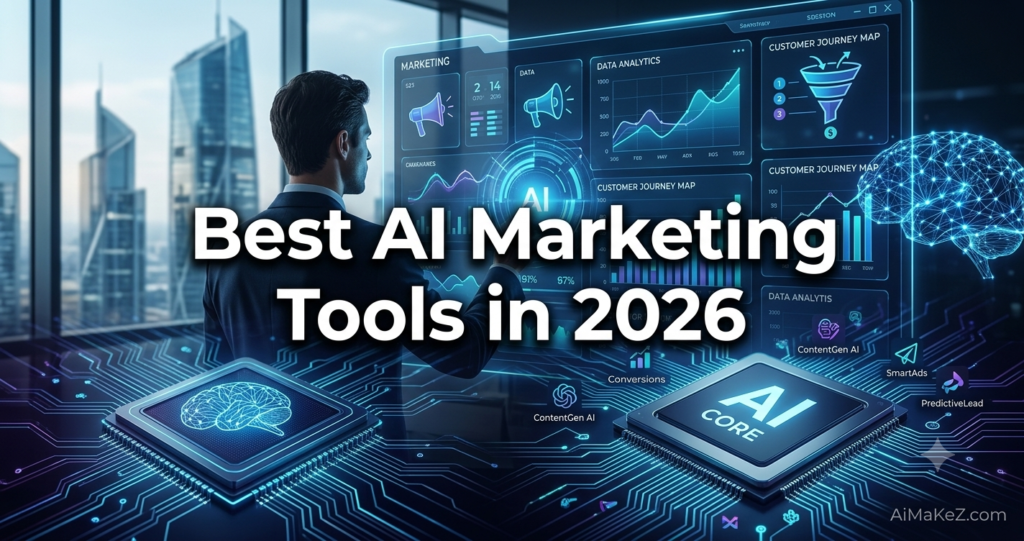
The practical advantages of integrating AI marketing tools into your marketing stack go well beyond saving time. Here’s what businesses across the US and Europe are consistently reporting:
Dramatically faster content production. A marketing team that used to produce 20 blog posts per month can now scale to 80–100 with AI assistance, maintaining quality through human editorial oversight. Agencies in particular are reporting 4–6x output increases after adopting AI writing platforms.
Lower customer acquisition costs. AI-driven ad targeting and lookalike audience modeling consistently outperform manually configured campaigns. Brands using AI-powered paid media tools report CAC reductions of 20–40% on average.
Higher email engagement rates. AI personalization in email marketing — including subject line optimization, send-time prediction, and dynamic content blocks — regularly lifts open rates by 15–30% and click-through rates by even more.
Better customer retention. Churn prediction models, powered by AI, allow customer success teams to identify at-risk accounts weeks before they cancel — enabling proactive outreach that meaningfully improves retention metrics.
Competitive SEO advantages. AI-powered SEO platforms analyze top-ranking content at a granular semantic level, identifying topic clusters, NLP entities, and content gaps that would take human researchers days to uncover. This directly translates into faster ranking improvements.
How AI Marketing Tools Work
Understanding the mechanics behind these platforms helps marketers use them more intelligently — and avoid the common trap of treating them as magic black boxes.
Step 1 — Data ingestion. The AI marketing tool connects to your existing data sources: CRM, website analytics, email platform, ad accounts, and social channels. The quality and breadth of your data directly determines how well the AI performs.
Step 2 — Model training and fine-tuning. Most modern AI marketing tools are built on large language models (LLMs) or specialized ML models that have been pre-trained on vast datasets. They’re then fine-tuned on marketing-specific data — ad copy, email sequences, landing page templates, keyword clusters — to improve domain relevance.
Step 3 — Task execution. Based on your inputs (prompts, templates, audience segments, campaign goals), the AI generates outputs — content drafts, audience segments, campaign recommendations, predicted outcomes, or automated sequences.
Step 4 — Human review and feedback. The best implementations involve human-in-the-loop workflows where marketers review, edit, and approve AI outputs before publication. Feedback loops allow the system to learn your preferences over time.
Step 5 — Continuous optimization. AI marketing tools monitor performance in real time, running A/B tests, adjusting bidding strategies, reweighting audience segments, and updating content recommendations based on what’s actually working.
Top AI Marketing Tools in 2026
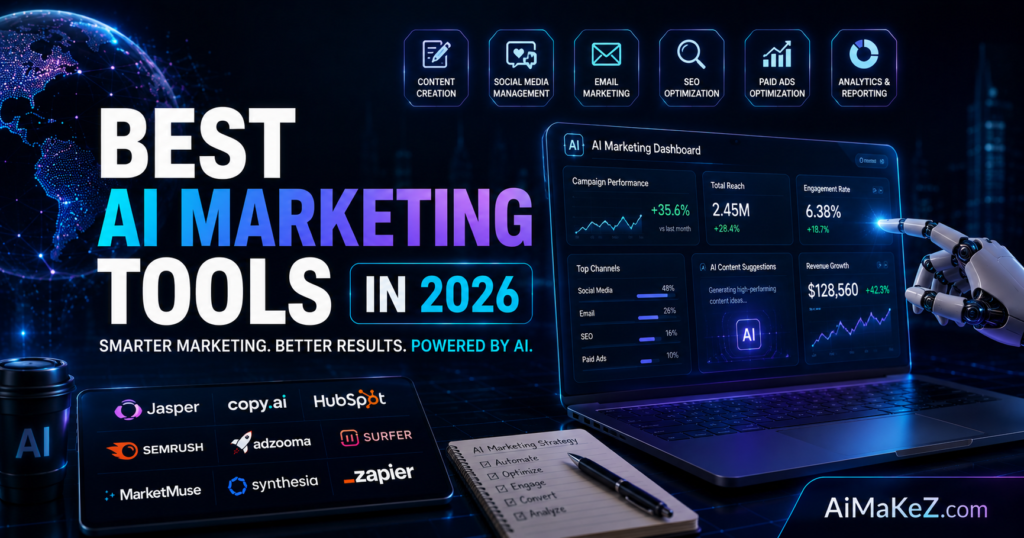
1. HubSpot AI (Breeze)
HubSpot’s unified platform now integrates AI across every hub — marketing, sales, service, and CMS — through its “Breeze” AI layer. For marketers, this means AI-assisted email generation, smart content personalization, predictive lead scoring, and an AI social media assistant that suggests optimal posting schedules and caption variations. HubSpot remains one of the most well-rounded AI marketing tools for mid-sized businesses because everything lives in one ecosystem with no integration headaches.
2. Jasper AI
Jasper has cemented its position as the go-to AI content platform for marketing teams. Its “Brand Voice” feature lets teams upload existing content to train a custom writing style, ensuring every AI-generated piece sounds authentically human and on-brand. Jasper’s knowledge base integrations and SEO mode (powered by Surfer SEO) make it especially powerful for content marketing at scale. It’s widely used by agencies managing multiple clients across different verticals.
3. Surfer SEO
Surfer SEO remains the benchmark for AI-driven content optimization. Its content editor scores your articles in real time against top-ranking competitors, suggesting NLP terms, heading structures, internal link opportunities, and optimal word counts. The platform’s AI-generated content outlines are now sophisticated enough that many SEO professionals treat them as near-final frameworks rather than rough starting points.
4. Salesforce Einstein
For enterprise marketing teams already embedded in the Salesforce ecosystem, Einstein AI is an obvious choice. It powers predictive analytics across email campaigns, ad targeting, and customer journey orchestration. Einstein’s engagement scoring helps marketers identify which contacts are most likely to respond to outreach — and at what point in the buyer’s journey. It’s particularly strong for B2B demand generation.
5. Semrush AI Writing Assistant + Copilot
Semrush has evolved from a keyword research tool into a comprehensive AI marketing intelligence platform. Its Copilot feature provides daily prioritized recommendations — “fix these technical SEO issues,” “publish content on this trending topic,” “your top competitor just launched a new ad campaign” — making it an indispensable tool for data-driven marketers who manage complex multi-channel strategies.
6. Canva Magic Studio
Visual marketing has been completely transformed by Canva’s AI suite. Magic Studio includes tools for AI image generation, background removal, text-to-image creation, brand kit enforcement, and one-click video editing. For marketers without dedicated design resources, it’s the most accessible and versatile creative AI platform available. The recent addition of AI-powered presentation generation has made it even more useful for content teams.
7. Klaviyo AI
In the ecommerce marketing space, Klaviyo’s AI features are exceptional. Predictive analytics models estimate customer lifetime value, churn probability, and next-purchase date with impressive accuracy. Its generative AI tools help create email flows and SMS campaigns tailored to specific customer segments automatically. For Shopify and WooCommerce brands, Klaviyo AI is arguably the highest-ROI tool on this list.
8. Adzooma / Google Performance Max
For paid advertising, Google’s Performance Max campaigns use AI to automatically allocate budget, test creative variations, identify the best-performing audience signals, and optimize bids in real time across Search, Display, YouTube, and Gmail. For marketers managing large ad budgets, PMax combined with tools like Adzooma (for cross-platform AI bid management) significantly reduces manual optimization overhead.
Real-World Use Cases
E-Commerce: Personalized Product Recommendation Engines
A mid-sized US fashion retailer integrated Klaviyo AI with their Shopify store and used predictive purchase modeling to send personalized “you might also love” email flows triggered by specific browsing behavior. Within 90 days, their revenue per recipient (RPR) increased by 34%, and their average order value grew by 18%. The entire campaign ran with minimal manual intervention once the initial segments were defined.
B2B SaaS: AI-Powered Content Marketing at Scale
A European B2B SaaS company used Jasper AI combined with Surfer SEO to expand their content library from 80 to 400 published articles over 18 months without adding headcount. Each article was AI-generated, human-edited, and Surfer-optimized before publication. Organic traffic tripled, and the company attributed a significant portion of their pipeline growth to inbound leads generated through this content program.
Agency: Client Campaign Management
A digital marketing agency in New York managing 30+ client accounts adopted HubSpot Breeze AI across all client portals. Using AI-generated email drafts, smart A/B testing, and automated campaign reporting, the agency reduced time-per-client from an average of 12 hours per week to 5 hours — without reducing campaign quality. This capacity increase allowed them to onboard eight new clients without hiring additional staff.
Education and Online Courses: AI-Driven Ad Targeting
An online education platform used Google Performance Max combined with Meta’s Advantage+ AI targeting to promote a new certification course. Instead of manually building audience segments, they fed the AI a broad interest pool and let the algorithm identify and optimize toward high-converting user profiles. CPA dropped by 28% compared to manually managed campaigns from the prior quarter.
Pros and Cons of AI Marketing Tools
| Aspect | Pros | Cons |
|---|---|---|
| Content Creation | Fast, scalable, consistent brand voice | Can sound generic without proper prompting |
| Personalization | Deep, data-driven, real-time | Requires clean, sufficient data to be effective |
| Cost | Reduces need for large teams | Premium tools have significant monthly costs |
| Analytics | Predictive, proactive insights | Complex setup and data integration required |
| Ad Optimization | Automated, always-on optimization | Less control over micro-targeting decisions |
| SEO | Semantic optimization at scale | Over-reliance can lead to thin, formulaic content |
| Learning Curve | Most tools have strong onboarding | Advanced features require time to master |
| Compliance | Some tools include GDPR-aware features | AI-generated content may still need legal review |
Pricing Overview
AI marketing tool pricing varies enormously depending on the platform’s scope, the size of your contact database, and whether you need enterprise features. Here’s a general breakdown as of mid-2026:
- Jasper AI: Plans start at $49/month (Creator) and scale to $125/month+ (Teams). Enterprise pricing is custom.
- Surfer SEO: Essential plan at $89/month; Scale at $129/month; Scale AI at $219/month with automated AI content briefs.
- HubSpot Marketing Hub (with Breeze AI): Starter from $15/month; Professional from $800/month; Enterprise from $3,600/month.
- Semrush (with Copilot + AI): Pro at $139.95/month; Guru at $249.95/month; Business at $499.95/month.
- Klaviyo AI: Free up to 250 contacts; scales with list size — approximately $150/month for 10,000 contacts.
- Canva Pro (Magic Studio): $15/month per person; Teams from $10/person/month.
- Salesforce Einstein: Included with Marketing Cloud licenses starting at approximately $1,250/month for basic packages.
Most platforms offer free trials or freemium tiers. Testing two or three tools side-by-side during a trial period before committing to annual contracts is strongly advisable.
Comparison With Alternatives
How do dedicated AI marketing tools stack up against more general-purpose AI solutions like ChatGPT, Claude, or Google Gemini used directly?
General-purpose LLMs are enormously powerful and increasingly capable of marketing tasks — drafting emails, generating ad copy, analyzing campaign data — but they lack the domain-specific integrations, real-time data connections, workflow automation, and marketing-specific output templates that purpose-built AI marketing tools provide. For example, Jasper AI’s SEO mode is directly integrated with keyword data and competitor analysis in a way that requires significant manual prompt engineering to replicate in a standalone ChatGPT session.
Traditional marketing automation platforms like Mailchimp, ActiveCampaign, or Constant Contact are adding AI features rapidly but still lag behind dedicated AI marketing tools in terms of generative content quality and predictive analytics depth. The gap is closing, but as of 2026, if AI capability is your primary criterion, dedicated AI marketing tools still outperform “AI-added-on” traditional platforms.
For very small businesses or solo marketers with tight budgets, a combination of a mid-tier general LLM subscription and a single specialized tool (e.g., Surfer SEO for content, Klaviyo for email) often delivers better ROI than an expensive all-in-one suite.
Best Practices for Using AI Marketing Tools
Always Start With Clean Data
AI is only as good as the data it learns from. Before deploying any AI marketing tools, audit your CRM for duplicate records, incomplete fields, and outdated contact data. Investing a few days in data hygiene upfront can dramatically improve the accuracy of AI-generated segments, predictions, and recommendations.
Maintain Human Editorial Oversight
AI-generated content should always be reviewed by a human before publication — especially for brand-sensitive contexts, legal compliance, or factual accuracy. Build a workflow where AI handles the first draft and humans handle refinement, fact-checking, and final approval. This “AI-assisted, human-led” model consistently outperforms either extreme.
Define Clear Goals Before Choosing a Tool
Are you trying to increase organic search traffic? Reduce email unsubscribe rates? Improve paid ad ROAS? The answer should determine which type of AI marketing tool you prioritize. Resist the temptation to buy an all-in-one platform and actually use only 10% of its features — specialized tools often dramatically outperform generalist ones in their specific domain.
Test, Iterate, and Track Attribution
Set up proper UTM tracking and attribution modeling before running AI-assisted campaigns. Without attribution, you won’t know which AI recommendations are actually driving revenue vs. vanity metrics. Most enterprise AI marketing tools include built-in attribution models, but connecting them to your broader analytics stack (GA4, Looker Studio, or similar) is essential for accurate reporting.
Common Mistakes to Avoid
Treating AI output as final. Even the best AI marketing tools produce content that benefits from human editing. Publishing AI drafts without review risks factual errors, off-brand tone, and generic phrasing that damages credibility.
Neglecting audience segmentation. AI personalization only works when your audience data is properly segmented. Feeding an AI engine a single unsegmented list and expecting magic results is a guaranteed way to get mediocre outcomes.
Over-automating customer interactions. AI chatbots and automated email sequences are powerful, but customers still value human touchpoints — especially in high-value or complex purchase decisions. Know when to hand off from AI to a human.
Ignoring GDPR and privacy compliance. If you’re marketing to audiences in the EU, many AI personalization and data analytics practices require explicit consent and careful data handling. Ensure any AI marketing tools you use have GDPR-compliant data processing agreements and support consent management.
Chasing every new tool. The AI marketing tool landscape moves fast, and it’s tempting to constantly switch platforms chasing the newest features. This leads to integration fragmentation, team confusion, and wasted onboarding time. Commit to a core stack, master it, and evaluate alternatives only when there’s a clear strategic reason to switch.
Underestimating the learning curve. Enterprise AI platforms like Salesforce Einstein or Adobe Marketo with AI features have significant complexity. Budget adequate time for training, onboarding, and iterative configuration before expecting full ROI.
Frequently Asked Questions
What are the best AI marketing tools for small businesses in 2026?
For small businesses, the best AI marketing tools balance affordability with meaningful impact. Jasper AI (for content creation), Canva Magic Studio (for visual marketing), Klaviyo AI (for email and SMS), and Semrush’s AI tools (for SEO) collectively form an excellent, cost-effective AI stack. Most offer free trials or affordable entry-tier plans that allow small teams to start seeing value quickly without large upfront commitments.
Can AI marketing tools replace human marketers?
No — and this question fundamentally misunderstands how AI marketing tools create value. They augment human capabilities rather than replace strategic thinking, creative judgment, brand stewardship, and relationship-building. The marketers who thrive in 2026 are those who use AI to handle high-volume, repetitive tasks (first drafts, data analysis, A/B testing) while focusing their own expertise on strategy, positioning, and creative direction that AI still cannot replicate.
How do AI marketing tools help with SEO?
AI marketing tools support SEO in multiple ways: identifying high-opportunity keyword clusters, generating semantically rich content outlines, analyzing competitor content gaps, suggesting internal linking opportunities, predicting content performance before publication, automating technical SEO audits, and providing real-time content optimization scores. Platforms like Surfer SEO and Semrush’s AI Copilot are specifically designed for this purpose and offer some of the strongest SEO-specific AI capabilities available.
Are AI marketing tools GDPR compliant?
Most leading AI marketing tools — including HubSpot, Klaviyo, Semrush, and Salesforce — offer GDPR-compliant data processing agreements and EU data residency options. However, compliance is not automatic. Marketers using these tools must still configure consent collection correctly, honor data subject access requests, implement proper data retention policies, and ensure that any AI personalization is based only on consented data. Always review a platform’s Data Processing Agreement (DPA) before deploying it for audiences in the European Union.
What is the ROI of using AI marketing tools?
ROI varies significantly by use case and industry, but the data is consistently positive. Content teams report 3–6x production increases. Email marketers see 15–30% improvements in open rates and click-through rates. Paid advertising teams reduce CAC by 20–40% using AI bid optimization. SEO teams accelerate ranking timelines by months. The key to achieving strong ROI is selecting the right tool for your specific bottleneck, integrating it properly with your existing stack, and committing to consistent usage over time rather than treating it as a one-time experiment.
Final Verdict
The landscape of AI marketing tools in 2026 is both extraordinarily powerful and genuinely complex to navigate. There’s no single platform that wins across every marketing discipline — the best approach is to build a focused stack tailored to your specific goals, team size, and budget.
For content-first marketers, a combination of Jasper AI and Surfer SEO remains unbeaten for scale and quality. For ecommerce brands, Klaviyo AI and Google Performance Max represent the highest-ROI pairing available. For full-funnel B2B marketing teams, HubSpot Breeze or Salesforce Einstein — depending on your CRM — provide the most cohesive end-to-end AI-assisted experience.
Whatever combination of AI marketing tools you choose, one thing is certain: the marketers and businesses that invest in mastering them today will have a compounding structural advantage over those who don’t. The tools are mature, the ROI is proven, and the barriers to entry have never been lower. There’s no better time to start than right now.