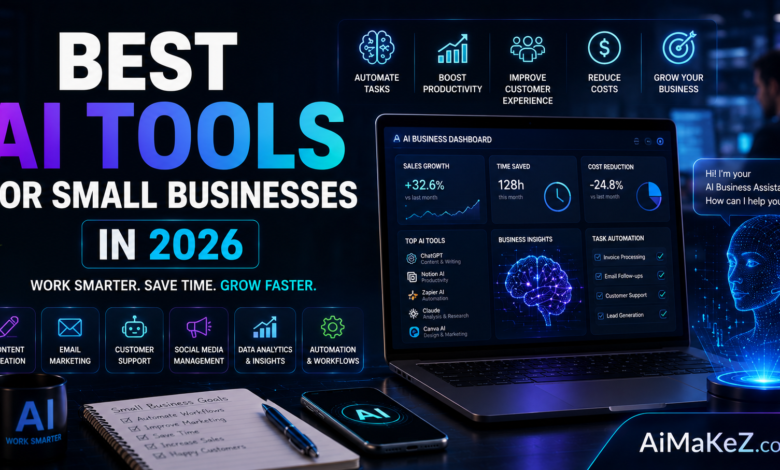
Running a small business in 2026 means competing with companies that have larger budgets, bigger teams, and more resources. The good news? AI tools for small businesses have leveled the playing field in ways that would have seemed impossible just a few years ago. Whether you’re a solo entrepreneur managing everything yourself or a small team trying to punch above your weight, artificial intelligence can help you automate repetitive tasks, understand your customers better, and grow your revenue without burning out.
This guide breaks down the best AI tools for small businesses available in 2026 — tested, compared, and explained in plain English. We’ll cover tools for marketing, content creation, customer service, accounting, productivity, and more. By the end, you’ll know exactly which AI tools for small business fit your needs and budget.
Table of Contents
What Are AI Tools for Small Businesses?
AI tools for small businesses are software applications powered by artificial intelligence, machine learning, and natural language processing (NLP) that help business owners automate, optimize, and scale their operations. Unlike traditional software that requires manual input for every task, AI tools can learn from data, make decisions, generate content, analyze trends, and even talk to your customers — all without constant human supervision.
In 2026, AI tools for small businesses range from AI writing assistants and chatbots to fully automated accounting systems and predictive analytics platforms. Most are cloud-based, affordable on a monthly subscription, and require zero coding knowledge to use. That makes them genuinely accessible to the average small business owner, freelancer, or startup founder.
The Evolution of AI in Small Business
Just five years ago, AI was largely the domain of enterprise companies with deep pockets and dedicated tech teams. Today, tools like ChatGPT, Jasper, and HubSpot AI have democratized access. A bakery in Ohio, a freelance designer in London, and a boutique agency in Austin can all use the same cutting-edge technology to compete, grow, and serve their customers better.
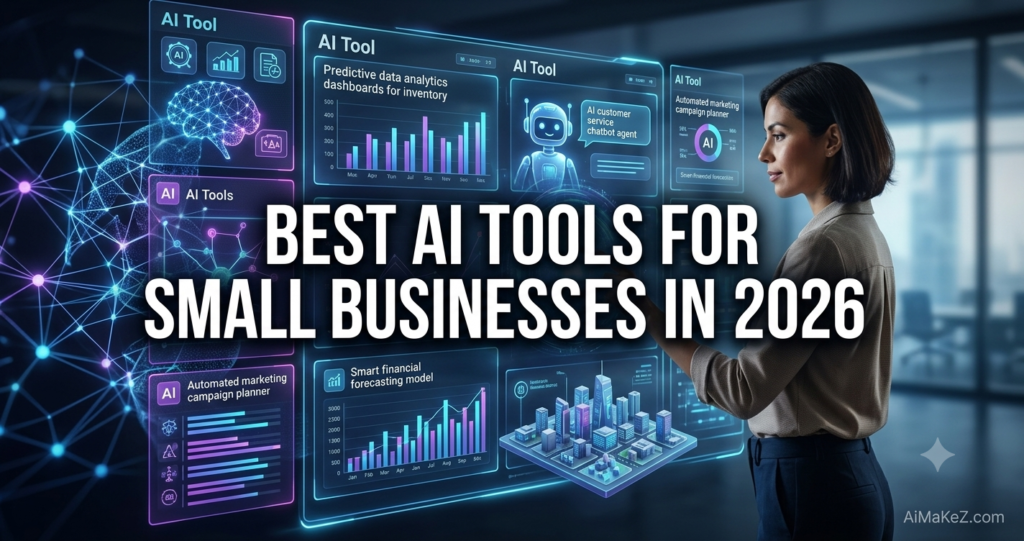
Key Features to Look For in AI Tools for Small Businesses
Not all AI tools for small businesses are created equal. Before signing up for any subscription, you should evaluate each tool against these critical criteria:
Ease of Use
Small business owners don’t have time to climb steep learning curves. The best AI tools feature intuitive dashboards, clear onboarding flows, and helpful templates. Look for tools that offer a free trial so you can test usability before committing.
Integration Capabilities
Your AI tool needs to connect seamlessly with the software you already use — whether that’s Shopify, QuickBooks, Gmail, Slack, or WordPress. Strong API support and native integrations with tools like Zapier or Make (formerly Integromat) are a major plus.
Affordability and Scalability
Small businesses operate on tight margins. When choosing AI tools for small businesses, prioritize tools that offer a free tier or low-cost entry plan with the option to scale as you grow. Avoid platforms with hidden fees or complex credit-based pricing models that make it hard to predict your monthly bill.
Data Security and Privacy
You’ll be feeding sensitive business data into these platforms. Make sure any AI tool you use is GDPR-compliant, SOC 2 certified (where applicable), and transparent about how your data is stored and used. This is especially important for US-based businesses handling customer information.
Customer Support Quality
When something goes wrong — and it will — you need responsive support. Look for tools with live chat, a robust knowledge base, and an active user community. For mission-critical tools, prioritize vendors offering phone or dedicated account manager support.
Top AI Tools for Small Businesses in 2026
Here’s our expert-curated list of the best AI tools across every major business function:
1. ChatGPT (OpenAI) — Best All-Around AI Assistant
ChatGPT remains the gold standard for conversational AI in 2026 and one of the most versatile AI tools for small businesses on the market. With GPT-4o powering the latest version, small business owners use it for drafting emails, writing product descriptions, creating social media content, answering customer FAQs, and even analyzing spreadsheet data. The ChatGPT Team plan at $25/user/month gives small teams access to advanced models, custom GPTs, and priority processing.
Best for: Content creation, customer communication, research, and task automation.
2. Jasper AI — Best for Marketing Content
Jasper is purpose-built for marketing teams and content creators. Its Brand Voice feature ensures that every piece of content — blog posts, ad copy, email campaigns, social posts — matches your company’s unique tone and style. Jasper integrates directly with Surfer SEO for optimized long-form content, making it a powerful combo for businesses focused on organic growth.
Best for: Marketing agencies, content-heavy businesses, e-commerce brands.
3. HubSpot AI — Best for CRM and Sales Automation
HubSpot’s AI-powered CRM suite is one of the most comprehensive AI tools for small businesses that want to manage their entire customer lifecycle in one place. Features include AI email assistants, predictive lead scoring, automated follow-up sequences, and a chatbot builder that requires no coding. The free tier is surprisingly capable, and paid plans start at $15/month per seat.
Best for: Service businesses, agencies, SaaS startups, consultants.
4. QuickBooks AI — Best for Accounting and Finance
QuickBooks has integrated AI throughout its accounting platform, making it one of the top AI tools for small businesses managing their finances. It offers automated expense categorization, cash flow forecasting, invoice generation, and tax preparation assistance. The AI-powered “Cash Flow Planner” alone has saved thousands of small business owners from nasty financial surprises. Plans start at $30/month for the Simple Start tier.
Best for: Small retailers, service providers, freelancers managing their own books.
5. Tidio — Best AI Chatbot for Customer Service
Tidio’s Lyro AI chatbot can handle up to 70% of customer inquiries automatically, resolving issues, tracking orders, and qualifying leads without human intervention. It’s especially popular among e-commerce businesses using Shopify or WooCommerce. The free plan includes 50 AI conversations per month, with paid plans from $29/month.
Best for: E-commerce stores, SaaS companies, any business with high customer support volume.
6. Canva AI — Best for Visual Content Creation
Canva’s Magic Studio suite — powered by generative AI — allows small business owners to create professional-quality graphics, presentations, videos, and social media content in minutes. Features like Magic Write (AI text generation), Magic Eraser (background removal), and Magic Animate (auto-animation) make it incredibly easy to produce polished visuals without hiring a designer.
Best for: Retail businesses, personal brands, restaurants, real estate agents.
7. Notion AI — Best for Team Productivity and Knowledge Management
Notion AI transforms the popular workspace tool into an intelligent knowledge hub. Teams can use it to auto-summarize meeting notes, generate project plans, create SOPs, and search across all documents using natural language queries. At just $10/user/month as an add-on, it delivers outsized value for distributed small teams.
Best for: Remote teams, agencies, startups managing complex projects.
8. Surfer SEO — Best for Search Engine Optimization
Surfer SEO uses AI to analyze top-ranking content for any keyword and gives you a clear, data-driven blueprint to outrank your competitors. Its content editor grades your writing in real time, while the AI outline builder dramatically speeds up the research process. For small businesses investing in organic search traffic, Surfer SEO pays for itself quickly.
Best for: Bloggers, content marketing agencies, e-commerce SEO teams.
9. Zapier — Best for Workflow Automation
Zapier is the glue that connects your entire tech stack. With AI-powered “Zaps,” you can automate thousands of repetitive tasks across 6,000+ apps — from automatically adding new leads to your CRM, to sending personalized emails when a customer makes a purchase. Its AI-powered workflow builder can suggest and build automations based on plain English descriptions.
Best for: Any small business with a multi-tool tech stack that needs automation without coding.
10. Grammarly Business — Best for Professional Communication
Grammarly Business goes beyond grammar checking. As one of the most underrated AI tools for small businesses, its AI writing assistant helps your entire team communicate more clearly, professionally, and on-brand. It integrates with email, Google Docs, Slack, and most content platforms, offering real-time suggestions for tone, clarity, and engagement. At $15/user/month for teams, it’s one of the highest-ROI AI tools available.
Best for: Any business where clear, professional communication matters — which is every business.
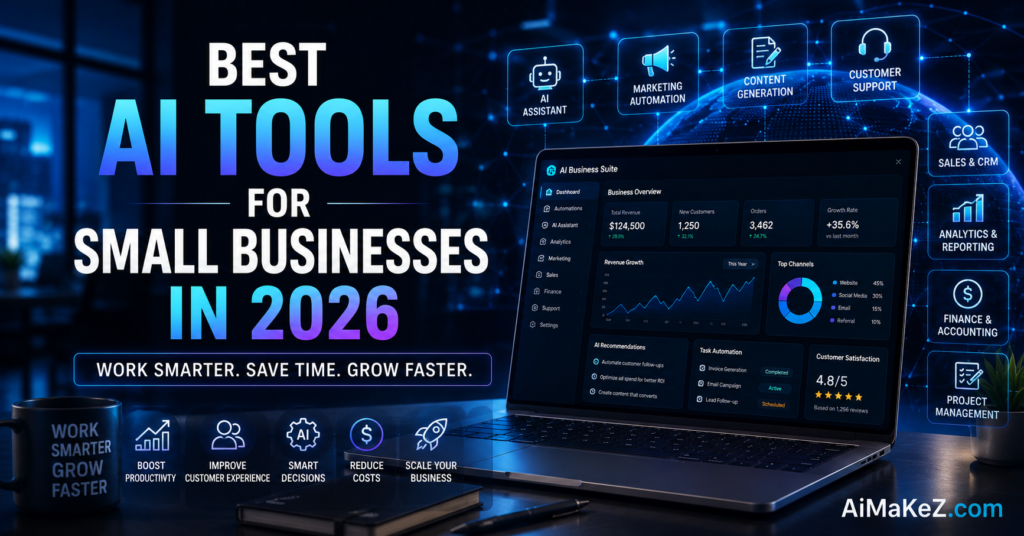
Benefits of Using AI Tools for Small Businesses
The advantages of integrating AI tools for small businesses into your operations go far beyond simple time savings:
Dramatic Cost Reduction
Hiring a full-time copywriter, social media manager, customer service rep, and data analyst could easily cost $200,000+ per year in combined salaries. AI tools for small businesses can handle a significant portion of these functions for a few hundred dollars per month. Small businesses that strategically deploy AI report reducing operational costs by 20–40% in the first year.
24/7 Availability
AI doesn’t sleep, take vacations, or call in sick. Your AI chatbot can answer customer questions at 3 AM. Your automated email sequences run on weekends. Your social media scheduler posts when your audience is most active, even if you’re on holiday. This always-on capability gives small businesses a competitive edge that used to be reserved for large corporations with global teams.
Data-Driven Decision Making
Many small business decisions are still made on gut instinct. AI tools for small businesses change this by giving you access to real-time analytics, customer behavior insights, and predictive forecasting. Tools like Google Analytics 4 with its AI insights feature and HubSpot’s reporting dashboards help you understand exactly what’s working, what’s not, and what to do next.
Faster Content Production
Content marketing is one of the most effective ways for small businesses to grow, but it’s also incredibly time-consuming. AI tools for small businesses focused on content can reduce the time it takes to produce a high-quality blog post from 8 hours to under 2. When you maintain consistency — publishing weekly instead of monthly — your organic traffic compounds significantly over time.
Personalization at Scale
Modern customers expect personalized experiences. AI tools for small businesses make it possible for even a two-person team to send personalized emails, show relevant product recommendations, and tailor messaging to individual customer segments — the same capabilities that large e-commerce brands spend millions building in-house.
How AI Tools Work for Small Businesses
Understanding the basics of how AI tools for small businesses work helps you use them more effectively and avoid common pitfalls.
Step 1 — Connect Your Data: Most AI tools start by ingesting your existing data — customer records, sales history, website analytics, email campaigns. The quality and quantity of your data directly impacts the quality of AI outputs.
Step 2 — Set Your Goals: Define what you want the AI to achieve. Are you trying to reduce customer support tickets? Generate more blog content? Improve email open rates? Clear objectives help you configure tools properly and measure success.
Step 3 — Train or Customize: Many AI tools allow you to customize their behavior — uploading brand guidelines, training chatbots on your product knowledge base, or creating custom content templates. This step is where good results become great results.
Step 4 — Monitor and Iterate: AI tools improve with feedback. Review outputs regularly, provide corrections, and refine your prompts or settings. The businesses that get the best results from AI are those that treat it as an ongoing collaboration, not a set-and-forget solution.
Real-World Use Cases for AI Tools for Small Businesses
E-Commerce: Automated Product Descriptions and Customer Support
A small Shopify store selling handmade candles leveraged AI tools for small businesses — specifically Jasper AI — to generate unique product descriptions for 200+ SKUs in a single afternoon, a task that would have taken weeks manually. They also deployed Tidio’s chatbot to handle shipping inquiries, reducing support emails by 60% within the first month. Revenue increased by 22% over the following quarter as the owner reinvested her time in product development.
Local Service Business: AI-Powered Appointment Scheduling
A dental practice in Denver integrated an AI scheduling assistant that automatically handles appointment bookings, sends reminders via SMS and email, and reschedules no-shows without any staff involvement. The practice reduced no-show rates from 18% to 6% and freed up two hours of front-desk time per day.
Freelance Agency: AI-Assisted Content Production
A three-person content agency in Austin started using ChatGPT plus Surfer SEO to scale output from 15 articles per month to 45 — without hiring additional writers. They maintained quality by having human editors review and refine all AI drafts. Their client retention improved because they could now offer faster turnaround and more competitive pricing.
Retail: Predictive Inventory Management
A boutique clothing retailer in Chicago implemented an AI inventory forecasting tool integrated with their POS system. The AI analyzed sales patterns, seasonal trends, and even local weather data to predict demand. They reduced overstock by 30% and stockouts by 45%, dramatically improving their cash flow and customer satisfaction scores.
Pros and Cons of AI Tools for Small Businesses
| Pros | Cons |
|---|---|
| Significantly reduces operational costs | Requires initial setup time and learning curve |
| Available 24/7 without additional cost | AI outputs can require human review and editing |
| Scales with your business without proportional cost increases | Subscription costs can add up across multiple tools |
| Improves consistency in customer communications | Over-reliance on AI can reduce personal touch |
| Provides data-driven insights previously only available to large enterprises | Data privacy concerns with third-party platforms |
| Dramatically speeds up content production | AI-generated content needs fact-checking |
| Enables personalization at scale | Not all tools integrate well with legacy software |
Pricing Overview
Here’s a realistic look at what you can expect to spend on AI tools for small businesses in 2026:
| Tool | Free Tier | Paid Plans Start At | Best For |
|---|---|---|---|
| ChatGPT | Yes (GPT-4o limited) | $20/month | All-around assistant |
| Jasper AI | 7-day trial | $39/month | Marketing content |
| HubSpot AI | Yes | $15/month/seat | CRM & sales |
| QuickBooks AI | 30-day trial | $30/month | Accounting |
| Tidio | Yes (50 AI chats) | $29/month | Customer service |
| Canva AI | Yes (limited) | $15/month | Visual content |
| Notion AI | Notion free | $10/month add-on | Productivity |
| Surfer SEO | No | $89/month | SEO optimization |
| Zapier | Yes (100 tasks) | $19.99/month | Workflow automation |
| Grammarly Business | Yes (basic) | $15/user/month | Communication |
A typical small business might spend between $100–$300/month on a curated stack of 3–5 AI tools, which is significantly less than the cost of a single part-time employee.
Comparison With Alternatives
When evaluating AI tools for small businesses, it’s worth understanding how they compare to traditional alternatives. The right AI tools for small business can save significant time and money versus conventional approaches:
AI Tools vs. Hiring Employees
Hiring covers tasks that require true human judgment, relationship building, and creative leadership. AI handles the high-volume, repetitive execution layer. The smartest small businesses use AI to eliminate low-value work so their human team can focus on what actually drives growth — client relationships, strategy, and innovation.
AI Tools vs. Traditional Software
Traditional software automates predefined workflows. AI software adapts, learns, and improves over time. For example, a traditional email marketing tool sends the same message to everyone. An AI email tool segments your list, personalizes every email, determines the best send time for each subscriber, and continuously optimizes based on engagement data.
AI Tools vs. Freelancers and Agencies
Freelancers and agencies bring specialized expertise, creativity, and accountability. AI tools bring speed, scale, and consistency. Many savvy small business owners use AI to handle volume and freelancers to handle quality control and strategy — getting the best of both worlds at a fraction of the cost of a full agency retainer.
Best Practices for Using AI Tools in Small Businesses
To maximize your ROI from AI tools for small businesses, follow these expert-backed recommendations:
Start With One Problem, Not One Tool
Don’t sign up for five AI tools at once and hope for the best. When adopting AI tools for small businesses, identify your single biggest pain point — whether that’s customer response time, content production, or expense tracking — and solve that first. Once you see results, expand strategically.
Always Apply the Human Review Layer
AI is a powerful assistant, not an infallible authority. Always have a human review AI-generated content, financial reports, and customer-facing communications before they go live. This protects your brand reputation and catches errors that AI systems still make.
Invest Time in Prompt Engineering
The quality of AI outputs is directly related to the quality of your inputs. Learning to write effective prompts — being specific about context, format, tone, and desired outcome — can dramatically improve results without spending a single extra dollar.
Measure ROI Consistently
Track the time saved, costs reduced, and revenue generated by each AI tool. If a $50/month tool saves you 10 hours of work per month at your effective hourly rate of $75, that’s a $700 monthly return on a $50 investment. These numbers justify expanding your AI stack and help you identify tools that aren’t delivering.
Common Mistakes to Avoid
Even well-intentioned adoption of AI tools for small businesses can go wrong. Here are the most common pitfalls small business owners fall into:
Using AI Without Clear Goals
Adopting AI because it’s trendy — without defining what success looks like — leads to wasted money and frustration. Before signing up for any tool, write down one specific, measurable goal it should help you achieve within 90 days.
Publishing AI Content Without Editing
Raw AI-generated content often lacks your brand voice, may contain factual errors, and can feel generic. Always edit for tone, accuracy, and personality before publishing. Google’s helpful content system penalizes content that provides little additional value beyond what AI generates automatically.
Ignoring Data Privacy Obligations
If you’re uploading customer data to AI platforms, you need to ensure this is permitted under your privacy policy and compliant with GDPR, CCPA, and any other regulations applicable to your business. Review the terms of service for every AI tool you use and consult a legal professional if you’re uncertain.
Tool Overload
It’s tempting to subscribe to every shiny new AI tool. But managing too many AI tools for small businesses creates complexity, increases costs, and makes it harder to measure what’s actually working. Curate your stack ruthlessly. Five well-integrated tools will outperform twenty loosely connected ones every time.
Expecting Instant Results
AI tools deliver compounding value over time, not overnight miracles. SEO content takes months to rank. Chatbots improve as they handle more conversations. Email automation gets smarter with more data. Set realistic timelines — 90 days for initial results, 6–12 months for transformative impact.
Frequently Asked Questions About AI Tools for Small Businesses
1. What is the best AI tool for a very small business or solopreneur?
For solopreneurs and micro-businesses, ChatGPT Plus ($20/month) combined with Canva AI ($15/month) offers the best value. These two AI tools for small businesses alone can handle content creation, customer communications, design work, research, and basic automation — covering the majority of your AI needs for $35/month. As your business grows, you can add specialized AI tools for small business needs like CRM, SEO, or accounting.
2. Are AI tools safe for small businesses to use?
Generally, yes — but with important caveats. Reputable AI tools from established vendors (OpenAI, HubSpot, Intuit, etc.) invest heavily in security and compliance. However, you should always review each tool’s privacy policy, avoid uploading sensitive personal data unless necessary, and ensure your use aligns with GDPR and CCPA obligations. Never share passwords, financial account details, or proprietary trade secrets with AI systems.
3. Can AI tools replace employees in a small business?
AI tools for small businesses can replace specific tasks but not complete roles — at least not in 2026. They’re most effective as force multipliers: enabling a small team to produce the output of a much larger team. Rather than replacing employees, the best approach is redeploying human talent toward higher-value activities that AI cannot replicate — relationship building, complex problem solving, and creative strategy.
4. How long does it take to see results from AI tools?
Results vary by tool and use case. Most AI tools for small businesses show measurable impact within weeks for customer-facing features like chatbots, while content marketing tools typically take 3–6 months to deliver significant organic traffic gains. CRM and sales automation tools usually demonstrate ROI within 60–90 days as lead management becomes more systematic. Set 90-day checkpoints to evaluate each tool’s contribution.
5. What is the most affordable AI tool stack for small businesses?
A highly effective and affordable AI stack for small businesses in 2026 would include: ChatGPT Free (GPT-4o, limited) for general tasks, HubSpot CRM Free for customer management, Canva Free for design, Tidio Free for basic chatbot functionality, and Zapier Free for 100 monthly automations. This zero-cost stack gives you a solid foundation to test AI adoption before investing in paid tiers.
Final Verdict: Which AI Tools for Small Businesses Are Worth Your Investment?
The landscape of AI tools for small businesses in 2026 is rich, mature, and genuinely transformative. What was once enterprise-only technology is now accessible to any business owner willing to spend an afternoon learning a new tool.
If you’re just starting out, the best AI tools for small business owners to begin with are ChatGPT and Canva AI — two tools that deliver immediate value across multiple business functions. Add HubSpot’s free CRM to manage customer relationships, and connect everything with Zapier to eliminate repetitive manual tasks. As your business grows and your needs become more specialized, layer in tools for SEO, accounting, and customer service.
The businesses that thrive over the next decade won’t necessarily be the ones with the biggest budgets — they’ll be the ones that most intelligently leverage AI to operate more efficiently, serve their customers better, and move faster than their competition. Start today, start small, and scale what works.
The AI advantage is available to everyone now. The only question is whether you’ll seize it.