If you’ve been exploring AI image generation tools lately, chances are you’ve come across Midjourney — and for good reason. This Midjourney review dives deep into everything you need to know about the platform in 2026: what’s new, how it works, how much it costs, and whether it’s still the best AI art generator on the market. Whether you’re a digital artist, marketer, content creator, or just curious about generative AI, this guide will help you decide if Midjourney is the right tool for your creative workflow.
Midjourney has evolved dramatically since its early days. In 2026, it’s not just a novelty — it’s a professional-grade creative tool used by agencies, game studios, fashion designers, and independent creators worldwide. But competition has never been fiercer. So, does Midjourney still hold the crown? Let’s find out.
Table of Contents
What Is Midjourney? (Midjourney Review Overview)
Midjourney is an AI-powered image generation platform that transforms text prompts into visually stunning artwork. Founded in 2022 by David Holz (co-founder of Leap Motion), Midjourney quickly became one of the most recognized names in generative AI, sitting alongside tools like DALL·E and Stable Diffusion.
Unlike many of its competitors, Midjourney has always prioritized aesthetic quality over raw realism. Its images carry a distinctive painterly quality — rich textures, strong compositions, and an almost cinematic feel that makes outputs feel crafted rather than computed. That reputation has only grown stronger in 2026 with the release of its latest model versions.
Midjourney operates primarily through a web interface at midjourney.com (having moved away from its earlier Discord-only model), making it far more accessible to mainstream users. It also retains Discord integration for users who prefer that workflow.
Key Features of Midjourney in 2026
In this Midjourney review, we’ve tested the platform extensively. Midjourney has packed its platform with features that cater to both beginners and professional artists. Here’s a breakdown of what makes it stand out in 2026:
1. Advanced Model Versions (V7 and Beyond)
Midjourney’s latest model delivers photorealistic outputs, improved hand rendering (a long-standing challenge for AI art), better text-in-image generation, and finer compositional control. The jump in quality from V5 to the current version is significant — prompts are interpreted more intelligently, and nuanced stylistic requests are handled with much greater accuracy.
2. Style Reference and Image Prompting
One of Midjourney’s most powerful features is the ability to use an existing image as a style reference. You can upload a photo, illustration, or artwork and instruct Midjourney to generate new images that match its visual style — without copying the original. This is invaluable for brand consistency and creative projects that require a cohesive look.
3. Character Consistency (Cref)
Character reference functionality allows users to generate multiple images featuring the same character across different scenes and poses. This is a game-changer for storytellers, comic creators, and game developers who need consistent character design without re-describing features in every prompt.
4. Personalization Engine
Midjourney’s personalization feature learns from your preferences over time. By rating pairs of images, you build a personal aesthetic profile that influences all future generations. The result? Outputs that align with your tastes without requiring elaborate prompt engineering every time.
5. Web-Based Interface and Image Editor
The dedicated web app now includes a built-in image editor, allowing users to make inpainting edits (changing specific regions of an image), zoom out (outpainting), and adjust generated images directly in the browser. This removes the need for third-party editing tools for many common workflows.
6. Aspect Ratio and Resolution Control
Users can generate images in a wide range of aspect ratios — from ultra-wide cinematic formats to portrait social media dimensions — with upscale options delivering high-resolution outputs suitable for print. This flexibility makes Midjourney practical for everything from Instagram posts to billboard-scale artwork.
7. Niji Mode for Anime and Illustration
Niji is a specialized model mode co-developed with Spellbrush, optimized for anime, manga, and stylized illustration aesthetics. It’s deeply popular in the Japanese creative community and among Western artists who work in anime-inspired styles.
Benefits of Using Midjourney
Beyond individual features, our Midjourney review found there are broader strategic benefits to incorporating Midjourney into your creative workflow:
Speed and scale: Generating a high-quality concept image that would take a human artist hours (or days) now takes seconds. For agencies and studios running on tight deadlines, this is transformative.
Reduced production costs: Stock photography subscriptions, hiring illustrators for initial concept work, and mood board creation all become significantly cheaper when Midjourney handles visual drafts.
Creative exploration: Midjourney acts as a rapid ideation engine. You can explore dozens of visual directions in minutes, identify what resonates, and refine from there. This iteration speed is something no traditional creative process can match.
Democratization of design: You don’t need formal design training to produce professional-looking visuals. A marketing manager, blogger, or educator can create compelling imagery without outsourcing — lowering the barrier to high-quality content production.
Unique, royalty-free outputs: Paid Midjourney subscribers own the images they generate (subject to Midjourney’s terms), which means no licensing headaches or stock photo restrictions.
How Midjourney Works: Step-by-Step
Getting started with Midjourney is more straightforward in 2026 than ever before. In our Midjourney review testing, here’s how the process works:
Step 1: Create an Account
Visit midjourney.com and sign up using your Google account or email. A free trial is available for new users, giving you a limited number of image generations to test the platform before committing to a paid plan.
Step 2: Write Your Prompt
Navigate to the image creation interface and type a text prompt describing what you want to see. Good prompts are descriptive but focused — include subject, style, mood, lighting, and composition details. For example: “A futuristic city at sunset, cyberpunk aesthetic, neon reflections on wet streets, cinematic wide shot, highly detailed”.
Step 3: Add Parameters (Optional)
You can fine-tune your generation with parameters like aspect ratio (--ar 16:9), model version (--v 7), stylize level (--s 750), and chaos level (--chaos 20). These give you granular control over the output without requiring a completely different prompt.
Step 4: Review and Iterate
Our Midjourney review found this step crucial: Midjourney generates four image variations simultaneously. You can upscale your favorite, generate variations of a specific image, or modify your prompt and regenerate. The iterative workflow is fast — most generations complete in 20–60 seconds.
Step 5: Download and Use
Once you’re satisfied, download your image in full resolution. Paid subscribers get access to higher resolution upscales and can use images commercially according to Midjourney’s licensing terms.
Real-World Use Cases
Our Midjourney review confirms the platform’s versatility — it’s applicable across a surprisingly wide range of industries and creative disciplines:
Marketing and Advertising
One of the key findings in our Midjourney review: marketing teams use Midjourney to produce campaign concepts, social media visuals, and ad creatives at a fraction of traditional production costs. A small e-commerce brand can generate product lifestyle imagery, seasonal campaign artwork, and branded backgrounds without hiring a photographer or creative agency.
Game Development and Concept Art
A Midjourney review would be incomplete without mentioning game development: indie studios and AAA teams alike use Midjourney for rapid concept art generation — characters, environments, UI elements, and mood boards. It dramatically shortens the pre-production phase, allowing teams to lock in a visual direction early and focus artistic resources on final asset production.
Interior Design and Architecture
As our Midjourney review discovered, interior designers use Midjourney to quickly visualize room layouts, color schemes, and furniture arrangements for clients. Architects generate exterior and interior renders for presentations before any detailed 3D modeling work begins.
Content Creation and Blogging
The Midjourney review also highlights how bloggers, newsletter writers, and YouTubers use Midjourney to create custom thumbnail images, article featured images, and social media graphics — giving their content a distinctive visual identity without relying on generic stock photos.
Fashion and Product Design
Fashion designers use Midjourney to sketch out collection concepts and trend directions. Product designers explore form, material, and color combinations visually before committing to prototyping. The platform has become a standard tool in fashion schools and design programs.
Education and Training
This Midjourney review would be incomplete without mentioning education: educators create custom illustrations for course materials, textbooks, and presentations. Corporate trainers generate scenario-based imagery for e-learning content. Historical scenes, scientific diagrams, and conceptual visualizations that would once require commissioned artwork can now be produced in minutes.
Pros and Cons
No tool is perfect. In our Midjourney review, here’s an honest look at what Midjourney does well — and where it still falls short:
| Pros | Cons |
|---|---|
| Best-in-class image quality and aesthetic consistency | No truly free plan — trial is very limited |
| Powerful style reference and character consistency features | Prompt engineering has a learning curve |
| Clean, accessible web interface in 2026 | Limited direct API access for developers |
| Niji mode for anime/illustration styles | Content policy restricts some creative requests |
| Active community and extensive prompt libraries | No native video generation (as of mid-2026) |
| Strong commercial licensing for paid users | Image editor is still less powerful than dedicated tools |
| Personalization engine improves output over time | Queue times can be slow on Basic plan |
Midjourney Review: Pricing Plans for 2026
Midjourney offers four subscription tiers. Here’s a breakdown of each plan and what you get:
| Plan | Monthly Price | Annual Price (per month) | GPU Minutes/Month | Commercial Use |
|---|---|---|---|---|
| Basic | $10/mo | $8/mo | ~200 fast generations | Yes |
| Standard | $30/mo | $24/mo | ~900 fast generations | Yes |
| Pro | $60/mo | $48/mo | ~1,800 fast generations + Stealth mode | Yes |
| Mega | $120/mo | $96/mo | ~3,600 fast generations + Stealth mode | Yes |
All paid plans include unlimited “relax mode” generations (slower queue). The Pro and Mega plans include Stealth Mode, which keeps your generated images private and not visible on the public Midjourney gallery — essential for commercial work on confidential projects. Annual billing saves 20% compared to month-to-month pricing.
For most individual creators, the Standard plan at $30/month hits the sweet spot of affordability and output volume. Agencies and power users will likely find the Pro or Mega plan necessary to maintain fast generation speeds at scale.
Midjourney Review: Comparing vs. Top Alternatives in 2026
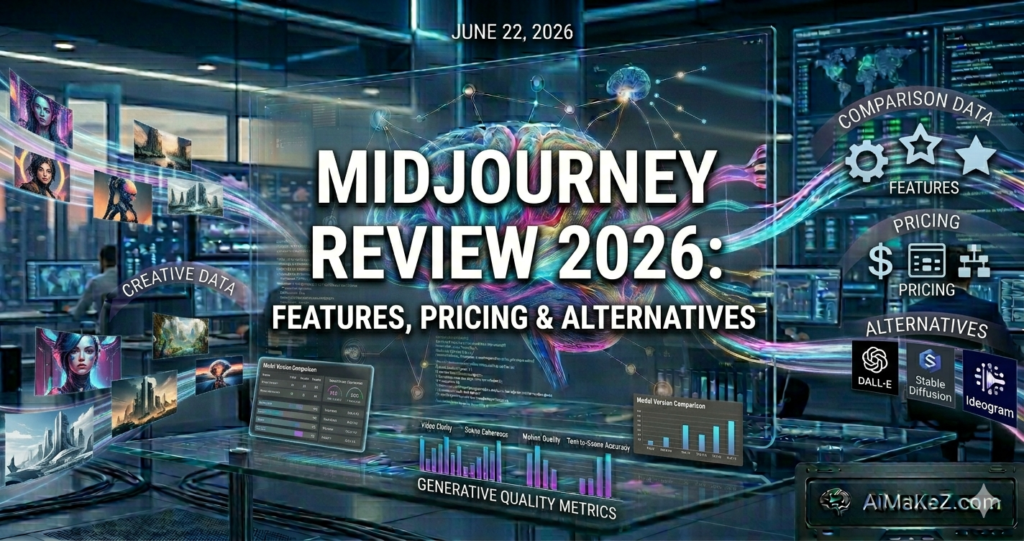
A key part of any Midjourney review is comparing it to alternatives. The AI image generation space has become increasingly competitive. Here’s how Midjourney stacks up against its main rivals in 2026:
Midjourney vs. DALL-E 3 (OpenAI)
When comparing tools for this Midjourney review, DALL-E 3, integrated into ChatGPT and available via the OpenAI API, excels at following precise text instructions and generating images with accurate text overlays. However, Midjourney generally produces more visually striking, aesthetically refined results. DALL-E 3 is more accessible (included in ChatGPT Plus) but lacks the depth of control and stylistic sophistication that Midjourney offers to advanced users.
Midjourney vs. Stable Diffusion
For this Midjourney review comparison, Stable Diffusion remains the go-to option for users who want maximum control and a fully local, open-source workflow. You can run it on your own hardware with no subscription fees and access a vast ecosystem of custom models and LoRAs. The trade-off? A steep technical learning curve and hardware requirements. Midjourney is far easier to use and produces consistently excellent results without any local setup.
Midjourney vs. Adobe Firefly
Adobe Firefly is deeply integrated into the Creative Cloud ecosystem (Photoshop, Illustrator, Express), making it an obvious choice for existing Adobe users. Its strength lies in commercially safe, IP-trained content that’s designed to integrate seamlessly into design workflows. Midjourney still wins on raw image quality and creative range, but Firefly’s integration advantage is real for professionals already working in Adobe’s tools.
Midjourney vs. Ideogram and Flux
Ideogram has carved out a niche as the best AI image tool for text-in-image generation — creating posters, logos, and graphics that require readable, stylized text. Flux (from Black Forest Labs) emerged as a strong open-source competitor with impressive photorealistic output. Neither fully matches Midjourney’s artistic output quality across diverse styles, but both are strong for specific use cases.
| Tool | Best For | Starting Price | Image Quality | Ease of Use |
|---|---|---|---|---|
| Midjourney | Artistic quality, creative work | $10/mo | 5/5 | 4/5 |
| DALL-E 3 | Instruction-following, text | $20/mo (ChatGPT+) | 4/5 | 5/5 |
| Stable Diffusion | Full control, no cost | Free (self-hosted) | 4/5 | 2/5 |
| Adobe Firefly | Adobe workflow integration | Included in CC | 4/5 | 5/5 |
| Ideogram | Text-in-image, posters | Free tier available | 4/5 | 4/5 |
Midjourney Review: Best Practices for Getting Great Results
Our Midjourney review found that getting consistently excellent results from Midjourney is part art, part science. Here are expert recommendations to maximize your output quality:
Be specific but not overwhelming. Include the most important visual elements — subject, setting, lighting, color palette, mood, and style — but avoid stuffing your prompt with too many competing ideas. A focused prompt almost always beats a sprawling one.
Use style references liberally. Uploading a reference image alongside your text prompt is one of the most reliable ways to get results that match your vision. Whether it’s a specific art style, a color palette you love, or a compositional approach, visual references communicate things that words struggle to capture.
Leverage the personalization feature. Spend 20-30 minutes rating image pairs in the personalization section. This trains Midjourney to align with your aesthetic preferences and makes every subsequent generation feel more “on-brand” for your style.
Iterate systematically. Don’t abandon a direction after one attempt. Use the variation buttons to explore the space around a promising result. Small prompt tweaks — changing one adjective, adjusting the stylize parameter — can produce dramatically different outputs from the same core concept.
Study community prompts. The Midjourney community feed and prompt libraries on sites like PromptHero are invaluable resources. Seeing what prompts produce what results accelerates your learning faster than any tutorial.
Use negative prompting sparingly. The –no parameter (e.g., –no text, watermark, blurry) helps exclude unwanted elements, but overusing it can constrain the model. Add negative prompts only when you’re consistently getting elements you don’t want.
Midjourney Review: Common Mistakes to Avoid
Our comprehensive Midjourney review found that even experienced users fall into these traps. Knowing them in advance will save you time and frustration:
Writing vague prompts. “A nice landscape” tells Midjourney almost nothing. “A misty Scottish highland at dawn, rolling hills covered in heather, soft golden light breaking through low clouds, moody and atmospheric, shot on a medium format camera” gives it something to work with. Specificity produces quality.
Ignoring aspect ratio. By default, Midjourney generates square images. If you need a banner, a social post, or a print-ready image, always specify your aspect ratio from the start — –ar 16:9, –ar 4:5, etc. Cropping after the fact always degrades the composition.
Overlooking the stylize parameter. The –s (stylize) parameter controls how strongly Midjourney applies its artistic interpretation. The default is 100, but values between 200-750 often produce noticeably more refined, polished results. Many users leave this at default and wonder why their outputs look flat.
Not using the web editor for refinements. Many users download an almost-right image and take it to Photoshop when Midjourney’s built-in inpainting editor could fix it in seconds. The “vary (region)” tool lets you select and regenerate specific areas of an image — use it before reaching for external tools.
Assuming all AI art is copyright-free. Midjourney’s terms grant commercial rights to paid subscribers, but the legal landscape around AI-generated content and copyright continues to evolve. Always review the current terms and consider whether specific outputs might incorporate protected visual elements before commercial use.
Skipping Niji mode for illustrated styles. If you’re creating anime, manga, or stylized cartoon content, always use Niji mode (–niji 6 as of 2026). Generating anime-style content in the standard model produces noticeably inferior results compared to the purpose-built Niji model.
Midjourney Review: Frequently Asked Questions
Is Midjourney free to use in 2026?
Midjourney occasionally offers limited free trials for new users, but there is no ongoing free plan. To generate images consistently, you need a paid subscription starting at $10/month for the Basic plan. The trial typically includes around 25 free image generations, which is enough to evaluate the platform before committing.
Can I use Midjourney images commercially?
Yes — paid subscribers can use Midjourney-generated images for commercial purposes, including in products, marketing materials, and client work. However, organizations with annual gross revenues exceeding $1,000,000 may need to use the Pro or Mega plan to maintain commercial rights. Always check Midjourney’s current terms of service for the most up-to-date licensing details.
What is the best Midjourney plan for beginners?
For most beginners, the Standard plan at $30/month is the best starting point. It provides enough fast GPU time for active daily use, includes unlimited relax-mode generations, and supports commercial use. The Basic plan at $10/month is workable but may feel limiting once you start experimenting seriously. If you’re still evaluating, start with the trial and upgrade to Standard once you’re sure Midjourney fits your workflow.
How does Midjourney compare to Adobe Firefly?
Midjourney and Adobe Firefly serve different primary audiences. Midjourney excels in artistic quality, stylistic range, and creative exploration — it’s the better choice for artists, content creators, and agencies focused on high-quality visual output. Adobe Firefly is more tightly integrated into the Creative Cloud workflow, making it the better choice for designers already working within Photoshop and Illustrator. For pure image quality and creative versatility, Midjourney currently leads.
Does Midjourney support video generation?
As of mid-2026, Midjourney remains focused on still image generation and does not offer native video generation. For AI video, tools like Sora (OpenAI), Runway Gen-3, and Kling are the current leaders. However, Midjourney has hinted at expanding into animated and video content in future updates — watch the official blog and Discord server for announcements.
Final Midjourney Review Verdict: Is It Worth It in 2026?
After this comprehensive Midjourney review, the conclusion is clear: Midjourney remains the gold standard for AI image generation quality in 2026. Its combination of exceptional aesthetic output, powerful style and character consistency features, an improved web interface, and a growing toolset makes it the top choice for creative professionals and serious enthusiasts alike.
Is this Midjourney review verdict final? Yes, though note that it’s not perfect. The lack of a robust free tier, limited API access, and no native video generation are real limitations. But for the core use case — generating beautiful, commercially usable imagery from text prompts — nothing currently matches Midjourney’s output quality and creative range at scale.
Based on our Midjourney review, if you’re a designer, marketer, content creator, or anyone who regularly needs high-quality visual assets, the $30/month Standard plan is one of the most cost-effective creative investments available right now. The time savings alone — compared to commissioning artwork, shooting photography, or sourcing stock images — make it worth several times its price for active users.
Our recommendation: Start with the free trial, run through 10-15 varied prompts, and pay attention to how the output quality compares to anything else you’ve tried. There’s a strong chance you’ll be upgrading to a paid plan before the trial ends.
Looking for more AI tool reviews? Check out our comprehensive guides on AI image generation tools and the latest innovations in artificial intelligence on AiMaKeZ.com.
Disclaimer: Pricing and features are based on information available as of June 2026. Always verify current plans and licensing terms directly on Midjourney’s official website before subscribing.