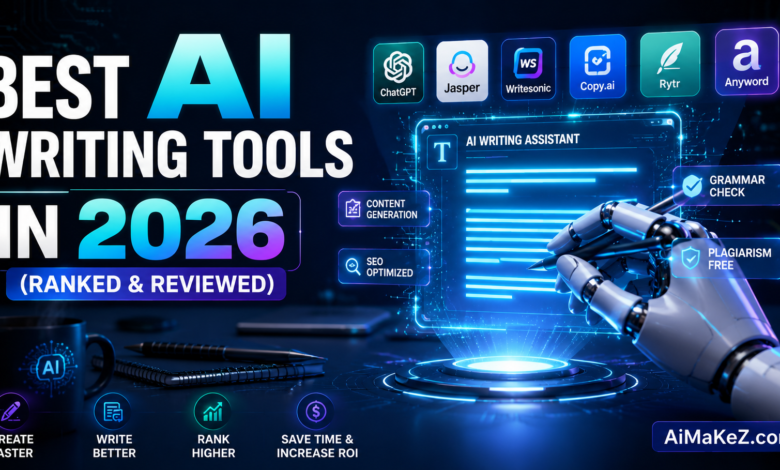
Finding the best AI writing tools in 2026 is no longer optional — it’s a competitive necessity. Whether you’re a solo blogger, a content marketing team in New York, a startup founder in Berlin, or a freelance copywriter in London, AI-powered writing assistants have fundamentally changed the speed, scale, and quality of content production. But with dozens of platforms flooding the market, choosing the right tool feels overwhelming.
This guide cuts through the noise. We’ve tested, ranked, and reviewed the best AI writing tools available right now, evaluating them on output quality, SEO capability, ease of use, pricing, and real-world performance — so you don’t have to start from scratch.
Table of Contents
What Are AI Writing Tools?
AI writing tools are software platforms powered by large language models (LLMs) — the same underlying technology behind GPT-4o, Claude 3.5, and Gemini 1.5 — that help humans plan, draft, edit, and optimize written content. They range from simple text generators to sophisticated content intelligence platforms capable of producing SEO-optimized blog posts, sales emails, social media captions, product descriptions, ad copy, and even technical documentation.
What separates 2026’s generation of best AI writing tools from earlier versions is context awareness. Modern tools don’t just string words together — they understand tone, brand voice, audience intent, and even SERP (Search Engine Results Page) competition. Some platforms now integrate directly with your CMS, pulling real-time search data to inform the content they produce.
Think of these tools not as replacements for human writers, but as force multipliers. A skilled writer using a top-tier AI writing assistant can produce three to five times more content per week without sacrificing quality — and often while improving consistency.
Key Features to Look For in the Best AI Writing Tools
Before diving into specific platforms, it’s worth understanding what separates the best AI writing tools from mediocre ones. Here are the features that genuinely matter when choosing the right best AI writing tools for your workflow in 2026.
Output Quality and Naturalness
The most important metric. Can the tool produce content that reads like a knowledgeable human wrote it? Look for platforms that avoid repetitive sentence structures, use varied vocabulary, and can adapt tone across different content types — from academic writing to punchy ad copy.
SEO Integration
The best tools in 2026 go beyond basic keyword insertion. They analyze SERP data, suggest semantic keywords, check content against top-ranking articles, and optimize for Google’s EEAT signals. Platforms that integrate with tools like Surfer SEO, Semrush, or Ahrefs give you a meaningful competitive edge.
Brand Voice and Memory
One of the biggest pain points in 2024–2025 was inconsistency. Leading tools now let you define your brand voice, upload previous content as style references, and maintain consistency across hundreds of pieces. This is particularly valuable for agencies managing multiple clients.
Workflow Integrations
Publishing workflows need to be frictionless. Look for native integrations with WordPress, HubSpot, Shopify, Google Docs, Notion, and Slack. The fewer copy-paste steps between drafting and publishing, the faster your team moves.
Plagiarism Detection and Fact-Checking
With AI-generated content proliferating, Google’s quality signals are sharper than ever. Tools that include built-in plagiarism checking and flag potentially inaccurate claims help maintain the trust your audience has placed in your brand.

Best AI Writing Tools in 2026 (Ranked & Reviewed)
1. Jasper AI — Best for Enterprise Content Teams
Jasper has consistently held its place as one of the most capable best AI writing tools for professional content teams, and its 2026 iteration is the most polished version yet. Built on a proprietary fine-tuned model trained on marketing and conversion-focused content, Jasper excels at producing high-converting blog posts, email sequences, landing page copy, and long-form articles.
What makes Jasper stand out is its Brand Voice system. You can train Jasper on your existing content, define your target audience, and set tone parameters — then watch it produce output that genuinely sounds like your brand. For content managers overseeing teams of writers and AI, this consistency is invaluable.
Best for: Marketing teams, agencies, and enterprises producing high volumes of content across multiple channels.
Standout features: Brand Voice training, Jasper Art integration, 50+ content templates, deep Surfer SEO integration, team collaboration workspace, and multi-language support in 30+ languages.
Pricing: Creator plan starts at $49/month; Pro plan at $69/month; Business pricing is custom. A 7-day free trial is available.
2. Copy.ai — Best for Sales and Marketing Copy
Copy.ai made its name generating short-form marketing copy fast, and in 2026 it’s expanded significantly into long-form territory with its GTM (Go-To-Market) AI platform. What used to be a simple ad copy generator is now a full-stack marketing automation hub that can run entire content workflows.
Its “Workflows” feature is genuinely impressive — you can set up automated pipelines that pull data from your CRM, generate personalized outreach emails, produce SEO blog posts, and push content to your publishing platforms, all with minimal manual input. For sales and marketing teams, this translates to measurable time savings.
Best for: Sales teams, growth marketers, and B2B content operations.
Standout features: GTM Workflows automation, infobase memory, 90+ templates, CRM integrations, and a generous free tier.
Pricing: Free plan available; Starter at $36/month; Advanced at $186/month; Enterprise pricing on request.
3. Writesonic — Best for SEO Blog Content
Writesonic has carved out a strong niche as the go-to AI writer for bloggers and SEO content teams. Its AI Article Writer 6.0 is a standout feature — capable of producing well-structured, factually grounded articles that are optimized for search intent. The platform integrates with Google Search Console, letting it pull real performance data to inform content recommendations.
Chatsonic, Writesonic’s conversational AI component, now includes real-time web access and image generation, making it a versatile all-in-one assistant for content researchers. For anyone building out a content cluster strategy in 2026, Writesonic’s topic clustering and internal linking suggestions are worth the subscription alone.
Best for: SEO bloggers, content strategists, and digital marketing agencies focused on organic growth.
Standout features: AI Article Writer 6.0, Chatsonic with web access, Google Search Console integration, bulk article generation, and factual accuracy checks.
Pricing: Free plan with 25 credits; Individual at $20/month; Standard at $99/month; Enterprise pricing available.
4. ChatGPT (OpenAI) — Best All-Around AI Writing Assistant
It’s impossible to rank the best AI writing tools without acknowledging ChatGPT’s dominance. Powered by GPT-4o and the newer GPT-4.5 architecture, ChatGPT in 2026 is a remarkably versatile writing partner. Its ability to switch between creative writing, technical documentation, persuasive copy, and casual conversation within a single session gives it an edge for users who need flexibility above all else.
The memory features introduced in 2025 have made ChatGPT dramatically more useful for ongoing projects. It remembers your preferred tone, your business context, and past conversations, reducing the need to re-explain your requirements every session. The GPT Store also provides access to hundreds of specialized writing GPTs built by the community.
Best for: Individuals, freelancers, and teams who need a flexible, multi-purpose writing assistant.
Standout features: GPT-4o and GPT-4.5 models, persistent memory, voice mode, image generation, code interpreter, custom GPTs, and extensive plugin ecosystem.
Pricing: Free tier available; ChatGPT Plus at $20/month; Team at $30/user/month; Enterprise pricing available.
5. Claude (Anthropic) — Best for Long-Form and Nuanced Writing
Claude has emerged as a favorite among professional writers, researchers, and editors who prioritize depth, nuance, and analytical quality over raw speed. Built by Anthropic with a strong emphasis on safety and accuracy, Claude 3.5 Sonnet and Claude 3.5 Haiku offer some of the most human-like outputs of any model available in 2026.
Where Claude truly shines is in long-context tasks. With a 200,000-token context window, you can feed it entire manuscripts, research papers, or lengthy briefs and receive coherent, deeply considered responses. Editors and researchers working on white papers, case studies, or in-depth editorial content regularly cite Claude as their preferred tool.
Best for: Writers, researchers, editors, and anyone who needs thoughtful, long-form content generation with minimal hallucination.
Standout features: 200K token context window, exceptional instruction-following, nuanced tone control, strong factual accuracy, and outstanding summarization capabilities.
Pricing: Free tier available; Claude Pro at $20/month; Claude Team at $30/user/month; Enterprise pricing available.
6. Rytr — Best Budget AI Writing Tool
For solopreneurs, students, and small business owners who need solid AI writing assistance without a large monthly bill, Rytr delivers exceptional value. It’s not the most powerful tool on this list, but for generating social media posts, email subject lines, product descriptions, and short blog intros, it punches well above its price point.
Rytr’s interface is clean and beginner-friendly, making it an ideal entry point for anyone new to AI writing tools. The tone selector covers 20 different writing tones, and the use-case library includes over 40 templates ranging from job descriptions to YouTube video descriptions.
Best for: Freelancers, students, small business owners, and anyone on a tight budget.
Standout features: 40+ use case templates, 20 writing tones, built-in plagiarism checker, Chrome extension, and support for 30+ languages.
Pricing: Free plan (10,000 characters/month); Saver at $9/month; Unlimited at $29/month.
7. Surfer SEO (with AI) — Best for Data-Driven SEO Content
Surfer SEO isn’t purely an AI writing tool — it’s a content intelligence platform that happens to include powerful AI writing capabilities. In 2026, its AI-powered content editor analyzes your target keyword against hundreds of ranking pages, then generates or scores your content based on NLP keyword usage, content structure, word count, and topical authority.
If you’re serious about organic search performance, Surfer’s combination of data-driven content briefs and AI writing assistance is hard to beat. The Content Score feature gives you a real-time gauge of how likely your article is to rank, and the AI handles first-draft generation based on winning SERP patterns.
Best for: SEO specialists, content marketers, and agencies focused on data-driven organic growth strategies.
Standout features: Real-time Content Score, NLP keyword analysis, SERP analyzer, competitor gap analysis, AI outline builder, and content audit tool.
Pricing: Essential at $99/month; Scale at $219/month; Scale AI at $289/month; Enterprise available.
Comparison Table: Best AI Writing Tools in 2026
| Tool | Best For | Starting Price | Free Plan | SEO Features | Long-Form |
|---|---|---|---|---|---|
| Jasper AI | Enterprise teams | $49/mo | Trial only | ★★★★★ | ★★★★★ |
| Copy.ai | Sales & marketing | $36/mo | Yes | ★★★★☆ | ★★★★☆ |
| Writesonic | SEO bloggers | $20/mo | Yes | ★★★★★ | ★★★★★ |
| ChatGPT | All-around use | Free / $20/mo | Yes | ★★★☆☆ | ★★★★☆ |
| Claude | Long-form & research | Free / $20/mo | Yes | ★★★☆☆ | ★★★★★ |
| Rytr | Budget users | $9/mo | Yes | ★★★☆☆ | ★★★☆☆ |
| Surfer SEO | Data-driven SEO | $99/mo | No | ★★★★★ | ★★★★☆ |
Pricing Overview: What to Expect in 2026
Best AI writing tools pricing has become more competitive as the market has matured. Most platforms now offer a free tier or free trial to reduce the barrier to entry, which is a significant shift from 2023 when almost every serious best AI writing tools option required upfront payment.
Budget-conscious users can start with ChatGPT’s free plan, Claude’s free tier, or Rytr’s 10,000-character monthly allowance. These free plans are functional for light use but will quickly hit their limits if you’re producing content at scale. Mid-tier subscriptions in the $20–$49 range are the sweet spot for individual content creators and small teams, offering meaningful generation limits, SEO features, and brand customization. Enterprise solutions from Jasper and Surfer, while pricey, include collaboration features, API access, and dedicated support that justify the cost for larger operations.
One important note on pricing: most tools price per seat or per word generated, so your actual cost depends heavily on your content volume. Always calculate cost-per-article before committing to a plan.
Real-World Use Cases for AI Writing Tools
Content Marketing and SEO Blogging
A mid-sized e-commerce brand selling outdoor gear used Writesonic and Surfer SEO together to scale their blog from 10 articles per month to 45, without adding headcount. Their organic traffic grew 312% in 8 months by targeting long-tail keywords with AI-assisted content. This kind of result is increasingly common for teams that combine AI generation with human editorial oversight.
Email Marketing and Outreach
A SaaS startup’s sales team cut email writing time by 70% using Copy.ai’s Workflows to generate personalized cold outreach sequences. By connecting their CRM data to the AI workflow, they could generate industry-specific, role-specific emails at scale — something that previously required a full-time copywriter.
Education and Research
University educators and research teams are increasingly using Claude for literature review summarization, research synthesis, and academic writing assistance. Its large context window makes it uniquely suited to processing and synthesizing long-form academic sources without losing coherence.
E-Commerce Product Descriptions
Online retailers with large catalogs use AI writing tools to generate hundreds of unique, SEO-optimized product descriptions in hours rather than weeks. Jasper’s Product Description template, combined with brand voice settings, produces consistent copy that reduces bounce rates and improves conversion.
Social Media and Short-Form Content
Social media managers use tools like Rytr and Copy.ai to maintain consistent posting schedules across LinkedIn, Instagram, and X (formerly Twitter) without burning out. A single blog post can be atomized into 10–15 social media variations using these tools in under 20 minutes.
Best Practices for Using AI Writing Tools in 2026
Getting the most out of any AI writing assistant comes down to how you use it, not just which one you choose. Here are expert-level recommendations that separate power users from casual ones.
Always start with a detailed brief. The quality of your AI output is directly proportional to the quality of your input. A vague prompt like “write a blog post about SEO” will produce generic content. A detailed brief specifying target audience, primary keyword, desired tone, key points to cover, and competitor articles to differentiate from will produce significantly better results.
Use AI for first drafts, humans for final edits. The best content operations treat AI as a speed layer, not a replacement for editorial judgment. Use AI to get from zero to 80% quickly, then apply human editing for accuracy, voice refinement, and fact verification. This hybrid approach consistently produces the highest-quality content.
Build and maintain a brand voice document. Before relying on any AI writing tool heavily, document your brand’s tone, vocabulary preferences, writing style, and audience personas in detail. Upload this to tools that support it (Jasper, Copy.ai) and reference it in prompts for tools that don’t.
Verify facts before publishing. AI models can confidently state incorrect information. Always fact-check statistics, quotes, product claims, and any technical details before they go live. Your credibility depends on it.
Integrate AI into your existing workflow. The biggest productivity gains come from embedding AI tools into your existing publishing workflow rather than treating them as standalone tools. Connect your AI writer to your CMS, your SEO platform, and your editorial calendar.

Common Mistakes to Avoid with AI Writing Tools
Publishing AI output without editing. Unedited AI content is often detectable, legally risky (for factual errors), and inconsistent in quality. Google’s quality raters are trained to evaluate EEAT signals that raw AI output frequently fails to demonstrate. Every piece needs a human pass before it goes live.
Ignoring AI detection risk. While AI detection tools are imperfect, major publishing platforms, academic institutions, and enterprise clients increasingly screen for AI-generated content. Writing that’s too formulaic or lacks genuine expertise signals can damage your brand’s reputation. Humanize your content through specific examples, personal perspective, and editorial polish.
Over-relying on a single tool. Different AI writing tools have different strengths. Experienced content teams often use two or three tools in combination — perhaps Surfer for SEO briefs, Claude for drafting, and Copy.ai for ad variations — rather than forcing a single tool to handle everything.
Skipping the prompt engineering learning curve. Many users underestimate how much better results become with refined prompting techniques. Learning to use chain-of-thought prompting, role assignment, and few-shot examples dramatically improves output quality across every tool.
Choosing based on price alone. The cheapest tool rarely delivers the best ROI. A $9/month tool that produces content requiring three hours of editing per article is more expensive, in real terms, than a $49/month tool that delivers publish-ready drafts in 20 minutes.
Frequently Asked Questions About AI Writing Tools
What is the best AI writing tool for beginners in 2026?
For beginners, ChatGPT and Rytr are the easiest entry points. ChatGPT offers a free plan with an intuitive conversational interface that requires no setup or templates — just type what you need. Rytr is a close second for beginners who want guided templates for specific content types like blog posts, emails, or product descriptions. Both platforms have gentle learning curves and don’t require any technical knowledge to start producing useful content.
Are AI writing tools good for SEO content?
Yes, but with important caveats. Tools like Writesonic, Jasper, and Surfer SEO are specifically optimized for SEO content creation, incorporating keyword research, semantic analysis, and SERP data directly into the writing process. However, no AI tool guarantees rankings — content quality, topical authority, backlinks, and technical SEO all still matter. AI tools accelerate the content production side of SEO; they don’t replace a holistic SEO strategy.
Can Google detect AI-written content?
Google’s official stance is that it focuses on content quality, helpfulness, and EEAT signals — not specifically on whether a human or AI wrote the content. That said, low-quality, formulaic AI content that lacks genuine expertise or original insight tends to underperform in search. High-quality AI-assisted content that demonstrates real knowledge, is fact-checked, and reflects genuine experience can rank very well. The key is quality and helpfulness, not the production method.
How much does a good AI writing tool cost per month?
For individual creators and freelancers, expect to pay between $20–$50 per month for a solid mid-tier AI writing tool with meaningful generation limits. Small teams typically spend $100–$200 per month for plans that include collaboration features, brand voice tools, and higher usage caps. Enterprise solutions from platforms like Jasper can run several hundred dollars monthly, but include dedicated support, API access, and team management features that justify the cost for high-volume operations.
What’s the difference between ChatGPT and specialized AI writing tools like Jasper?
ChatGPT is a general-purpose AI assistant — incredibly flexible, but not specifically optimized for marketing or SEO content workflows. Specialized tools like Jasper are built on top of foundation models (often OpenAI’s) but add layers specifically for content marketers: pre-built templates for dozens of content types, brand voice training, direct SEO integrations, team collaboration features, and a structured workflow designed for content production at scale. For a freelancer producing occasional content, ChatGPT is often sufficient. For a marketing team producing 50+ pieces monthly, a specialized tool typically delivers more consistent, workflow-friendly results.
When evaluating the best AI writing tools for your specific needs, consider how each platform handles your particular content type. For a deep comparison of the underlying AI models powering these tools, see our detailed guide on ChatGPT Review 2026 and our Claude AI Review 2026. These platform-specific breakdowns will help you understand the technical capabilities behind each writing assistant.
According to Semrush’s State of Content Marketing report, 68% of content teams now use AI writing tools as a core part of their production workflow — and teams that do so report a 47% increase in content output. This data underscores why choosing the right platform matters so much in 2026.
Industry research from Content Marketing Institute also shows that brands using integrated AI writing tools alongside human editors consistently outperform those relying solely on human-written content when it comes to publishing frequency and keyword coverage.
Choosing from the best AI writing tools in 2026 ultimately comes down to matching the tool’s strengths with your content operation’s needs. Whether you prioritize SEO optimization, long-form quality, automation, or budget efficiency, the landscape of best AI writing tools available today offers an excellent solution for every type of creator and team.
Final Verdict: Which Are the Best AI Writing Tools in 2026?
After thorough evaluation of the best AI writing tools, it’s clear that no single tool wins across all categories — but the right best AI writing tools for you depends on your specific use case, budget, and content goals.
If you’re an enterprise content team or agency prioritizing brand consistency and high-volume production, Jasper AI is the most complete solution. If SEO performance is your primary objective, combining Writesonic with Surfer SEO delivers the strongest data-driven results. For individuals and freelancers who need versatility without commitment, ChatGPT Plus or Claude Pro at $20/month offer remarkable value. Budget-focused creators will find Rytr sufficient for most short-form tasks, while sales and marketing teams will appreciate Copy.ai’s automation workflow capabilities.
The bottom line: the best AI writing tools are the ones you’ll actually integrate into your workflow consistently. Start with a free trial of two or three platforms, test them with real content tasks from your own work, and commit to the one that fits how you actually create content — not just the one with the best marketing page.
Best AI writing tools in 2026 are mature enough to deliver genuine value at every budget level. The question is no longer whether to use these tools — it’s which combination of best AI writing tools will give your content operation the greatest competitive advantage.