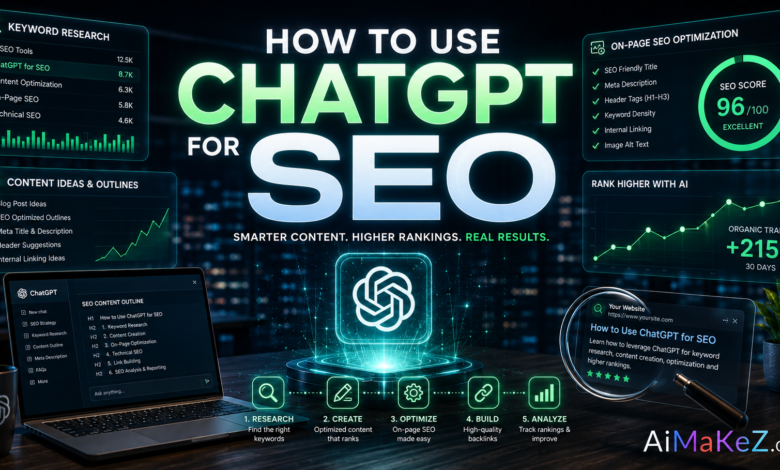
Ranking on Google feels harder every year. Search results shift, competition grows, and creating enough high-quality content to stay visible can drain your time and budget. This is exactly where using ChatGPT for SEO becomes a game changer for marketers, bloggers, agencies, and business owners who want to work smarter instead of just harder. Instead of spending hours brainstorming topics, mapping keywords, and drafting outlines, you can turn a well-trained AI assistant into a research partner, a copywriter, and a technical helper rolled into one.
In this in-depth 2026 guide, you will learn precisely how to use ChatGPT for SEO from start to finish. We will cover keyword research, content briefs, on-page optimization, meta tags, schema markup, internal linking, and even technical SEO tasks. You will also get real prompts, practical use cases, a pros and cons breakdown, pricing details, and expert best practices so you can apply everything today. By the end, you will know exactly how to put ChatGPT for SEO to work in your own daily process. If you are comparing tools, our guide on AI tools and workflows at AiMaKeZ is a helpful companion resource.
Table of Contents
What is ChatGPT for SEO?
ChatGPT is a conversational AI model built by OpenAI that generates human-like text based on the prompts you give it. When people talk about using ChatGPT for SEO, they mean applying this large language model to the everyday tasks that improve search rankings: finding keyword ideas, structuring articles, writing optimized copy, generating meta descriptions, clustering topics, and streamlining technical work like structured data.
It is important to understand what the tool is not. ChatGPT is not a live rank tracker, and it does not crawl your website in real time. Instead, it acts as an intelligent assistant that speeds up the thinking, writing, and organizing behind a strong search strategy. Think of it as a tireless junior strategist that drafts, edits, and brainstorms while you provide direction, data, and human judgment.
In 2026, most professionals pair the model with dedicated SEO platforms such as Ahrefs, Semrush, or Google Search Console. You can learn more about the model on the official OpenAI ChatGPT page. The AI handles language-heavy tasks, while the SEO tools supply hard metrics like search volume, keyword difficulty, and backlink data. Together they form a fast, reliable workflow.

Key Features
The features that make ChatGPT for SEO so valuable for organic growth go far beyond simple text generation. Below are the capabilities that matter most for search optimization.
Natural language content generation
The model produces fluent, context-aware writing that reads like a human wrote it. You can request blog intros, product descriptions, category copy, and FAQ answers that match a specific tone, region, or reading level, which supports both engagement and dwell time.
Keyword and topic clustering
Give it a seed keyword and it can suggest related terms, long-tail variations, and semantic entities. It groups these into logical topic clusters, which is the backbone of a modern content hub strategy and topical authority.
On-page optimization support
From title tags and meta descriptions to header structure and image alt text, the assistant helps you cover the on-page signals that search engines reward. It can also rewrite existing pages to improve clarity and keyword placement without stuffing.
Technical and structured data help
The model can generate clean JSON-LD schema, robots.txt rules, and regex patterns, and it can explain crawl or indexing issues in plain English. This lowers the barrier for teams without a dedicated developer.
Multilingual and localization ability
For brands targeting readers across the United States and Europe, it can adapt copy for different English variants and translate content while preserving intent, which is useful for international SEO.
Benefits
Adopting ChatGPT for SEO delivers measurable advantages that compound over time. The most obvious is speed. Tasks that once took an afternoon, such as building a content outline or drafting twenty meta descriptions, now take minutes.
The second benefit is scale. A single writer using ChatGPT for SEO can suddenly manage the output of a small team, producing consistent briefs, drafts, and supporting assets across many pages. This matters for e-commerce catalogs and large publisher sites that need thousands of optimized pages.
A third advantage is cost efficiency. Reducing dependence on multiple freelancers and shortening production cycles frees up budget for link building, design, and paid promotion. Finally, the tool improves creativity by breaking writer’s block and offering fresh angles you might not have considered.
Used correctly, these benefits of ChatGPT for SEO translate into faster publishing, stronger topical coverage, and a healthier organic traffic curve. The key phrase to remember is human oversight: the AI accelerates the work, but a knowledgeable editor guarantees accuracy and trust.
How to Use ChatGPT for SEO Step by Step
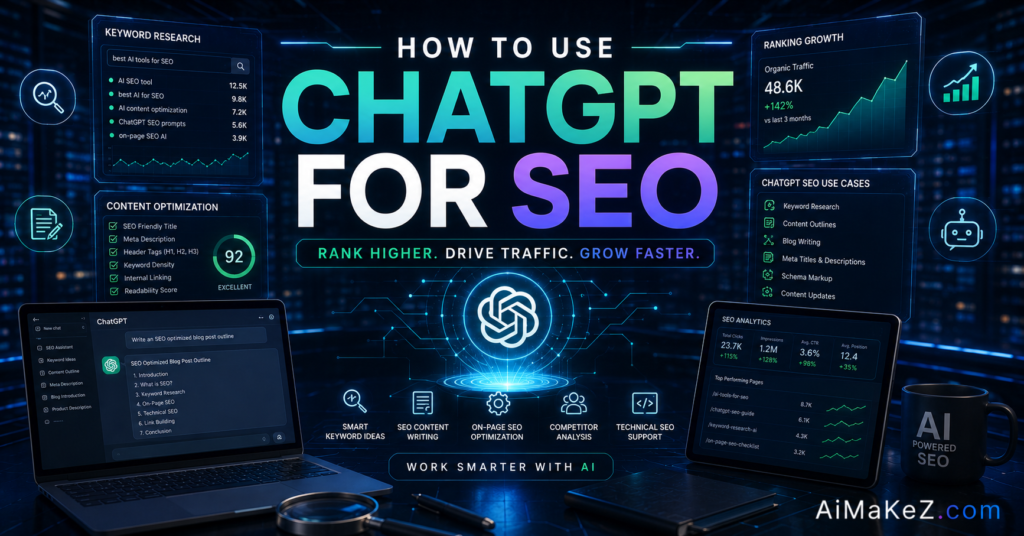
Turning the model into a search optimization engine follows a repeatable process. The workflow below shows exactly how to use ChatGPT for SEO from research to publishing, and you can copy it for any project. Mastering this ChatGPT for SEO workflow is what separates fast, scalable teams from slower competitors.
Step 1: Research your keywords
Start with a seed topic and ask the AI to expand it into long-tail keywords, questions, and related entities. A sample prompt: “Act as an SEO strategist. Generate 30 long-tail keywords and 10 questions around ‘home espresso machines’ grouped by search intent.” Validate the output with real search volume data from your SEO tool of choice.
Step 2: Build the content brief and outline
Feed the target keyword back in and request a full outline with H2 and H3 headings, a suggested word count, and NLP terms to include. This creates a structured blueprint that aligns with search intent before a single paragraph is written.
Step 3: Draft and optimize the content
Draft section by section rather than all at once, since smaller requests produce sharper, more accurate writing. Ask the tool to weave in your primary keyword naturally, add semantic variations, and keep paragraphs short for readability.
Step 4: Generate metadata and schema
Once the draft is ready, request an SEO title under 60 characters, a meta description of 150 to 160 characters, and any relevant JSON-LD schema such as Article or FAQ markup. Paste this straight into Rank Math.
Step 5: Edit, fact-check, and publish
Every AI draft needs a human pass. Verify statistics, add first-hand experience, refine the tone, and confirm the facts. This final layer is what satisfies Google’s EEAT expectations and protects your reputation.
Real-World Use Cases
The theory is helpful, but the value of ChatGPT for SEO becomes obvious in practice. Here are concrete examples across different fields.
Business and local SEO
A local dental clinic in Chicago used the AI to write unique service pages for each treatment and to draft Google Business Profile posts. By covering patient questions in detail, the clinic improved its visibility for “emergency dentist near me” style queries within a few months.
Content marketing and blogging
A SaaS blog team used the model to build topic clusters around their core product. They generated pillar-and-cluster outlines, then wrote supporting articles that interlinked naturally, strengthening topical authority and boosting non-branded traffic.
E-commerce and product copy
An online furniture store had thousands of thin product descriptions. Using structured prompts, the team rewrote them into unique, benefit-led copy with keyword-rich but natural language, reducing duplicate content issues across the catalog.
Education and training
An online course provider generated FAQ sections, glossary pages, and lesson summaries optimized for informational queries. This helped capture students searching for beginner concepts and funneled them toward paid courses.
Productivity and automation
Agencies connect the model to automation tools and the OpenAI API to batch-produce meta descriptions, alt text, and social snippets. One agency automated its monthly content calendar, cutting planning time by more than half while keeping a human editor in the loop.
Pros and Cons
No tool is perfect. Before you rely on ChatGPT for SEO every day, weighing the strengths against the limitations helps you set realistic expectations before you build a workflow around it.
| Pros | Cons |
|---|---|
| Speeds up content production dramatically | Can produce inaccurate or outdated facts |
| Scales output without a large team | No live search volume or ranking data |
| Great for outlines, briefs, and ideation | Risk of generic text without editing |
| Generates schema and technical snippets | Needs human oversight for EEAT and trust |
| Cost effective for solo creators and SMBs | Overuse can lead to thin, similar content |
Pricing
When budgeting for ChatGPT for SEO, OpenAI offers several tiers so individuals and teams can choose what fits their workload. Prices can change, so always confirm the latest figures on the official OpenAI website before committing.
- Free plan: Access to a capable model at no cost, ideal for testing and light use.
- Plus plan: Around 20 US dollars per month, offering faster responses, higher limits, and access to the most advanced models.
- Team and Business plans: Roughly 25 to 30 dollars per user each month, adding collaboration, higher usage, and admin controls.
- Enterprise plan: Custom pricing with enhanced security, larger context, and dedicated support.
- API access: Pay-as-you-go pricing based on tokens, perfect for automation and bulk SEO tasks.
For most solo bloggers and small businesses, the Plus plan delivers the best balance of capability and cost. Agencies handling large volumes often combine the Team plan with API-based automation.
Comparison With Alternatives
ChatGPT for SEO is powerful, yet several AI writing and optimization tools compete in this space. Understanding how they differ helps you build the right stack.
| Tool | Best For | Key Difference |
|---|---|---|
| ChatGPT | Flexible writing and ideation | Most versatile, conversational, strong reasoning |
| Jasper | Marketing teams | Templates and brand voice, higher price |
| Surfer SEO | On-page scoring | Data-driven content grading, not a writer |
| Gemini | Google ecosystem users | Tight integration with Google tools |
| Claude | Long-form nuance | Large context window and careful tone |
For a deeper breakdown, see our related comparisons on the AiMaKeZ blog. The smartest strategy in 2026 is not choosing one tool but combining them. Many professionals draft with a conversational model, grade with Surfer or Rank Math, and confirm metrics with Ahrefs or Semrush.
Best Practices
To get consistent, high-quality results from ChatGPT for SEO, treat the AI like a skilled collaborator that still needs clear direction and review.
- Give it a role and context. When you start using ChatGPT for SEO, begin prompts with “Act as an experienced SEO specialist” and describe your audience, goal, and target keyword.
- Work in small sections. Break big articles into focused requests for tighter, more accurate output.
- Always add human experience. Insert first-hand insights, data, and examples the model cannot know to satisfy EEAT.
- Fact-check everything. Verify statistics, names, and claims against trusted sources before publishing.
- Match real search intent. Compare drafts against top-ranking pages to ensure you cover what users actually want.
- Edit for a unique voice. Rewrite generic lines so the content sounds distinctly like your brand.

Common Mistakes to Avoid
Even experienced marketers stumble with ChatGPT for SEO when they lean on automation too heavily. Watch out for these frequent errors.
- Publishing raw output. Unedited AI text often reads flat and may contain errors that damage trust and rankings.
- Ignoring search intent. Beautiful copy that answers the wrong question will not rank, no matter how polished it is.
- Keyword stuffing. Forcing the same phrase repeatedly harms readability and can trigger spam signals.
- Skipping fact-checking. Language models sometimes invent statistics or sources, so verification is non-negotiable.
- Producing near-duplicate pages. Reusing the same prompt without customization creates thin, similar content across your site.
- Forgetting internal links and structure. Great text still needs proper headings, links, and metadata to perform.
Advanced ChatGPT SEO Prompts and Workflows
Once you are comfortable with the basics, you can push ChatGPT for SEO much further by chaining prompts into repeatable workflows. Instead of asking a single question and moving on, treat each conversation as a mini project where every prompt builds on the last. This approach keeps context intact, reduces repetitive instructions, and produces far more consistent output across an entire content campaign.
Prompt chaining for topic clusters
Start by asking the model to map a pillar topic into eight to ten supporting subtopics, then have it rank those subtopics by search intent and commercial value. In the next message, ask it to turn the strongest subtopics into individual article briefs, complete with suggested headings, target questions, and internal link opportunities back to the pillar page. Because the model remembers the earlier context, each brief stays aligned with the overall cluster strategy, which is exactly what search engines reward when they evaluate topical authority.
Role-based prompting for sharper output
One of the most effective techniques is to assign the model a clear role before you ask for anything. Telling it to act as a senior SEO strategist, a technical auditor, or a conversion copywriter changes the tone, depth, and structure of the response. Combine the role with concrete constraints such as reading level, word count, target keyword, and audience, and you will spend far less time editing. The more specific your framing, the more the AI behaves like a specialist rather than a generalist.
Building a reusable prompt library
Serious practitioners of ChatGPT for SEO save their best prompts in a document or a notes app so they never rebuild the same instruction twice. A good library includes templates for title generation, meta descriptions, FAQ schema, outline creation, and content refreshes. Over time this library becomes a genuine competitive asset, letting you or your team produce optimized drafts in minutes while keeping quality predictable. Review and refine the templates every few months as the model improves and as your own style guide evolves.
Refreshing and repurposing existing content
ChatGPT is not only for new articles. Paste an older post and ask the model to identify outdated statistics, weak headings, and missing subtopics that competitors now cover. You can then repurpose a single strong article into a newsletter, a set of social posts, a short video script, and an FAQ block, all optimized around the same core keyword. This multiplies the value of your best content and strengthens the internal linking web that supports your most important pages.
Frequently Asked Questions
Is using ChatGPT for SEO against Google’s guidelines?
No, using ChatGPT for SEO is not against the rules. Google rewards helpful, high-quality content regardless of how it is produced. The key is that the content is accurate, original, and genuinely useful. As long as you add human oversight, expertise, and value, AI-assisted content is fully compliant.
Can ChatGPT do keyword research on its own?
ChatGPT for SEO can generate keyword ideas, long-tail variations, and topic clusters, but it cannot provide real search volume or difficulty data. Pair it with tools like Ahrefs, Semrush, or Google Keyword Planner to validate the numbers before you commit.
Will AI content hurt my rankings?
Only if it is low quality, inaccurate, or unhelpful. Thin, unedited, mass-produced pages can hurt you. Well-edited, original, and valuable content backed by real expertise performs just as well as human-only writing.
Which model is best for SEO writing?
The most advanced available model generally produces the best reasoning and writing. For heavy work, the paid Plus plan is worth it. Many users also combine multiple tools to balance creativity, accuracy, and on-page scoring.
How do I keep AI content from sounding robotic?
Give the tool a clear tone, provide examples of your voice, work in small sections, and always edit the final draft. Add personal stories, opinions, and real data so the piece feels authentically human.
How many articles can I realistically produce with ChatGPT?
There is no fixed limit, but volume should never come at the expense of quality. Many small teams comfortably move from four or five polished posts a month to fifteen or twenty once they add prompt templates and a clear editing checklist. The bottleneck is rarely the drafting anymore. It becomes research validation, fact-checking, and the human review needed to add genuine expertise, so scale your output only as fast as your editing process can keep up.
Should I disclose that content was created with AI?
Google does not require a disclosure label as long as the content is helpful and accurate, but transparency can build trust with your audience in sensitive niches such as health or finance. Many publishers add a short editorial note explaining that AI assists with drafting while human experts review and approve every piece. Choose the approach that matches your brand values and the expectations of your specific readers.
What is the biggest time saver when using ChatGPT for SEO?
Most users report that outlining and first drafts save the most time. Turning a blank page into a structured, keyword-aligned draft in minutes removes the hardest part of the writing process. From there your energy goes into refining the argument, adding original data, and layering in the experience and voice that no model can replicate on its own.
Final Verdict
Learning how to use ChatGPT for SEO is one of the highest-leverage skills a modern marketer can develop. ChatGPT for SEO compresses hours of research, outlining, and drafting into minutes, lets small teams punch above their weight, and opens the door to consistent, scalable content production. When you combine it with reliable SEO tools and a sharp human editor, the results can rival or beat traditional workflows.
The tool is not a magic button, though. It will not replace strategy, expertise, or the trust that comes from genuine experience. Treat ChatGPT for SEO as a powerful assistant that drafts, brainstorms, and organizes while you supply direction, accuracy, and personality. Do that, and you will publish faster, cover more topics, and build lasting organic visibility. For anyone serious about growth in 2026, adopting an AI-assisted SEO workflow is no longer optional; it is the new competitive baseline.