Every time you type a question into a search box, you are making a small bet on where the best answer lives. For two decades that bet almost always meant a list of blue links. In 2026, that habit is breaking down fast, because AI search engines now read your question, understand its intent, and hand you a synthesized answer with sources attached. If you have ever felt buried under ten tabs just to answer one simple question, this shift matters to you. This guide explains the best options available today, how they actually work, and how to choose the right one for research, marketing, coding, or everyday curiosity.
Table of Contents
What Are AI Search Engines?
AI search engines are search tools that use large language models and natural language processing to interpret a query, retrieve relevant information from the web or private data, and generate a direct, conversational answer. Instead of returning a ranked list of pages and leaving you to do the reading, they combine retrieval and reasoning to produce a summarized response that usually cites its sources.
The core difference from traditional search is the output. A conventional engine like classic Google gives you documents to evaluate. A generative search engine gives you an answer, then shows the documents behind it. Most modern systems rely on retrieval-augmented generation, a technique that grounds the model’s response in live sources so answers stay current and verifiable rather than relying purely on training memory.
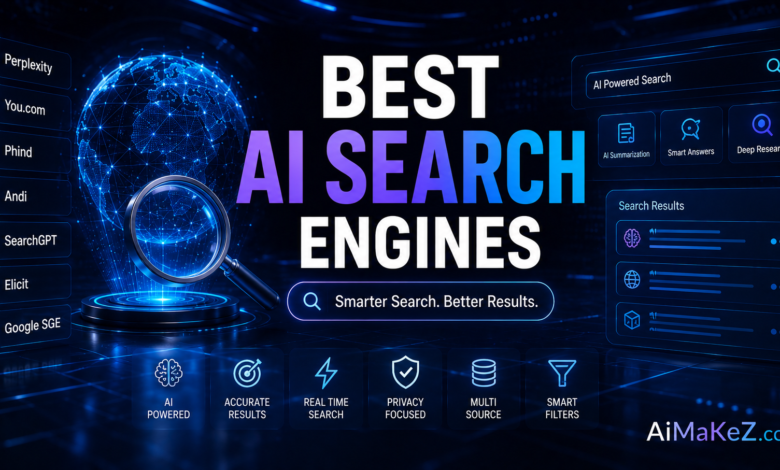
Popular examples include Perplexity AI, Google’s AI Mode and AI Overviews, Microsoft Copilot, You.com, Brave Search with its Answer feature, Andi, and Arc Search. Each blends conversational AI, semantic search, and source citation in a slightly different way, but all share the same goal: turning a messy question into a clear, trustworthy answer.
From Keyword Matching to Understanding Intent
To appreciate why this shift feels so significant, it helps to remember how search used to work. Early engines matched the literal words in your query against the words on a page, which meant you had to think like a machine and guess the exact phrasing a document might use. Over the years, ranking grew smarter and understood synonyms and context, but the fundamental output stayed the same: a page of links you still had to read and reconcile yourself.
AI search engines change the contract. They aim to understand what you actually mean, gather the evidence, and hand back a conclusion, turning search from a hunt for documents into a request for an answer.

Key Features of AI Search Engines
The best generative search tools share a set of capabilities that separate them from a standard results page. Understanding these features helps you judge which tool fits your workflow.
Conversational, Cited Answers
Rather than keywords, you ask a full question in plain language. The engine responds with a written answer and inline citations, so you can click through and verify each claim. This citation layer is what makes generative search trustworthy for research.
Rather than keywords, you ask a full question in plain language. The best AI search engines respond with a written answer and inline citations, so you can click through and verify each claim. This citation layer is what makes generative search trustworthy for research.
Modern tools remember the thread of a conversation. You can ask a broad question, then refine it with “compare those two” or “explain the second point” without repeating yourself. This contextual memory turns search into a genuine dialogue.
Multimodal and Real-Time Search
Leading platforms accept images, PDFs, and voice alongside text. Many also pull live data, so you get today’s stock movement, breaking news, or updated documentation instead of stale training data. Features like Perplexity’s focus modes and Copilot’s web grounding are built for this.
Agentic Actions and Deep Research
A defining 2026 feature is agentic search. Tools now run multi-step research tasks on your behalf, browsing dozens of sources, comparing them, and returning a structured report. Perplexity’s Deep Research and similar modes can compile a competitive analysis in minutes.
Benefits of Using AI Search Engines
The practical advantages go well beyond convenience. For anyone who researches, writes, or makes decisions online, an AI-powered search engine reshapes daily work.
The clearest benefit is speed. A question that once required opening five tabs and skimming each now resolves in a single, sourced paragraph. That time saving compounds across a workday. The second benefit is synthesis: instead of reading three articles and mentally merging them, the engine does the merging and shows its sources, which is invaluable for comparison shopping, literature reviews, and market research.
Trust is another advantage when citations are present. Because reputable AI search tools link every claim, you can fact-check quickly rather than accepting an unsourced summary. Finally, accessibility improves for everyone: plain-language queries, voice input, and follow-up questions lower the barrier for people who struggle with rigid keyword search.
How AI Search Engines Work
Under the hood, most generative search tools follow a similar pipeline. Knowing the steps helps you understand why answers are usually accurate and where errors can creep in.
- Query understanding: A language model parses your question, detects intent, and expands it into related concepts using natural language processing.
- Retrieval: The engine searches a live index, its own crawler, or partner APIs to gather the most relevant documents and passages.
- Ranking and filtering: Semantic search ranks passages by meaning rather than exact keywords, then filters out low-quality or duplicate sources.
- Generation: The model writes a grounded answer using retrieval-augmented generation, weaving retrieved facts into readable prose.
- Citation and delivery: Sources are attached inline, and the answer is returned with options to ask follow-ups or dig deeper.
Because the answer is grounded in retrieved documents rather than memory alone, hallucinations drop sharply compared with a raw chatbot. Still, the model can occasionally misread a source, which is why citations matter and why you should verify high-stakes facts.
Real-World Use Cases
These tools are not just for tech enthusiasts. Across industries, teams are folding AI search engines into everyday tasks.
Business and Market Research
Analysts use AI search engines like Perplexity or Copilot to compile competitor pricing, funding news, and industry trends into a single sourced brief. What used to take an afternoon of manual reading now takes minutes, freeing analysts to interpret rather than collect.
Marketing and SEO
Marketers research keywords, audience questions, and content gaps by asking direct questions and reviewing cited data. Pairing this with the right AI SEO tools makes the workflow even stronger. They also study how AI Overviews summarize a topic to shape content that earns citations, a discipline now called generative engine optimization.
Content Creation
Writers gather background facts and verify claims without leaving their research tool, and many pair them with dedicated AI tools for content creators to speed up drafting. Because sources are attached, producing an accurate, well-referenced article becomes faster while keeping human judgment in the loop.
Education, Coding, and Productivity
Students use conversational search to explain difficult concepts step by step. Developers query documentation and debug errors with cited code examples. Knowledge workers automate repetitive lookups so routine questions stop interrupting deep work.
Privacy and Security Considerations
Because these tools sit between you and the open web, they see every question you ask, and those questions can be surprisingly revealing. A single research session might expose your employer, a health concern, a legal problem, or an unreleased product. That makes it worth understanding how each provider treats your data before you make one part of your daily routine. Some engines log queries to improve their models, some let you opt out, and a few are built specifically to minimize tracking and avoid building a profile of you.
A few habits keep you safe without slowing you down. Avoid pasting confidential documents, client data, or personal identifiers into a public tool, especially on a free tier where retention policies may be looser. Read whether conversations are used for training and turn that off if the option exists. When a task involves genuinely sensitive material, favor an engine with a clear privacy stance or an enterprise plan that contractually keeps your data out of training. Treating the search box as a semi-public space, rather than a private notebook, is the simplest way to avoid regret.
Security extends to the answers themselves. Because these tools browse the live web, a malicious page could in theory try to feed misleading instructions into a summary, and low-quality sources can slip into an otherwise solid response. This is another reason to open citations rather than trusting a clean-looking paragraph at face value. For anything that touches money, health, or legal exposure, treat the AI answer as a well-informed first draft and confirm the specifics with a primary source or a qualified professional.
No tool is perfect. Here is a balanced view of where generative search shines and where it still needs caution.
No tool is perfect. Here is a balanced view of where generative search shines and where it still needs caution.
| Pros | Cons |
|---|---|
| Direct answers save time versus scanning links | Occasional hallucinations on niche topics |
| Inline citations support fact-checking | Free tiers limit advanced models and queries |
| Conversational follow-ups refine results | Can reduce traffic to original publishers |
| Multimodal input handles images and files | Privacy varies widely between providers |
| Agentic deep research automates whole tasks | Answers may reflect source or model bias |
Pricing of Popular AI Search Engines
Most leading tools use a freemium model: a capable free tier plus a paid plan that unlocks stronger models, higher limits, and advanced research modes. Prices below reflect typical 2026 rates and may vary by region.
| Engine | Free Tier | Paid Plan |
|---|---|---|
| Perplexity AI | Yes, unlimited quick search | Pro around $20/month |
| Microsoft Copilot | Yes | Copilot Pro around $20/month |
| Google AI Mode | Yes, built into Search | Included with Google One AI tiers |
| You.com | Yes, limited | Pro around $15-20/month |
| Brave Search | Yes, free answers | Premium around $3/month |
For most casual users, the free tiers are genuinely useful. Heavy researchers, marketers, and developers usually find a paid plan pays for itself through access to premium reasoning models and unlimited deep research.
For most casual users, the free tiers of these AI search engines are genuinely useful. Heavy researchers, marketers, and developers usually find a paid plan pays for itself through access to premium reasoning models and unlimited deep research.
Choosing between the top options comes down to your priority: research depth, ecosystem, privacy, or speed.
Perplexity AI remains the specialist favorite for research, thanks to clean citations, focus modes, and its Deep Research feature. Google AI Mode wins on sheer index size and integration with the tools people already use. Microsoft Copilot is strongest inside the Microsoft 365 and Windows ecosystem, blending web answers with your documents. You.com appeals to power users who want to switch between multiple underlying models, while Brave Search leads on privacy with an independent index and no profiling.
If you only pick one, Perplexity is the safest default for serious research, Google AI Mode for everyday breadth, and Brave for the privacy-conscious. Many professionals keep two open and cross-check important answers between them.

How to Choose the Right AI Search Engine
With several strong options available, the right choice depends less on which tool is objectively best and more on what you actually do all day. Start by naming your primary job to be done. If you spend your time on structured research and need to trust every claim, prioritize citation quality and dedicated research modes. If your work lives inside a particular software suite, an engine that plugs into that ecosystem will save more time than a marginally smarter competitor that sits in a separate tab.
It also helps to weigh a few practical factors before you commit. Consider the depth and clarity of citations, since an answer you cannot verify is only half useful. Look at how the tool handles follow-up questions and whether it remembers context across a session. Check the free tier limits against your real volume, because hitting a wall every afternoon quickly erodes any productivity gain. Evaluate privacy policies closely if you handle sensitive material, and confirm that the engine pulls live data on the topics you care about rather than serving stale summaries.
Finally, run a short trial before you standardize on anything. Ask each candidate the same handful of questions drawn from your own work, then compare not just the answers but the sources behind them. The engine that consistently surfaces credible, recent references for your domain is the one worth paying for. Many professionals ultimately settle on a primary tool for daily use and a secondary one for cross-checking important results, and that two-tool habit tends to beat loyalty to any single platform.
Best Practices for Using AI Search Engines
Getting great results is a skill. These expert habits will sharpen your queries and protect you from errors.
- Ask specific questions. Add context, dates, and constraints so the model retrieves the right sources.
- Always open the citations. Treat the summary as a starting point and verify important claims at the source.
- Use follow-ups. Refine iteratively instead of cramming everything into one prompt.
- Choose the right mode. Most AI search engines offer academic, coding, or deep-research modes—pick the one that matches your task for higher-quality retrieval.
- Cross-check high-stakes facts. For medical, legal, or financial topics, confirm with a second tool or an expert.
Common Mistakes to Avoid
Even experienced users trip over the same pitfalls. Avoiding these keeps your results reliable.
- Trusting answers blindly. Skipping the citations is how misinformation slips through.
- Using vague prompts. A one-word query gives a generic answer; detail drives precision.
- Ignoring dates. On fast-moving topics, confirm the sources are recent, not cached.
- Sharing sensitive data. Avoid pasting private or confidential information into public tools.
- Relying on a single engine. Different indexes surface different sources; cross-checking pays off.
Frequently Asked Questions
What are the best AI search engines in 2026?
The strongest options are Perplexity AI for research, Google AI Mode for everyday breadth, Microsoft Copilot for the Microsoft ecosystem, You.com for model flexibility, and Brave Search for privacy. Your best choice depends on whether you value depth, integration, or data protection.
Are AI search engines free to use?
Most offer capable free tiers. Perplexity, Copilot, Google AI Mode, You.com, and Brave all let you search without paying. Paid plans, usually around $15 to $20 per month, unlock premium models, higher limits, and advanced research modes.
Are AI search engines accurate and safe to trust?
They are generally accurate because they ground answers in live sources and cite them, which reduces hallucinations. Even so, mistakes happen, so open the citations and verify high-stakes medical, legal, or financial information independently.
How are AI search engines different from ChatGPT?
A pure chatbot answers from its training data, which can be outdated. AI search engines retrieve live web results first and then generate a cited answer, so their responses are more current and verifiable for factual questions.
Will AI search engines replace Google?
They are changing search rather than fully replacing it. Google itself now leads with AI Overviews and AI Mode. The likely future is hybrid, where generative answers sit alongside traditional links for tasks that still need exploration.
Do AI search engines work well for coding and technical questions?
Yes, and this has become one of their strongest use cases. Developers use these tools to look up API documentation, understand error messages, and compare libraries without leaving their research flow. The engine can pull the latest version of a framework’s docs, surface relevant Stack Overflow threads, and explain a snippet line by line with citations you can open. For fast-moving ecosystems where syntax changes between releases, live retrieval is far more reliable than a chatbot answering from older training data. Even so, always test generated code in a safe environment before shipping it, because a plausible-looking answer can still reference a deprecated method.
How can website owners get their content cited by AI search engines?
Earning citations is the heart of the new discipline called generative engine optimization. In practice, it means writing clear, well-structured content that directly answers real questions, using descriptive headings, concise summaries near the top, and factual statements an engine can quote with confidence. Original data, expert commentary, and up-to-date figures make a page more citation-worthy because they cannot be found everywhere else. Technical health still matters too: fast loading, clean markup, and accessible structure help crawlers parse your pages. The publishers who win in AI search are the ones who treat every article as a potential source rather than just a ranking target.
The Future of AI Search
The trajectory of AI search points toward engines that do more than answer questions; they complete tasks. The clearest trend for the near future is deeper agentic capability. Instead of returning a report and stopping, tomorrow’s tools will book the appointment, draft the email, or assemble the spreadsheet that the research implied, all while keeping a human in the approval loop. Early versions of this already exist in deep-research modes, and they will only grow more capable as models learn to plan and use tools reliably.
A second shift is personalization balanced against privacy. Engines will increasingly tailor answers to your role, your history, and the documents you connect, yet the providers that thrive will be the ones that make this optional and transparent rather than intrusive. Expect clearer controls over what an engine remembers and stricter separation between your private context and the public web. The tension between helpful memory and genuine privacy will define which platforms professionals trust with sensitive work.
Finally, the relationship between AI search and the open web is still being negotiated. As generative answers satisfy more queries without a click, publishers, search providers, and regulators are working out how attribution, licensing, and traffic sharing should function. The healthiest outcome is a model where citations drive meaningful visits and creators are compensated for the content that grounds these answers. However that settles, the reader’s takeaway is simple: the tools will keep getting faster and smarter, so the durable skill is learning to question them well.
Final Verdict
The way we find information has genuinely turned a corner, and the best AI search engines are now dependable enough for daily professional use. They save hours, synthesize scattered sources, and, when they cite their work, let you verify answers with a single click. For most readers in the United States and Europe, Perplexity AI is the strongest all-around choice for research, Google AI Mode is the most convenient for everyday questions, and Brave Search is the best pick for privacy.
The smartest strategy is not loyalty to one tool but fluency across a few: ask sharp questions, always check the citations, and let these engines handle the heavy lifting while you keep the final judgment. Adopt them thoughtfully and you will spend far less time searching and far more time acting on what you find.