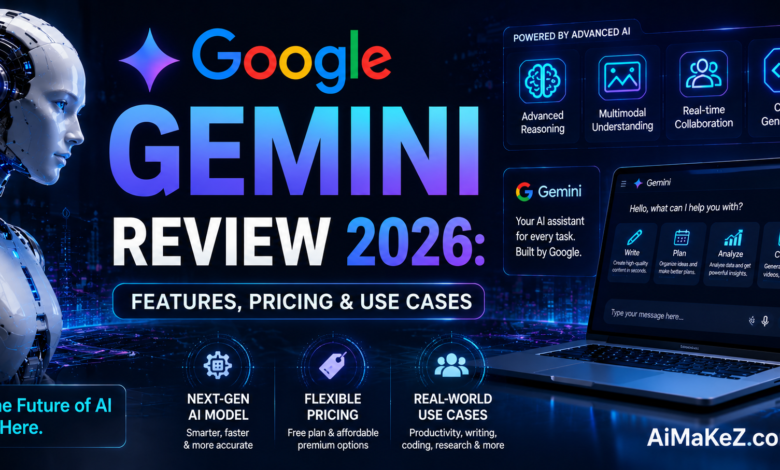
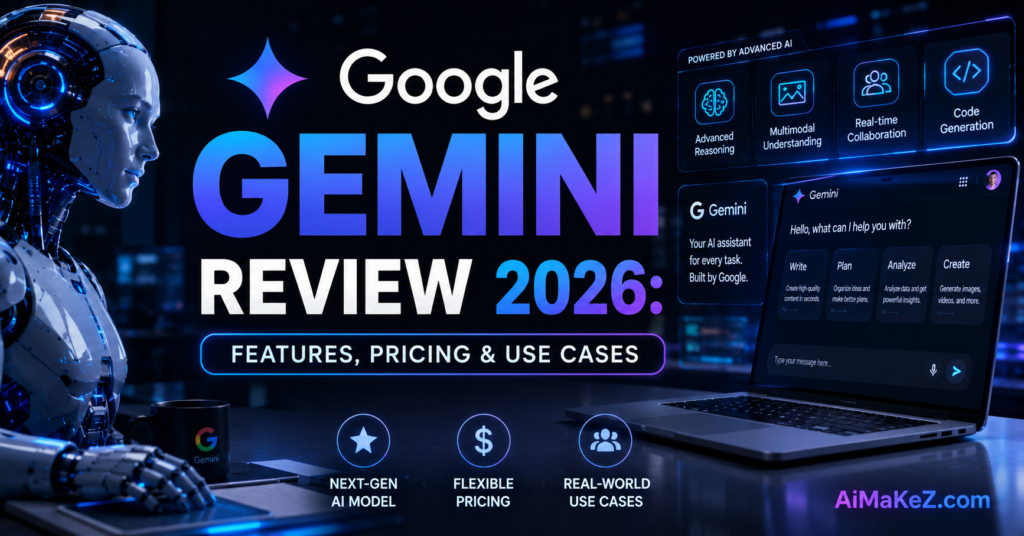
If you’ve been searching for an honest, up-to-date Google Gemini review, you’ve landed in the right place. Google’s flagship AI assistant has undergone a dramatic transformation since its early days — and in 2026, it’s a genuinely powerful platform worth serious consideration. Whether you’re a business professional, content creator, student, or developer, this Google Gemini review covers everything you need to make an informed decision before diving in.
Google Gemini has evolved from a capable but uneven chatbot into a multimodal AI powerhouse that integrates deeply with Google’s vast ecosystem — Search, Workspace, Android, and beyond. But with strong competition from ChatGPT, Claude, and Microsoft Copilot, the real question is: does Gemini deserve a spot in your daily toolkit? Let’s break it down completely.
Table of Contents
What Is Google Gemini? (Google Gemini Review Overview)
In this Google Gemini review, we start with the basics: Google Gemini is Google’s flagship family of large language models (LLMs) and AI assistant platform, developed by Google DeepMind. First announced in December 2023 under the name “Bard” and later rebranded as Gemini, the platform has gone through multiple major version releases — Gemini 1.0, 1.5, and the current 2.0 series — each bringing significant capability leaps.
Unlike traditional search engines that retrieve existing information, Gemini generates original, contextual responses by drawing on a vast training corpus and real-time Google Search data. It’s designed to handle text, images, audio, video, and code — making it a true multimodal AI system rather than just a text chatbot.
In 2026, Gemini is no longer just a standalone assistant. It’s woven into the fabric of Google’s products — appearing inside Gmail, Google Docs, Google Sheets, Google Meet, Android devices, and even Chrome. This deep integration is what sets the Google Gemini review conversation apart from assessments of competing AI tools that operate in isolation.
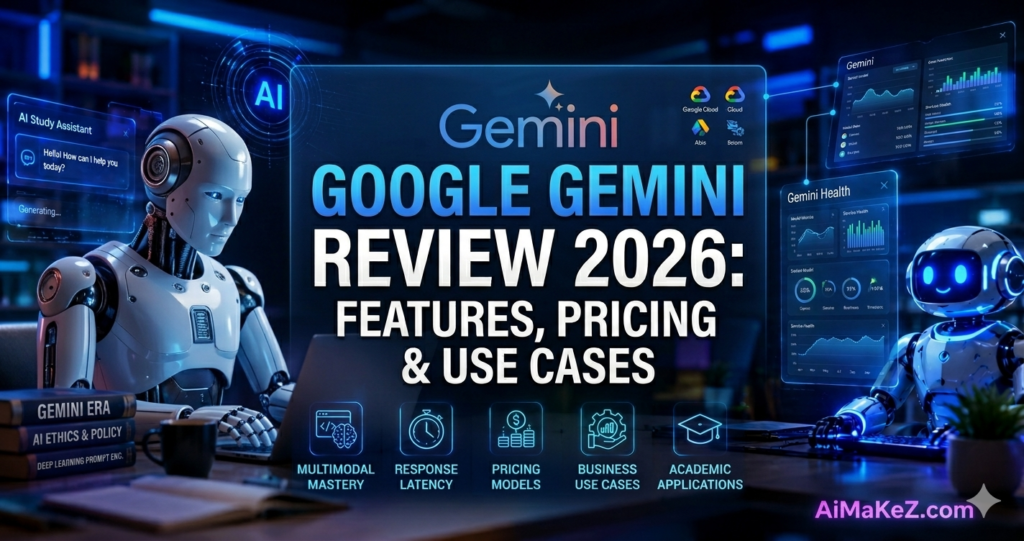
Key Features of Google Gemini in 2026
Our Google Gemini review found the platform packed with capabilities that span far beyond basic question-answering. Here’s a detailed look at its most important features:
1. Multimodal Understanding
Gemini can process and reason across multiple input types simultaneously — text, images, audio, video, PDFs, and code. You can upload a photograph and ask it to analyze content, describe what’s happening, or even generate written descriptions for accessibility purposes. This native multimodality (not bolted on as an afterthought) makes Gemini one of the most versatile AI tools available.
2. Gemini 2.0 Flash and Ultra Models
In 2026, Gemini offers tiered model access. The Gemini 2.0 Flash model delivers fast, efficient responses for everyday tasks at lower latency. Gemini 2.0 Ultra is the most capable tier — designed for complex reasoning, advanced coding, research analysis, and creative projects. Flash is ideal for speed-sensitive workflows; Ultra is best when accuracy and depth matter most.
3. Deep Google Workspace Integration
One of Gemini’s defining advantages in this Google Gemini review is its native integration with Google Workspace. Users on paid plans can summon Gemini directly inside Docs to draft or rewrite content, inside Sheets to analyze data and build formulas, inside Gmail to compose or summarize emails, and inside Slides to generate presentation outlines. This workflow integration is unmatched by any competitor.
4. Long Context Window (1 Million+ Tokens)
Gemini 1.5 Pro and the 2.0 series support an industry-leading context window of up to 1 million tokens — and this is actively usable in the Gemini Advanced tier. This means you can feed it entire books, lengthy legal documents, large codebases, or extensive research papers and ask questions across the entire document without losing context. This is a game-changing feature for professionals handling large volumes of information.
5. Google Search Grounding
Unlike many AI models that can produce outdated or hallucinated information, Gemini uses real-time Google Search grounding. When enabled, Gemini cites current web sources and links to them, giving users a verifiable, up-to-date response rather than a confident-sounding but potentially stale answer.
6. Gemini Live (Real-Time Conversational AI)
Gemini Live allows natural, back-and-forth voice conversations in real time. Unlike earlier voice assistants that felt robotic, Gemini Live can be interrupted mid-sentence, handles topic changes fluidly, and maintains conversational context across a full session. It’s available on Android and iOS, making it a powerful on-the-go AI companion.
7. Gemini for Developers (API Access)
Through Google AI Studio and the Gemini API (available via Google Cloud Vertex AI), developers can integrate Gemini’s capabilities into their own applications. Supported languages include Python, JavaScript, Go, and more. The API supports function calling, structured output, and multimodal inputs — making it a robust foundation for AI-powered products.
8. Gems (Custom AI Agents)
Gemini Advanced users can create “Gems” — personalized AI agents configured with specific instructions, personas, and knowledge bases. A marketing agency could create a Gem specialized in brand voice guidelines; a teacher could create a Gem tuned for a specific curriculum. Gems are Google’s answer to OpenAI’s Custom GPTs, and they work seamlessly within the Gemini interface.
Benefits of Using Google Gemini
In our Google Gemini review, the platform’s practical advantages proved compelling across multiple user categories:
Our Google Gemini review found that ecosystem synergy is one of Gemini’s biggest advantages: for anyone already using Gmail, Google Drive, Docs, or Android, Gemini’s integration dramatically reduces context-switching. Your AI assistant lives inside the tools you’re already using — you don’t need to copy-paste between apps.
Real-time, grounded information: Because Gemini can pull from live Google Search, it sidesteps one of the most frustrating limitations of AI tools — outdated knowledge cutoffs. Users researching current events, market trends, or recent product releases get accurate, cited responses.
Truly free tier: Google offers a genuine free version of Gemini that includes the standard model with solid capability. For casual users, students, or those evaluating the platform, this lowers the barrier to entry significantly.
Multilingual performance: Gemini performs strongly across dozens of languages, making it a practical choice for global teams, multilingual content creators, and international businesses.
Developer-friendly infrastructure: Google’s mature cloud infrastructure and well-documented APIs make Gemini one of the most production-ready AI platforms for enterprise developers.
How Google Gemini Works: Step-by-Step Guide
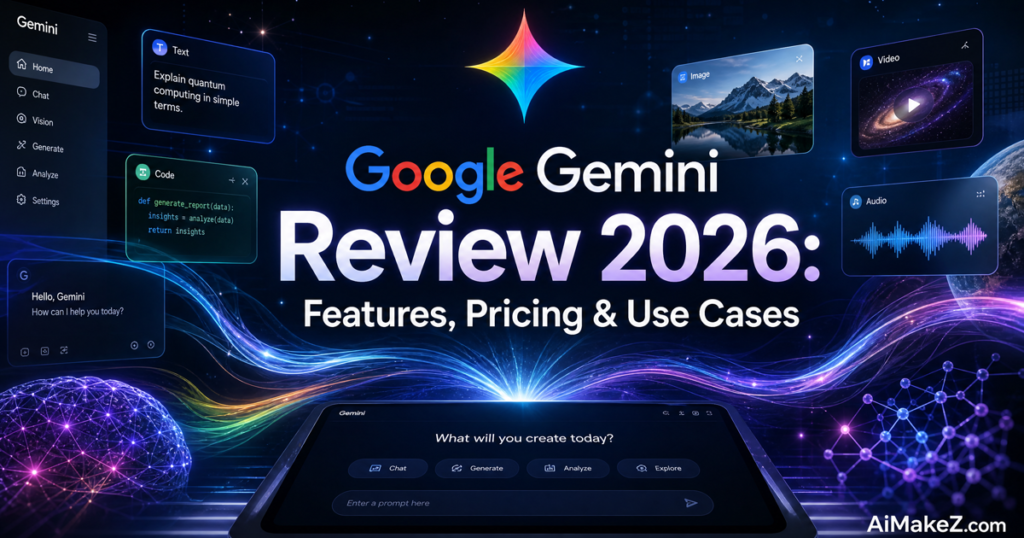
This Google Gemini review wouldn’t be complete without a practical walkthrough of using the platform from scratch:
Step 1: Access Gemini
Visit gemini.google.com and sign in with any Google account. The free tier activates immediately. If you’re a Google One or Workspace subscriber, Gemini Advanced features are accessible from the same interface.
Step 2: Choose Your Model
At the top of the interface, select between Gemini 2.0 Flash (faster, for everyday tasks) and Gemini 2.0 Ultra/Advanced (for complex reasoning and long-context work). Free users default to the Flash model. Advanced subscribers can toggle between all available models.
Step 3: Enter Your Prompt
Type your prompt in the text field, or upload files (images, PDFs, spreadsheets) using the attachment icon. You can combine text and media in a single prompt — for example, uploading a chart and asking Gemini to interpret the trends shown.
Step 4: Review, Refine, and Iterate
Gemini displays its response with source citations when Search grounding is active. You can ask follow-up questions, request a different format (bullet points, table, code), adjust tone, or regenerate a response. The conversation thread maintains full context throughout the session.
Step 5: Use Within Google Apps
On a paid plan, click the Gemini icon inside Gmail, Docs, Sheets, or Slides to summon the AI assistant contextually. In Gmail, it can read your existing thread and draft a reply; in Docs, it can rewrite a selected paragraph; in Sheets, it can write a complex formula based on a plain-English description.
Real-World Use Cases for Google Gemini
The Google Gemini review process revealed a platform that genuinely excels across diverse professional contexts:
Business Productivity and Operations
Professionals use Gemini to summarize lengthy meeting transcripts from Google Meet, draft executive summaries from uploaded reports, prepare client proposals in Google Docs, and analyze financial data inside Google Sheets. A marketing director might upload a 50-page campaign brief and ask Gemini to extract key action items and budget allocations in seconds.
Content Creation and Marketing
Content teams use Gemini to draft blog posts, social media copy, email newsletters, and SEO content briefs. Its real-time Search grounding is particularly valuable for content marketers who need articles to reflect current statistics and recent developments — not information that’s 12 months stale. Our Google Gemini review found it especially strong at outlining long-form content and generating varied headline options.
Software Development and Coding
When researching this Google Gemini review, developers find Gemini’s coding capabilities impressive — it can write, debug, explain, and refactor code across multiple languages including Python, JavaScript, TypeScript, SQL, and Kotlin. The large context window is particularly useful for code reviews: developers can paste an entire codebase file and ask Gemini to identify bugs, suggest optimizations, or write unit tests.
Education and Research
Students and researchers use Gemini to break down complex academic papers, generate study guides, create practice exam questions, and explore concepts through dialogue. The ability to upload PDFs directly and ask questions across the entire document makes it far more useful than traditional search for academic work.
Customer Service and Automation
The Google Gemini review also highlights API use cases: through the Gemini API, businesses build intelligent customer support bots, automated email response systems, and document processing pipelines. Companies in sectors from healthcare to e-commerce have deployed Gemini-powered agents to handle routine inquiries, significantly reducing support team workloads.
Personal Productivity and Planning
On a personal level, Gemini functions as an always-available thinking partner — helping plan trips, draft personal emails, organize notes, explain complex topics, and even coach users through difficult conversations. Gemini Live takes this further by enabling real-time verbal collaboration that feels genuinely natural.
Pros and Cons: Google Gemini Review Breakdown
Every honest Google Gemini review must acknowledge both strengths and limitations:
| Pros | Cons |
|---|---|
| Deep Google Workspace and Android integration | Advanced features require a paid subscription |
| Real-time Search grounding for current information | Occasionally verbose responses vs. more concise competitors |
| Industry-leading 1M+ token context window | Gemini Live not available in all regions/languages |
| Genuinely capable free tier available | Custom Gems less mature than OpenAI’s GPT ecosystem |
| Strong multimodal capabilities (text, image, audio, video) | Enterprise pricing can be complex through Google Cloud |
| Gemini Live for natural voice conversations | Privacy considerations for users outside Google’s ecosystem |
| Gems for personalized AI agent creation | Coding output occasionally requires manual error correction |
Google Gemini Review: Pricing Plans for 2026
Understanding the cost structure is a critical part of any Google Gemini review. Here’s the complete breakdown:
| Plan | Price | Model Access | Key Features |
|---|---|---|---|
| Gemini (Free) | $0/month | Gemini 2.0 Flash | Standard chat, image uploads, basic Google app integration |
| Gemini Advanced (Google One AI Premium) | $19.99/month | Gemini 2.0 Ultra | 1M context window, Gems, Workspace integration, Gemini Live |
| Google Workspace + Gemini | From $14/user/month (Business Starter) | Gemini 2.0 Flash/Pro | Gemini in Gmail, Docs, Sheets, Slides, Meet |
| Gemini Enterprise (Workspace) | From $30/user/month (add-on) | Gemini 2.0 Ultra | Advanced Workspace AI, NotebookLM Enterprise, security controls |
| Gemini API (Vertex AI) | Pay-per-use (token-based) | All models | Developer API access, function calling, multimodal API |
The Gemini Advanced plan at $19.99/month is the most popular consumer choice and includes 2TB of Google One storage in addition to the AI features — making it competitive with standalone cloud storage subscriptions. For businesses, bundling Gemini with a Google Workspace plan delivers the best value-per-seat ratio.
Google Gemini Review: How It Compares to Alternatives
No Google Gemini review would be complete without benchmarking it against the competition. Here’s how Gemini stacks up against the major AI platforms in 2026:
Google Gemini vs. ChatGPT (OpenAI)
ChatGPT remains the most recognized AI assistant globally. GPT-4o and subsequent models excel in creative writing, instruction-following, and plugin/tool use. However, Gemini’s real-time Search grounding and Google Workspace integration give it a meaningful advantage for users embedded in Google’s ecosystem. ChatGPT’s GPT Store offers a more mature library of custom agents; Gemini’s Gems are catching up but not quite there yet.
Google Gemini vs. Claude (Anthropic)
Anthropic’s Claude models are widely regarded as among the most nuanced, safe, and thoughtful AI writers — particularly strong for long-form content and complex document analysis. Claude also offers a large context window. However, Gemini’s multimodal capabilities and Google ecosystem integration give it practical advantages for everyday business users that Claude doesn’t yet match.
Google Gemini vs. Microsoft Copilot
Microsoft Copilot (powered by OpenAI models) is Gemini’s most direct enterprise competitor. Copilot integrates with Microsoft 365 (Word, Excel, Outlook, Teams) just as Gemini integrates with Google Workspace. The choice largely comes down to which productivity suite your organization uses. For Google Workspace shops, Gemini is unambiguously the stronger choice; for Microsoft 365 environments, Copilot has the integration edge.
Google Gemini vs. Perplexity AI
Perplexity has built a strong reputation as a search-first AI tool with excellent citation quality. For research-heavy workflows, Perplexity’s source presentation is arguably cleaner and more readable than Gemini’s Search grounding. However, Perplexity lacks Gemini’s multimodal capabilities, Workspace integration, and the breadth of agentic features that Gemini offers in 2026.
| Platform | Best For | Starting Price | Context Window | Workspace Integration |
|---|---|---|---|---|
| Google Gemini | Google ecosystem, multimodal AI | Free | 1M+ tokens | Google Workspace |
| ChatGPT | Creative writing, custom agents | Free / $20/mo Plus | 128K tokens | Limited |
| Claude | Long-form writing, analysis | Free / $20/mo Pro | 200K tokens | Limited |
| Microsoft Copilot | Microsoft 365 users | Free / $30/user/mo | ~128K tokens | Microsoft 365 |
| Perplexity AI | Research, real-time search | Free / $20/mo Pro | ~32K tokens | None |
Google Gemini Review: Best Practices for Maximum Results
Our Google Gemini review found that results improve dramatically when users follow these key principles:
Be explicit about format requirements. Gemini responds well to format instructions — if you want a table, numbered list, executive summary, or JSON output, say so explicitly in your prompt. Vague prompts produce generically structured responses.
Use the context window aggressively. Don’t summarize documents before uploading them — send the full original. Gemini’s massive context window is designed to handle entire reports, contracts, or research papers. Let it do the summarization work.
Enable Search grounding for factual queries. For anything time-sensitive — current news, recent statistics, product specifications, regulatory changes — always toggle on Google Search grounding to get cited, current responses rather than potentially outdated training data.
Create Gems for recurring tasks. If you ask Gemini similar types of questions regularly (daily standup summaries, weekly SEO reports, customer email drafts), invest 10 minutes in creating a Gem with the relevant context and instructions. You’ll cut your setup time per session to zero.
Combine modalities in a single prompt. Don’t limit yourself to text-only prompts. Upload a screenshot, a PDF, and a spreadsheet all in one conversation. Gemini’s ability to reason across multiple input types in a single context is one of its most underused strengths.
Iterate with follow-up specificity. If the first response isn’t quite right, don’t regenerate from scratch. Follow up with specific corrections: “Make the tone more formal,” “Cut this to 150 words,” or “Rewrite the third paragraph to emphasize cost savings.” Iterative refinement consistently produces better results than starting over.
Google Gemini Review: Common Mistakes to Avoid
Our comprehensive Google Gemini review also uncovered frequent errors that trip up new and intermediate users alike:
Treating Gemini like a search engine. Single-keyword queries (“best CRM software”) produce poor results. Gemini thrives on conversational, detailed prompts: “I run a 15-person SaaS company using Google Workspace. What CRM tools integrate best with our stack, and how do their pricing tiers compare for teams our size?”
Ignoring the free tier’s real limitations. The free version doesn’t include the 1 million token context window, Gems, or full Workspace integration. Users who feel underwhelmed by Gemini may simply be using the free tier and assuming that’s all it offers. The Advanced tier represents a fundamentally different capability level.
Skipping source verification. Even with Search grounding active, Gemini can occasionally misquote or misattribute information. For anything going into published content, client deliverables, or legal documents, always click through to verify cited sources directly.
Not using Gemini in Workspace apps. Many users set up a Gemini subscription but continue switching to the standalone interface instead of using the in-app integration. The in-app version has access to your document’s full context — it’s dramatically more useful than a standalone chat session for document-related tasks.
Overlooking privacy settings. By default, Google may use conversation data for training. Enterprise and privacy-conscious users should review the Gemini Apps Activity settings and consider whether to opt out of data sharing — especially important when handling confidential business information.
Expecting perfect first-draft output. Gemini is an incredibly powerful writing assistant, but it’s a collaborator, not a replacement for human judgment. Treat its output as a high-quality draft that needs your editorial perspective — not as final copy ready to publish without review.
Google Gemini Review: Frequently Asked Questions
Is Google Gemini free to use in 2026?
Yes — Google offers a free version of Gemini that includes access to the Gemini 2.0 Flash model, text and image input, and basic functionality at gemini.google.com. The free tier is genuinely useful for everyday tasks. For advanced features including the Ultra model, 1M token context window, Gems, and full Workspace integration, the Gemini Advanced plan costs $19.99/month.
How does Google Gemini compare to ChatGPT in 2026?
Both are powerful AI assistants, but they excel in different contexts. In this Google Gemini review, Gemini’s key advantages are its real-time Search grounding, longer context window (1M+ tokens), and superior Google Workspace integration. ChatGPT leads in its mature custom agent ecosystem (GPT Store) and is preferred by many users for creative writing tasks. The best choice depends on which productivity suite you use and whether real-time web data matters to your workflow.
Can Google Gemini access the internet?
Yes — when the Google Search grounding feature is enabled, Gemini can retrieve current information from the web and cite its sources. This distinguishes it from many AI models that rely solely on their training data cutoff. Users should note that Search grounding availability can depend on the plan and region.
Is Google Gemini good for coding?
Yes, Gemini is a capable coding assistant. It supports a wide range of languages including Python, JavaScript, TypeScript, Go, Java, Kotlin, and SQL. The Gemini 2.0 Ultra model in particular demonstrates strong performance on coding benchmarks. The large context window is especially useful for code review and refactoring tasks. For embedded coding assistance, Google also offers Gemini Code Assist (formerly Duet AI) for use directly within IDEs like VS Code.
What are Gems in Google Gemini?
Gems are personalized AI assistants within Gemini Advanced that users can configure with custom instructions, specific personas, and tailored knowledge. Think of them as specialized versions of Gemini tuned for a particular purpose — a writing coach, a coding assistant, a customer support agent, or a specific internal process. Gems are available to Gemini Advanced and eligible Google Workspace subscribers.
Final Google Gemini Review Verdict: Is It Worth It in 2026?
After this thorough Google Gemini review, the verdict is clear: Gemini is one of the most capable and strategically positioned AI platforms available in 2026 — and for Google Workspace users, it may well be the single best AI tool on the market.
The combination of an industry-leading context window, real-time Search grounding, genuinely deep Workspace integration, and strong multimodal capabilities creates a platform that’s hard to match in a Google-centric workflow. The free tier is honest and capable. The Advanced tier at $19.99/month delivers exceptional value when you factor in the included 2TB of Google One storage.
Is Gemini perfect? Not quite. The Gems ecosystem is still maturing, response verbosity can be frustrating, and enterprise pricing through Google Cloud requires careful planning. But these are refinements, not dealbreakers.
Our Google Gemini review recommendation: if you use Gmail, Google Docs, or Android regularly, the Gemini Advanced plan is worth the investment. If you’re on the fence, start with the free tier, explore its capabilities for two weeks, then upgrade when you hit its ceiling. For enterprise teams on Google Workspace, the Gemini add-on is increasingly essential — not optional.
Looking for more expert AI tool comparisons? Explore our full library of AI tool reviews and guides on AiMaKeZ.com to find the best tools for your workflow.
Disclaimer: Pricing and features reflect information available as of June 2026. Always verify current plans and terms directly on Google’s official website before subscribing.