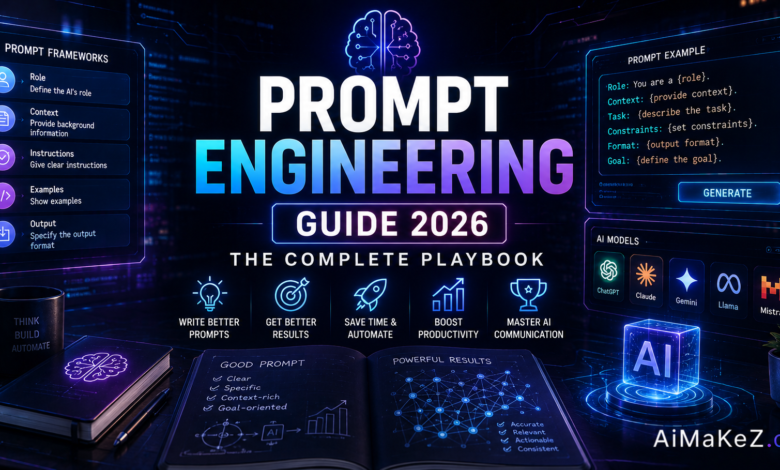
If you have ever typed a request into an AI chatbot and received a vague, off-target, or plainly wrong answer, the problem was rarely the model. More often, it was the instructions. That gap between what you ask and what you actually need is exactly where prompt engineering lives, and in 2026 it has become one of the most valuable practical skills for anyone working with large language models. This guide gives you a clear, hands-on roadmap for writing prompts that consistently produce accurate, useful, and repeatable results.
Whether you are a marketer generating campaign copy, a developer building an AI feature, an educator designing lessons, or a founder automating operations, the difference between a mediocre output and a great one usually comes down to how well you communicate with the model. Below, you will find definitions, features, benefits, step-by-step workflows, real-world use cases, pricing context, comparisons, best practices, and the mistakes that quietly ruin results.
Table of Contents
What Is Prompt Engineering?
Prompt engineering is the practice of designing, structuring, and refining the instructions you give to an AI model so it reliably returns the output you want. Think of it as the interface between human intent and machine reasoning. A prompt is not just a question; it is a set of directions that can include context, role definitions, constraints, examples, tone, and the exact format you expect back.
Large language models such as GPT-class systems, Claude, and Gemini predict text based on patterns learned during training. They do not read your mind, and they respond to signals in your wording. When you clarify the goal, supply relevant details, and remove ambiguity, the model’s probability distribution shifts toward the answer you actually need. That is why two people asking the “same” thing can get wildly different results.
Why Prompt Engineering Matters More in 2026
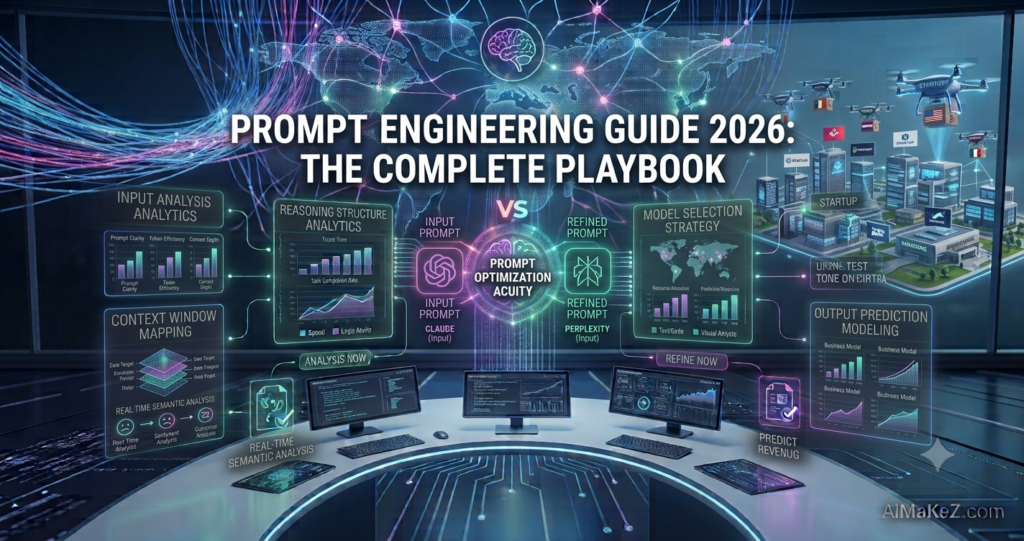
As models grow more capable, the ceiling on what a good prompt can unlock keeps rising. Modern systems handle long context windows, follow multi-step reasoning, call external tools, and process images, audio, and code. Effective prompt engineering is now the difference between a model that merely responds and one that behaves like a dependable collaborator embedded in real workflows. For a deeper technical foundation, the official OpenAI prompting documentation is a useful reference.
Key Features of Effective Prompt Engineering
Strong prompting is built from a handful of repeatable components. Understanding each one lets you assemble prompts like building blocks rather than guessing.
- Role and persona setting: Telling the model who it should be (“You are a senior financial analyst”) sharpens tone, vocabulary, and depth.
- Context injection: Supplying background, source data, or prior decisions grounds the response in your specific situation.
- Explicit constraints: Word counts, formats, forbidden phrases, and audience level keep output usable without heavy editing.
- Few-shot examples: Showing one or more sample inputs and outputs teaches the model your preferred pattern.
- Chain-of-thought prompting: Asking the model to reason step by step improves accuracy on math, logic, and analysis.
- Output formatting: Requesting tables, JSON, bullet points, or markdown makes results ready for downstream systems.
- Iterative refinement: Treating the first answer as a draft and correcting it conversationally is a core feature of the workflow.
Benefits for Users and Businesses
The practical advantages of learning to prompt well compound quickly. On an individual level, you save hours by getting the right answer on the first or second try instead of the tenth. On a team level, standardized prompts create consistency across writers, support agents, and analysts.
Businesses gain measurable value. A well-designed prompt can turn a general-purpose model into a specialized assistant that drafts contracts, summarizes research, triages support tickets, or generates code, all without expensive fine-tuning. Because prompts are cheap to test and iterate, you can prototype an AI feature in an afternoon rather than a quarter. The result is faster output, lower error rates, reduced review time, and a lower cost per task.
For individuals, the payoff is largely about time and confidence. Tasks that once meant staring at a blank page, such as drafting an outline, rewriting an awkward paragraph, or summarizing a long document, become fast and low-friction. Because you can iterate instantly, you spend less energy on the mechanics of producing text and more on judgment, editing, and the parts of the work that genuinely need a human. Over time this shifts the everyday relationship with AI from occasional novelty to a dependable part of the workflow.
How Prompt Engineering Works: A Step-by-Step Guide
You do not need to be a programmer to apply this. Follow this repeatable process and your results will improve immediately.
- Define the goal: Write one sentence describing the exact outcome you want, including the audience and purpose.
- Assign a role: Tell the model what expert it should embody so its reasoning and tone match the task.
- Provide context: Paste the relevant data, background, or constraints the model needs to work from.
- Specify the format: State the length, structure, and style, such as a 200-word summary in three bullet points.
- Add examples if needed: Include a short sample of the ideal output to anchor the pattern.
- Ask for reasoning when accuracy matters: Request a step-by-step approach for analytical or numerical tasks.
- Review and refine: Evaluate the response, then correct or extend it conversationally until it meets your standard.
Here is a quick before-and-after. A weak prompt reads: “Write about email marketing.” A strong prompt reads: “You are a B2B email strategist. Write a 150-word promotional email for a project-management SaaS aimed at operations managers. Use a confident tone, one clear call to action, and no jargon.” The second version leaves almost nothing to chance.
Advanced Prompting Techniques
Once the fundamentals feel natural, a handful of advanced techniques will noticeably raise the quality of your results. The most widely used is few-shot prompting, where you include two or three worked examples of the input and the ideal output before asking for a new one. Those examples act as a template the model can pattern-match against, which is far more reliable than describing the format in words alone. When you need a specific structure, style, or edge-case behavior, showing beats telling almost every time.
Chain-of-thought prompting is the second technique worth mastering. For reasoning-heavy problems such as math, logic, multi-step planning, or careful analysis, instructing the model to work through the problem step by step before giving a final answer improves accuracy dramatically. You can also break a large task into a sequence of smaller prompts, feeding the output of one stage into the next. This prompt-chaining approach keeps each step focused and makes it far easier to spot exactly where a workflow goes wrong.
Finally, use role and system-level framing deliberately. Assigning the model a clear persona, defining the audience, and setting explicit boundaries about what it should and should not do shapes the tone and scope of every response that follows. Combined with a defined output format and a request for the model to ask clarifying questions when instructions are ambiguous, these techniques transform a general assistant into a dependable specialist tuned to your exact task.
Real-World Use Cases
Marketing and Content Creation
Marketers use structured prompts to generate blog outlines, ad variations, product descriptions, and social captions at scale. By defining brand voice and audience in the prompt, teams keep messaging consistent across dozens of assets while cutting first-draft time dramatically. If you are exploring related tools, browse our other AI guides and reviews on AiMaKeZ.
Software Development and Automation
Developers prompt models to write functions, explain unfamiliar code, generate unit tests, and debug errors. Combined with tool calling and automation platforms, prompts drive AI agents that process data, update records, and trigger workflows with minimal human oversight.
Education and Learning
Teachers and students use prompts to create quizzes, simplify complex topics, build study plans, and receive tailored explanations at different reading levels. A well-worded prompt turns a general model into a patient, personalized tutor available around the clock.
Business Productivity
In day-to-day operations, prompts summarize long meetings, draft emails, extract action items, analyze spreadsheets, and prepare reports. Support teams rely on prompt templates to answer tickets accurately and in a consistent brand voice, freeing agents for complex cases.
Research and Data Analysis
Analysts and researchers rely on prompt engineering to extract structure from messy information. A well-framed prompt can turn a wall of survey responses into clean themes, convert a dense report into a bulleted brief for stakeholders, or classify thousands of records against a fixed set of categories. By specifying the exact schema you want back, such as a table with defined columns or a JSON object with named fields, you get outputs that plug directly into spreadsheets and dashboards. The key is to define the categories, tone, and level of detail up front so the model does not invent its own framework, which keeps results consistent across large batches of data.
Pros and Cons
| Pros | Cons |
|---|---|
| No coding required to get started | Results can vary between models and versions |
| Fast and cheap to test and iterate | Requires practice to master advanced techniques |
| Dramatically improves output quality | Poor prompts can produce confident but wrong answers |
| Scales consistency across teams | Long prompts may increase token costs |
| Works across text, code, and images | Model updates can change how prompts behave |
Pricing and Cost Considerations
Prompt engineering itself is a skill, not a paid product, so learning it is free. Costs come from the AI platforms you use. Most major providers offer a free tier with usage limits, a consumer subscription in the range of roughly $20 per month for advanced models, and pay-as-you-go API pricing billed per token for developers building applications.
Because pricing is usage-based at the API level, prompt efficiency directly affects your bill. Concise, well-structured prompts that avoid unnecessary padding reduce token consumption, which means better prompting can literally lower your operating costs at scale. Always check the current pricing page of your chosen provider, as rates and plan features change frequently.
Comparison With Alternatives
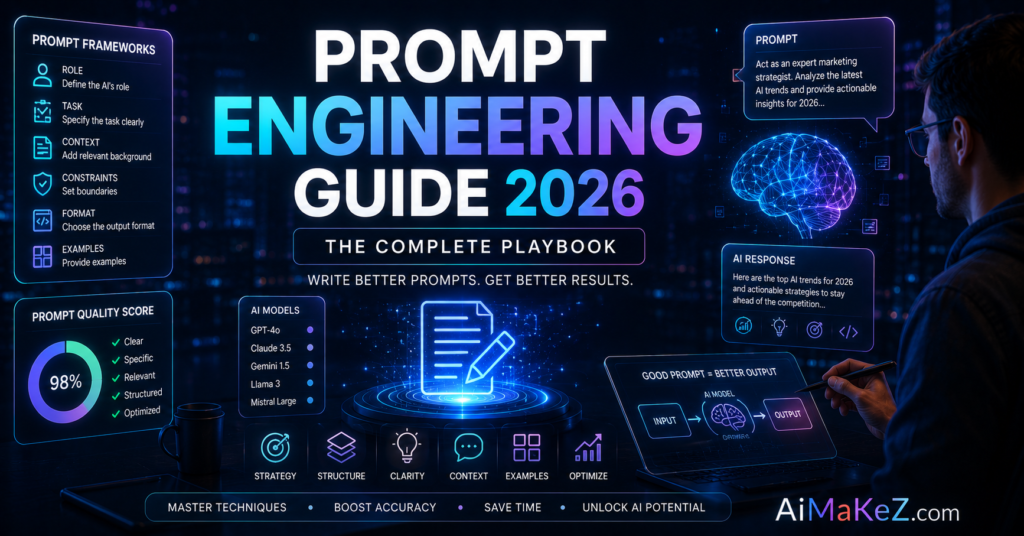
Prompt engineering is one of several ways to shape AI behavior, and it is usually the first and most cost-effective option. Compared with fine-tuning, which retrains a model on your data, prompting is faster, cheaper, and easier to adjust, though fine-tuning can win for highly specialized, repetitive tasks. Retrieval-augmented generation (RAG) pairs prompts with a searchable knowledge base and is ideal when responses must draw on private or frequently updated documents.
| Approach | Best For | Cost and Effort |
|---|---|---|
| Prompt engineering | Most everyday tasks and rapid prototyping | Low |
| Retrieval-augmented generation | Answers grounded in private or live data | Medium |
| Fine-tuning | Narrow, repeatable specialized tasks | High |
In practice, the strongest systems combine all three: sharp prompts, relevant retrieved context, and occasional fine-tuning where the volume justifies it.
Best Practices From Experience
After building and testing thousands of prompts across projects, a few principles consistently separate reliable results from frustrating ones.
Beyond the basics, treat prompting as an iterative craft rather than a one-shot task. Save your most effective prompts in a reusable library so you are never rewriting the same instructions from scratch, and version them the way a developer versions code. When a prompt underperforms, change one variable at a time, such as the role, the format, or the level of detail, so you can see exactly which adjustment moved the needle. This disciplined approach compounds quickly, and within a few weeks you will have a personal collection of battle-tested templates for your most common tasks.
It also pays to give the model room to think before it answers. Asking it to reason step by step, outline its approach, or list assumptions before producing a final response often reduces errors on complex tasks. For anything where accuracy matters, request that the model flag uncertainty rather than guessing, and ask it to cite the specific parts of the source material it relied on. These small structural habits turn a confident-sounding assistant into a genuinely trustworthy one.
- Be specific over clever: Clear, concrete instructions beat vague, elaborate ones every time.
- Show, don’t just tell: One good example teaches the model faster than three paragraphs of description.
- Constrain the output: Define length, format, and tone so you spend less time editing.
- Break big tasks into steps: Chaining smaller prompts outperforms one giant instruction.
- Ask the model to verify: Requesting a self-check or a list of assumptions catches errors early.
- Save what works: Keep a personal library of proven prompt templates to reuse and improve.

Common Mistakes to Avoid
Most disappointing AI results trace back to a small set of avoidable errors. Being vague is the biggest one: asking the model to “improve this” without saying how leaves it guessing. Overloading a single prompt with too many unrelated tasks confuses the model and dilutes quality, so split them instead.
Other frequent pitfalls include forgetting to provide context, assuming the model knows your private data, skipping examples when the format is unusual, and accepting the first answer without review. Finally, treating a confident tone as proof of correctness is dangerous; always verify facts, figures, and citations independently before you rely on them.
A subtler mistake is failing to test a prompt before relying on it at scale. A prompt that works perfectly on one example can fail on the tenth if you never checked the edge cases, so run varied inputs through it before trusting it in production or client work. Equally common is accepting the first output without pushing back; a quick follow-up such as asking the model to critique its own answer or tighten a specific section often produces a noticeably better result than starting a fresh prompt. Treat the first response as a draft, not a final deliverable.
Frequently Asked Questions
Is prompt engineering still relevant in 2026?
Yes. As models become more powerful and integrated into daily workflows, the ability to communicate intent clearly matters more, not less. Better prompting unlocks better output, lowers costs, and remains a core skill for anyone using AI professionally.
Do I need coding skills to learn prompt engineering?
No. Prompting is done in plain language, so anyone can start today. Coding only becomes useful when you build applications through an API, but the core skill of writing clear instructions requires no programming at all.
What is the difference between prompt engineering and fine-tuning?
Prompt engineering shapes behavior through instructions at the moment of use, while fine-tuning retrains the model on custom data. Prompting is faster and cheaper for most needs; fine-tuning suits narrow, high-volume, repetitive tasks.
How long should a good prompt be?
Only as long as it needs to be. Include enough context, constraints, and examples to remove ambiguity, but avoid padding. A focused prompt of a few clear sentences often outperforms a bloated one.
Which AI models are best for practicing prompt engineering?
Any leading general-purpose model works well for practice, including GPT-class systems, Claude, and Gemini. Try the same prompt across a couple of them to see how wording changes results and to build intuition faster.
How do I know if my prompt is working well?
Judge a prompt by the consistency and accuracy of its outputs, not by a single lucky response. Run the same prompt several times and check whether the results stay on target, follow your format, and avoid factual drift. If the answers vary wildly, your instructions are too open; tighten the role, constraints, and examples until the model behaves predictably. Keeping a short log of what you changed and how the output improved turns prompting from guesswork into a measurable, repeatable process.
Can prompt engineering skills transfer between different AI models?
Yes, the core principles transfer almost entirely. Clear roles, specific context, explicit constraints, and well-chosen examples improve results on virtually every modern model. What changes between systems is the fine detail: token limits, formatting quirks, system-message support, and how strictly each model follows instructions. Once you master the fundamentals, adapting to a new model is a matter of light tuning rather than starting over, which is why the skill remains durable even as providers release new versions.
Final Verdict
In 2026, prompt engineering has matured from a niche trick into a foundational literacy for the AI era. The models are extraordinarily capable, but they still respond to the quality of your instructions, and that is precisely where you hold the advantage. By defining goals clearly, supplying context, constraining output, and iterating with intention, you transform a general assistant into a dependable specialist for almost any task.
The recommendation is simple: start applying the step-by-step framework in this guide today, build a personal library of prompts that work, and refine relentlessly. The skill costs nothing to learn, pays off immediately, and compounds over time. Master prompt engineering now, and you will consistently get more value from every AI tool you touch, whether you are in the United States, Europe, or anywhere your work takes you.