Table of Contents
Introduction
If you have ever hit a usage cap in the middle of an important project, watched a chatbot slow to a crawl during peak hours, or simply balked at a monthly subscription fee, you already understand why so many people are hunting for reliable free ChatGPT alternatives in 2026. ChatGPT changed how millions of us write, code, brainstorm, and learn, but it is no longer the only game in town. A crowded field of capable rivals now offers comparable, and sometimes superior, results without asking for your credit card.
This guide to the best free ChatGPT alternatives walks you through the twelve best free AI chatbots available today, how they actually work, what they cost once you outgrow the free tier, and how to pick the right one for your goals. Whether you write marketing copy in Chicago, study for exams in Berlin, or automate workflows for a startup in Amsterdam, there is a no-cost tool here that fits your needs. If you also create written content for a living, our guide to the best AI tools for content creators in 2026 pairs nicely with this one. Let us break down the options so you can stop guessing and start working smarter.

What Are Free ChatGPT Alternatives?
Free ChatGPT alternatives are AI chatbots and large language model (LLM) platforms that let you generate text, answer questions, write code, and analyze information at no charge. These free ChatGPT alternatives compete directly with OpenAI’s flagship product but offer their own free tiers, open-source models, or generous daily allowances. Some are built by tech giants such as Google and Microsoft, while others come from research labs, startups, and the open-source community.
These conversational AI tools rely on the same underlying technology as ChatGPT, namely transformer-based neural networks trained on massive text datasets. The difference lies in the model behind the scenes, the pricing structure, and the extra features layered on top, such as live web search, image generation, or document analysis. A free ChatGPT alternative may run on a proprietary model like Google Gemini or Anthropic Claude, or on an open-weight model like Meta’s Llama or Mistral that anyone can self-host.
In short, they give you access to generative AI without the paywall, making advanced natural language processing available to students, freelancers, small businesses, and curious hobbyists alike.
Key Features to Look For
Not every free AI assistant is built the same way, and the best free ChatGPT alternatives stand out on capability rather than marketing. Before you commit to one, it helps to know which features separate a genuinely useful tool from a limited demo. Here are the capabilities that matter most in 2026.
Real-Time Web Access
ChatGPT’s free tier has historically had a knowledge cutoff. Rivals like Perplexity AI, Microsoft Copilot, and Google Gemini pull live results from the internet, so their answers reflect current events, prices, and news rather than stale training data.
Multimodal Understanding
The strongest free chatbots handle more than text. They read images, interpret charts, summarize PDFs, and even process audio. This multimodal ability turns a simple text box into a research assistant.
Generous Context Windows
A large context window lets the model remember more of your conversation or ingest longer documents. Claude and Gemini lead here, comfortably handling long reports without losing track of earlier details.
Privacy and Data Control
Open-source options such as Llama and Mistral can run locally, meaning your prompts never leave your machine. For privacy-conscious users in the EU navigating GDPR, self-hosted models offer peace of mind.
Integrations and Extensions
Look for tools that connect to your existing stack, whether that is Google Workspace, Microsoft 365, VS Code, or Zapier. The right integration turns a chatbot into a workflow engine.
Benefits of Using Free ChatGPT Alternatives
Switching to one of the best free ChatGPT alternatives is about more than saving money, although that is a welcome perk. The practical advantages compound quickly once these assistants become part of your daily routine.
Zero financial risk. You can experiment, learn prompt engineering, and discover what AI can do without committing a single dollar or euro. This lowers the barrier for students and bootstrapped founders.
Diverse model strengths. Different models excel at different tasks. Claude writes with nuance, Gemini shines at research, and Llama offers full customization. Using free alternatives lets you match the tool to the job.
Escape from vendor lock-in. Relying on a single provider is risky. Free alternatives give you fallback options if one service raises prices, changes its terms, or suffers an outage.
Faster responses during peak demand. When one platform is overloaded, another is often running smoothly. Having two or three tools ready keeps you productive.
Enhanced privacy for sensitive work. Locally run open-source models keep confidential data on your own hardware, a genuine benefit for legal, medical, and financial professionals who cannot risk exposure.
How Free ChatGPT Alternatives Work
Understanding how free ChatGPT alternatives work under the hood helps you write better prompts and set realistic expectations. Here is the process from your keyboard to the answer on your screen, step by step.
Step 1: You enter a prompt. You type a question, instruction, or request into the chat box. The clearer and more specific your prompt, the better the result.
Step 2: The text is tokenized. The AI breaks your words into smaller units called tokens, converting language into numbers the model can process.
Step 3: The model predicts a response. Using patterns learned during training, the large language model calculates the most probable sequence of words to answer your prompt.
Step 4: Optional tools activate. If the tool supports web search, code execution, or image analysis, it may call those functions to enrich the reply with fresh or external data.
Step 5: The answer is generated and refined. The response streams back to you word by word. You can then follow up, ask for revisions, or change direction entirely, and the model uses the conversation history to stay on topic.
Real-World Use Cases
Theory is useful, but examples make the value obvious. Here is how people across industries put free ChatGPT alternatives to work every day.
Content Creation and Marketing
A freelance copywriter in London uses Claude to draft email newsletters, then switches to Gemini to fact-check statistics with live search. A social media manager generates thirty caption variations in minutes, freeing hours for strategy.
Business and Productivity
Small business owners summarize long client emails, draft proposals, and turn messy meeting notes into clean action items. Microsoft Copilot, baked into Word and Excel, helps a Boston accountant build formulas and clean spreadsheets faster than ever.
Education and Research
Students use Perplexity AI to gather cited sources for essays, while teachers create quizzes and lesson plans on demand. A graduate researcher in Munich feeds dense papers into Claude to get plain-language summaries before diving deeper.
Software Development
Developers lean on free tiers of tools like DeepSeek and Codestral to debug functions, explain unfamiliar code, and scaffold projects. A solo indie developer ships features faster by pairing with an AI that never sleeps.
Automation and Workflows
By connecting an open-source model to Zapier or Make, a marketing agency auto-sorts incoming leads, drafts personalized replies, and tags support tickets, all without human intervention on repetitive tasks.
Pros and Cons
| Pros | Cons |
|---|---|
| No upfront or subscription cost | Free tiers often cap daily messages |
| Access to multiple model strengths | Advanced features locked behind paid plans |
| Live web search on many platforms | Slower speeds during peak demand |
| Open-source options protect privacy | Self-hosting requires technical skill |
| No vendor lock-in | Quality varies between providers |
| Great for learning and experimentation | Occasional inaccuracies still require review |
Pricing Explained
The word free carries some fine print worth understanding. Most free ChatGPT alternatives follow a freemium model: a capable free tier for casual use, with paid upgrades for heavy users. Here is a realistic look at what you get for nothing and what typically sits behind the paywall in 2026.
Google Gemini offers a robust free tier with web access; the Advanced plan bundles into Google One at roughly $20 per month. Microsoft Copilot is free for everyday chat, with Copilot Pro around $20 per month adding priority access and Office integration.
Anthropic Claude provides a free plan with daily limits; Claude Pro runs about $20 per month for higher usage and priority. Perplexity AI is free for standard searches, with Perplexity Pro near $20 per month unlocking advanced models and more sources.
Open-source models such as Llama, Mistral, and DeepSeek are free to use and even free to self-host; your only cost is the hardware or the cloud compute you choose to run them on. For most users, the free tiers are more than enough for daily tasks.
Comparison With Top Alternatives
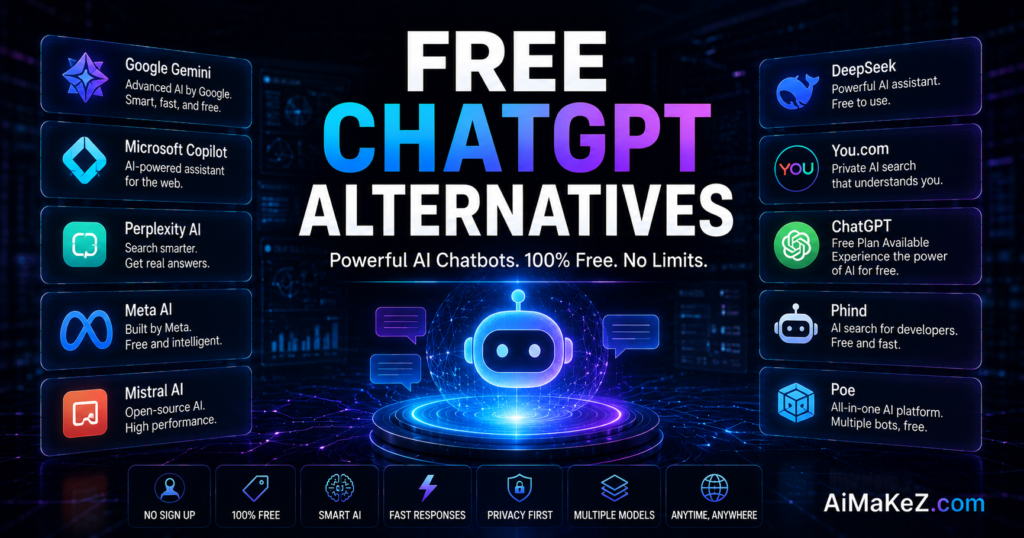
To help you choose among the leading free ChatGPT alternatives, here is a side-by-side look at how the biggest names stack up on the features that matter.
| Tool | Best For | Web Search | Free Tier |
|---|---|---|---|
| Google Gemini | Research and Google users | Yes | Generous |
| Microsoft Copilot | Office and Windows users | Yes | Generous |
| Anthropic Claude | Writing and long documents | Limited | Daily limit |
| Perplexity AI | Cited answers and research | Yes | Standard search |
| Meta Llama | Privacy and customization | Depends on host | Fully open |
| DeepSeek | Coding and reasoning | Yes | Generous |
| Mistral (Le Chat) | EU users and speed | Yes | Generous |
Gemini and Copilot win on convenience for people already inside the Google and Microsoft ecosystems. Claude is the favorite of many writers for its tone and clarity, while Perplexity is unmatched when you need sources you can cite. For total control and privacy, the open-weight trio of Llama, Mistral, and DeepSeek is hard to beat. Each of these free ChatGPT alternatives targets a slightly different user, so the winner depends on your workflow.
Best Practices
Getting great results is a skill. These expert recommendations will help you squeeze the most value from any free ChatGPT alternative you choose.
Write specific prompts. Vague requests produce vague answers. State your goal, audience, tone, and format up front. Instead of asking for a blog intro, ask for a 100-word intro aimed at beginners in a friendly tone.
Match the tool to the task. Use Perplexity for research with citations, Claude for polished writing, and DeepSeek for code. Keeping a small toolkit beats forcing one model to do everything.
Verify important facts. AI can sound confident while being wrong. Cross-check statistics, dates, and quotes before you publish or make decisions.
Iterate in stages. Treat the first output as a draft. Ask follow-up questions, request revisions, and refine step by step rather than expecting perfection on the first try.
Protect sensitive data. Never paste passwords, financial records, or confidential client information into a public chatbot. Choose a self-hosted open-source model when privacy is critical.
Common Mistakes to Avoid
Even experienced users trip over the same pitfalls when adopting free ChatGPT alternatives. Sidestep these and you will save time and frustration.
Trusting output blindly. The most common error is treating AI answers as gospel. Always apply human judgment, especially for legal, medical, or financial topics.
Using one tool for everything. Loyalty to a single chatbot means missing the unique strengths of others. Spread your work across two or three free alternatives.
Writing lazy prompts. Garbage in, garbage out. Skipping context and detail almost guarantees a mediocre response.
Ignoring privacy terms. Not every free service keeps your data private. Read the policy, particularly if you handle sensitive information under GDPR or similar regulations.
Overlooking free tiers of premium tools. Many people assume the best models cost money. In reality, Gemini, Claude, and Copilot all offer strong free plans that cover the majority of everyday needs.
Who Should Use Free ChatGPT Alternatives?
These tools are not one-size-fits-all, and knowing where you fit helps you pick faster. Students and lifelong learners benefit enormously from free ChatGPT alternatives, since a free AI tutor can explain calculus, summarize a dense chapter, or quiz you before an exam without a monthly fee. In the United States and across Europe, where subscription fatigue is real, a capable no-cost assistant removes a genuine barrier to learning.
Freelancers and solo entrepreneurs gain a virtual team member. A one-person marketing shop can draft ad copy, outline blog posts, and brainstorm campaign angles in the time it used to take to write a single email. Because free tiers cover most day-to-day volume, the savings go straight to the bottom line, which is why free ChatGPT alternatives have become a staple for lean teams. If search visibility matters to you, it is worth pairing them with the best AI SEO tools in 2026 for a complete workflow.
Small and midsize businesses use these assistants to standardize routine communication, speed up onboarding documents, and support customer service teams with instant draft replies. Developers and technical teams tap open-weight models for private, self-hosted deployments that satisfy strict compliance requirements. Even casual users, the people who simply want quick answers, meal ideas, or travel plans, find that a free chatbot handles the everyday questions that once meant a dozen browser tabs.
The Future of Free AI Chatbots in 2026 and Beyond
The pace of progress shows no sign of slowing, and free ChatGPT alternatives are improving fastest of all. Models keep getting smaller and faster while growing more capable, which means the gap between free and paid tiers continues to narrow. Expect deeper multimodal features, so a single free assistant will read your documents, watch a short clip, interpret a spreadsheet, and reply in natural speech within one conversation.
Open-source momentum is another force reshaping the landscape. As community models like Llama, Mistral, and DeepSeek mature, more organizations will run private AI on their own infrastructure, keeping data in-house and costs predictable. For everyday users, fierce competition among Google, Microsoft, Anthropic, and a wave of startups keeps free tiers generous, because whoever wins your attention today has a shot at your loyalty tomorrow. The takeaway is simple: the value you can access for free will only grow, so building the habit now puts you ahead of the curve.
Frequently Asked Questions
Are free ChatGPT alternatives as good as ChatGPT?
For most everyday tasks, yes. The best free ChatGPT alternatives, such as Google Gemini, Claude, and Microsoft Copilot, match or exceed ChatGPT’s free tier in areas like writing, research, and live web access. The best choice depends on your specific needs rather than raw capability alone.
Which free ChatGPT alternative is best for writing?
Anthropic Claude is widely regarded as the strongest free option for writing thanks to its natural tone, nuance, and large context window. Google Gemini is a close second, especially when you need research folded into the draft.
Do free AI chatbots keep my data private?
It varies by provider. Cloud-based tools may use conversations to improve their models unless you opt out. For maximum privacy, run an open-source model such as Llama or Mistral locally so your prompts never leave your device.
Can I use these tools for coding?
Absolutely. DeepSeek, Codestral, and Gemini all offer capable free coding assistance, including debugging, code explanation, and generation across many programming languages. Developers often pair them with an editor like VS Code.
Will free tiers stay free in the future?
Competition is fierce, which keeps generous free tiers alive as providers fight for users. While specific limits may shift, the availability of strong free ChatGPT alternatives is very likely to continue well beyond 2026.
Final Verdict
The era when premium AI meant a monthly bill is firmly behind us. Today’s free ChatGPT alternatives deliver professional-grade writing, research, coding, and automation without asking for a payment. Rather than crowning a single winner, the smartest move is to build a small toolkit: Google Gemini or Microsoft Copilot for research and everyday convenience, Anthropic Claude for polished long-form writing, Perplexity AI for cited answers, and an open-source model like Llama or Mistral when privacy or customization matters most.
Start with one that matches your primary task, learn to write clear prompts, and verify anything important before you rely on it. Do that, and you will get remarkable results at zero cost. For a deeper look at one popular productivity option, see our Notion AI review. The best free ChatGPT alternative is ultimately the one that fits your workflow, so experiment freely, keep a backup ready, and let these free ChatGPT alternatives handle the busywork while you focus on the thinking only you can do.