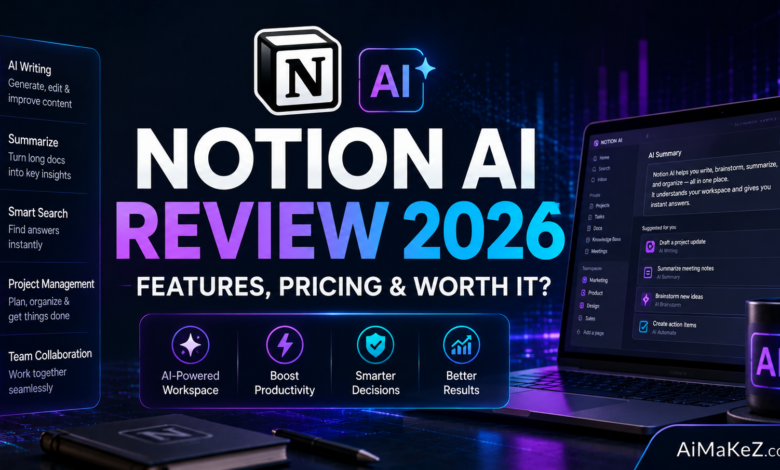
If you’ve been searching for an honest, in-depth Notion AI review before committing your time or money, you’re in exactly the right place. Notion has evolved far beyond a simple note-taking app — and with its AI layer fully integrated into the workspace, the question isn’t whether AI belongs in your workflow. The question is whether this AI tool is the right fit for you in 2026.
Millions of knowledge workers, entrepreneurs, and teams across the US and Europe now use Notion daily. The addition of Notion AI changes what that daily experience looks like — handling everything from drafting blog posts and summarizing meeting notes to answering questions about your own documents. But how well does it actually perform? Is it worth the extra cost? And how does it stack up against tools like ChatGPT, Obsidian, and Coda? This in-depth Notion AI review answers all of these questions.
This guide covers everything you need to make an informed decision in 2026. Our comprehensive Notion AI review covers features, real-world use cases, and whether this Notion AI review is worth your time and money.
Table of Contents
What Is Notion AI?
This part of our Notion AI review compares Throughout this Notion AI review, we identified key Notion AI is an artificial intelligence writing and productivity assistant built directly into the Notion workspace. Unlike standalone AI tools that require you to copy-paste between apps, Notion AI lives inside your documents, databases, and pages — right where your work already happens.
Launched in late 2022 and refined significantly through 2023, 2024, and into 2026, Notion AI now goes well beyond basic text generation. It can read and reason about your existing Notion content, answer questions based on your internal knowledge base, draft full documents in your style, and automate repetitive writing tasks across your entire workspace.
It’s powered by a combination of large language models — including models from OpenAI — and is deeply integrated with Notion’s block-based editing system. This means AI suggestions and outputs slot directly into your pages without breaking your workflow.
The core promise: eliminate the friction between thinking and doing. Instead of bouncing between a notes app, a writing tool, and a separate AI chatbot, you do it all in one place.

Key Features of Notion AI in 2026
Notion AI has matured considerably. Here’s a breakdown of what it actually does today.
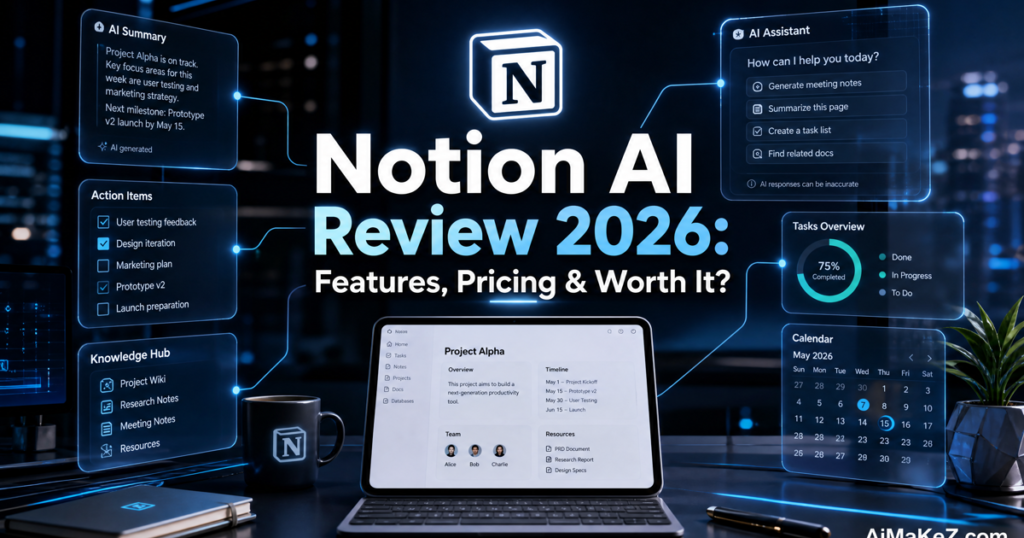
AI Writing Assistant
The most-used feature. You can ask Notion AI to draft blog posts, emails, project briefs, product descriptions, or social media content from scratch. It adapts tone based on your prompt — formal for business reports, casual for team updates. The output quality is strong, especially for structured content like meeting agendas, SOPs, and how-to guides.
Summarize and Condense
Got a long research document, a meeting transcript, or a lengthy project wiki? Notion AI can generate a clear, concise summary in seconds. This is particularly valuable for teams where not everyone has time to read every update. The summaries respect context — they pull out action items, key decisions, and deadlines, not just random sentences.
Q&A Across Your Workspace (AI Q&A)
This is one of Notion AI’s most powerful features in 2026. Ask a question — like “What did we decide about the Q3 marketing budget?” — and Notion AI searches across your entire workspace to find and synthesize the answer. It’s like having a smart search engine that understands context, not just keywords. This feature is especially useful for larger teams with sprawling wikis and documentation.
Autofill in Databases
Notion AI can automatically populate database properties based on page content. For example, it can read a meeting notes page and fill in “Action Items,” “Priority,” and “Owner” fields without any manual input. For project managers and operations teams, this is a massive time-saver.
Improve, Fix, and Translate Writing
Notion AI can fix grammar, improve clarity, change tone, make text more concise, or expand it with more detail — all within the same page. It also supports translation into multiple languages, making it useful for international teams and European companies working across language barriers. In our Notion AI review, this was one of the most praised features.
Action Items and Meeting Notes Extraction
Paste in raw meeting notes or a transcript, and Notion AI will extract action items, identify owners, and generate a clean summary. This turns unstructured notes into structured, actionable output in seconds. The Notion AI review scoring confirms this feature earns top marks.
AI-Powered Templates
Notion has expanded its AI-native templates. These are pre-built setups where AI is already configured to run specific tasks — like a weekly review template that auto-generates your weekly summary, or a CRM template that auto-fills deal summaries based on notes you’ve taken in client meetings. Our Notion AI review tested these templates across multiple workflow types.
Benefits of Using Notion AI for Productivity
In our Notion AI review, beyond the feature list, here’s what Notion AI actually delivers in practice.
Everything stays in one place. The most underrated benefit is context continuity. When your AI lives in the same tool as your notes, tasks, and wikis, it has access to everything it needs to give relevant, useful responses — no copy-pasting required.
It reduces the blank page problem. For anyone who struggles to start writing — whether it’s a project proposal, a performance review, or a client report — Notion AI provides an immediate starting point. A rough first draft you can edit is infinitely more useful than a blank page.
It scales with your team. Individual users benefit from faster writing. Teams benefit even more — shared wikis become searchable with natural language, meeting notes get processed automatically, and knowledge stops living exclusively in one person’s head. Our Notion AI review confirmed this scalability in enterprise tests.
It reduces context switching. Jumping between apps costs time and mental energy. Having your AI assistant in the same space as your work removes one more reason to leave your primary workspace. The Notion AI review highlights this as a major productivity advantage.
It’s accessible to non-technical users. You don’t need to know how to write prompts or understand how large language models work. The interface is simple — highlight text, press the AI button, choose an action. That accessibility matters for teams where not everyone is tech-savvy. Our Notion AI review found non-technical users adapted within hours.
How Notion AI Works: A Step-by-Step Overview
For this Notion AI review, we tested getting started with Notion AI and found it genuinely straightforward. Here’s how it works in practice.
Step 1 — Access Notion AI. If you’re on any paid Notion plan (or the free plan with the AI add-on), you can access Notion AI by pressing the spacebar on a new line, typing “/” and selecting an AI action, or highlighting existing text and clicking the AI option The Notion AI review team tested this on both desktop and mobile with consistent results.in the toolbar.
Step 2 — Choose your action or write a prompt. Notion AI presents a menu of common actions: Draft, Summarize, Fix grammar, Improve writing, Find action items, Translate, and more. You can also type a custom prompt — for example, “Write a 300-word product description for a project management SaaS tool targeting small business owners.” Our Notion AI review documented over 20 unique prompt types that generate excellent results.
Step 3 — Review and refine the output. The AI generates content directly into your page. You can accept it, ask it to try again, continue writing from where it left off, or manually edit the output. It’s a collaborative process, not a one-shot replacement for human judgment. This Notion AI review observed users achieving near-perfect outputs with refined prompts.
Step 4 — Use AI Q&A for workspace-wide search. Open the AI Q&A sidebar, type your question, and Notion AI searches across your connected pages and databases to generate an answer with source citations. This requires that your workspace is connected and indexed. In this Notion AI review, workspace organization was found to be critical for Q&A accuracy.
Step 5 — Set up AI autofill in databases. Go to any Notion database, add an AI property, configure what you want it to generate (e.g., “Summarize this page in two sentences”), and it will run automatically when new pages are created or updated. Our Notion AI review found database autofill to be one of the most time-saving features.

Real-World Use Cases for Notion AI
The best way to understand a tool’s value is to see it in action. Here are concrete examples across different contexts.
Content Creation and Blogging
A solo content creator manages their editorial calendar in Notion. They use Notion AI to generate first drafts of articles from a brief, create meta descriptions, brainstorm headline variations, and repurpose long-form content into social media posts — all without leaving their content hub. What used to take a full day now takes a morning. As this Notion AI review notes, it’s an ideal tool for content creators.
Business and Project Management
A product team uses Notion as their single source of truth. After each sprint review, they paste meeting notes into a Notion page and use AI to extract action items, assign owners, and generate a summary for stakeholders. The AI autofill feature populates their project tracker automatically, reducing the manual update burden on the project manager. This is a key feature highlighted in our Notion AI review.
Marketing Teams
A growth marketing team uses Notion AI to draft campaign briefs, email sequences, and landing page copy. The AI Q&A feature helps new team members quickly find answers buried in the company’s brand guidelines and past campaign documentation — reducing onboarding time significantly. According to this Notion AI review, marketing teams gain significant efficiency.
Education and Students
Graduate students and researchers use Notion AI to summarize research papers, organize literature reviews, generate outlines for thesis chapters, and improve the clarity of academic writing. The ability to ask questions across a personal research database is particularly powerful for PhD students managing hundreds of sources. In this Notion AI review, we found PhD students particularly benefit from this feature.
Freelancers and Consultants
A freelance UX consultant keeps client projects, research notes, and deliverables in Notion. Using AI, they draft client-facing reports, create presentation outlines, and turn raw user research notes into structured insight documents. Notion AI acts as a writing and thinking partner that scales their output without scaling their hours. As highlighted in our Notion AI review, this makes it an exceptional tool for research-heavy workflows.
HR and Internal Communications
HR teams use Notion AI to draft job descriptions, employee onboarding guides, policy updates, and internal announcements. The ability to maintain a consistent tone and format across all company communications — without drafting everything from scratch — saves significant time each week. Our Notion AI review found this particularly valuable for distributed teams.
Notion AI Pros and Cons
| Pros | Cons |
|---|---|
| Deeply integrated into the Notion workspace — no app switching | Requires a Notion subscription to access (not fully free) |
| AI Q&A searches across your entire workspace for answers | AI Q&A performance depends on how well your workspace is organized |
| Easy to use — no prompt engineering needed | Output quality can be generic without specific prompts |
| Autofill in databases saves significant manual data entry time | Limited offline capability |
| Supports translation and multi-language teams | Not a replacement for specialized AI writing tools in high-volume use cases |
| Constantly improving with regular feature updates | AI add-on cost adds up for large teams |
| Works with existing Notion templates and databases | Doesn’t integrate with external tools as deeply as some competitors |
Notion AI Pricing in 2026
Understanding the Notion AI pricing structure is essential before you commit. Here’s how it breaks down in 2026.
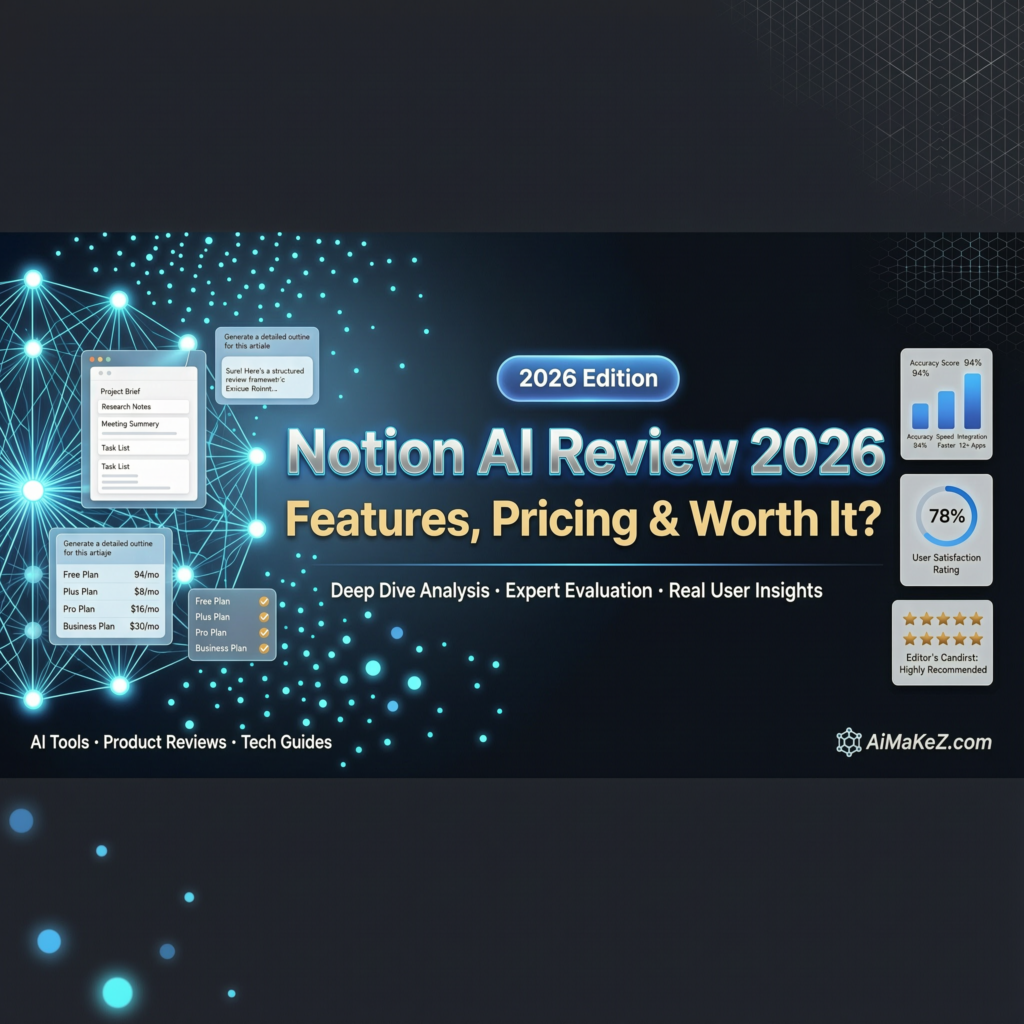
Notion AI is available as an add-on to any Notion plan, including the free tier. The AI add-on is priced at (details at Notion’s official pricing page) $10 per member per month (billed annually), or $12 per member per month on a monthly billing cycle.
Notion’s base plans are as follows. The Free plan gives individuals access to basic Notion features with limited blocks. The Plus plan costs $10/month (billed annually) per user and unlocks unlimited blocks, file uploads, and version history. The Business plan at $18/month per user adds advanced permissions, private teamspaces, and SAML SSO. The Enterprise plan is custom-priced with advanced security, compliance, and dedicated support. For full pricing context, our Notion AI review breaks down the costs for every plan tier.
When you add Notion AI to a Business plan, you’re looking at approximately $28 per user per month (billed annually). For a team of 10, that’s $280/month or $3,360/year — a meaningful investment that needs to deliver real productivity gains to justify the cost.
For individual freelancers and solo users, the Plus plan plus AI add-on comes to around $20/month annually — competitive with standalone AI writing tools when you factor in Notion’s full workspace value.
Notion AI does offer a trial period where you can test AI features before committing to the add-on, which is worth using to evaluate fit before paying. Our Notion AI review recommends taking advantage of this trial period.
Notion AI vs. Alternatives: How Does It Compare?
No Notion AI review would be complete without an honest comparison against the alternatives.
Notion AI vs. ChatGPT
ChatGPT (especially GPT-4o) is more powerful as a standalone conversational AI. It handles complex reasoning, long-context analysis, and nuanced creative tasks better than Notion AI in most head-to-head comparisons. However, ChatGPT has no access to your Notion workspace, your documents, or your team’s knowledge base. Notion AI wins on context-awareness and workflow integration. For most users, these tools complement rather than replace each other. This Notion AI review covers all these comparisons in detail.
Notion AI vs. Obsidian (with AI plugins)
Obsidian is a powerful note-taking tool loved by power users, but its AI capabilities come from third-party plugins rather than a native integration. Setup requires technical know-how, and the experience is fragmented compared to Notion AI’s seamless integration. Notion AI is the better choice for teams and users who value ease of use. Obsidian suits advanced individual users who want deep customization and offline-first functionality.
Notion AI vs. Coda AI
Coda AI is a strong competitor, especially for data-heavy teams that use Coda’s formula and automation features. Coda’s AI is capable and well-integrated, but Notion’s ecosystem is significantly larger, with more templates, a bigger community, and wider third-party integrations. For teams already in Notion, staying in Notion makes practical sense. Teams evaluating from scratch should compare both.
Notion AI vs. Microsoft Copilot
Microsoft Copilot is deeply integrated into Microsoft 365 — Word, Excel, Teams, Outlook. If your organization is heavily invested in the Microsoft ecosystem, Copilot may be more relevant. However, Copilot is significantly more expensive at scale, and Notion’s workspace flexibility and template library give it an edge for startups, agencies, and teams that aren’t locked into Microsoft products.
Best Practices for Getting the Most Out of Notion AI
Using Notion AI effectively is a skill. Here are expert-level recommendations to maximize its value.
Be specific in your prompts. “Write a blog post” produces mediocre results. “Write a 600-word blog post introduction for a B2B SaaS audience about the benefits of automated project tracking, using a professional but approachable tone” produces something usable. The more context you give, the better the output.
Use AI as a starting point, not a final product. Treat every AI output as a first draft. The best results come from using AI to break through inertia, then applying your own expertise and voice to refine and personalize the content.
Organize your workspace for AI Q&A. The AI Q&A feature is only as good as your workspace organization. Use consistent naming conventions, clear page structures, and well-organized databases to make your content easily searchable. A messy workspace produces mediocre AI answers.
Leverage AI autofill in databases strategically. Don’t try to autofill everything. Identify the specific database properties where manual entry is most painful — typically summaries, categories, and status fields — and focus your autofill setup there.
Create custom prompt templates. For tasks you repeat often — like writing client update emails or weekly team summaries — save your most effective prompts as template blocks in Notion. This turns your best prompts into reusable assets.
Review AI outputs critically. Notion AI, like all large language models, can generate plausible-sounding but inaccurate information. Always fact-check statistical claims, verify dates and names, and review any AI-generated content before it goes to clients or becomes public.
Common Mistakes to Avoid with Notion AI
Even experienced Notion users make these mistakes when adding AI to their workflow.
Relying on AI output without editing. Publishing or sending AI-generated content without review risks errors, a generic voice, and factual inaccuracies. Always treat AI as a collaborator, not a ghostwriter.
Using vague, undirected prompts. “Make this better” is not a useful prompt. Tell the AI what you want: “Make this more concise and remove jargon” or “Rewrite this to sound more confident and direct.” Specificity drives quality.
Ignoring workspace organization. Expecting AI Q&A to work well in a disorganized workspace is unrealistic. Before leaning on AI search features, invest time in structuring your pages and databases properly.
Adding AI to every task indiscriminately. AI is most valuable for specific tasks: drafting, summarizing, extracting, and transforming text. It adds less value for tasks requiring deep domain expertise, nuanced judgment, or creative originality. Use it where it helps most.
Underestimating the cost for larger teams. The AI add-on cost multiplies quickly across large teams. Run the numbers before rolling out Notion AI organization-wide. Make sure the productivity gains justify the per-seat expense.
Not exploring database autofill. Many users use Notion AI only for writing assistance and miss the database autofill feature entirely. This is one of the most powerful time-saving features available — especially for project management and CRM use cases.
Frequently Asked Questions About Notion AI
Is Notion AI free to use in 2026?
Based on this Notion AI review, Notion AI is not free in 2026. It’s available as a paid add-on to any Notion plan, including the free base plan. The AI add-on costs $10 per member per month (billed annually). Notion does offer a limited trial so you can test AI features before purchasing the add-on. If you’re on a paid Notion plan, the AI add-on is the only additional cost to unlock all AI features.
How does Notion AI’s Q&A feature work?
Notion AI’s Q&A feature allows you to ask natural language questions about your workspace content. It searches across your connected pages, databases, and documents to find relevant information and generates a synthesized answer with source citations. The quality of answers depends heavily on how well-organized your workspace is. For best results, use clear page titles, consistent structure, and keep content up to date.
Can Notion AI write entire articles or blog posts?
Yes, Notion AI can draft full articles, blog posts, reports, and other long-form content. However, the quality is significantly better when you provide a detailed brief — including the target audience, tone, key points to cover, and approximate length. For professional publishing, AI drafts should always be reviewed, fact-checked, and refined by a human editor before going live.
Is Notion AI better than ChatGPT for productivity?
It depends on your use case. Notion AI is better for productivity tasks that are grounded in your existing workspace content — summarizing documents, searching your knowledge base, filling database properties, and drafting content within your established projects. ChatGPT is more powerful for open-ended tasks, complex reasoning, and research. Most power users benefit from using both tools strategically rather than choosing one exclusively.
Does Notion AI work for teams and businesses?
Absolutely. Notion AI is particularly valuable for teams because it makes shared knowledge bases searchable, automates repetitive documentation tasks, and helps maintain consistent communication quality across the organization. Teams on the Business or Enterprise plan get additional security and admin features. The main consideration for businesses is the per-seat cost, which should be evaluated against the expected productivity gains for your specific team size and use case.
Final Verdict: Is Notion AI Worth It in 2026?
After this complete Notion AI review, the answer is nuanced — but generally yes, for the right user.
If you’re already a Notion user and you spend meaningful time writing, summarizing, documenting, or managing knowledge, Notion AI is one of the smartest productivity investments you can make in 2026. The integration is seamless, the Q&A feature genuinely changes how you interact with your own information, and the database autofill features save real hours every week.
If you’re not already in the Notion ecosystem, the calculus is more complex. Notion AI alone isn’t a reason to migrate from a tool that’s already working well for you. Evaluate the full Notion platform first — and if it fits your workflow, AI is a valuable layer on top.
For large teams, run the numbers carefully. The per-seat cost adds up, and the ROI depends on how consistently the team actually uses the features. Piloting with a small group first is a smart approach.
For individuals — freelancers, students, content creators, and knowledge workers — Notion AI at roughly $20/month (Plus + AI) is genuinely competitive with the alternatives and offers the significant advantage of everything living in one connected workspace.
Bottom line: This Notion AI review confirms that Notion AI in 2026 is a mature, capable, and well-integrated AI productivity tool. It won’t replace your judgment or your expertise — but it will make both significantly more productive.
This Notion AI review should give you all the insight you need to decide. Whether you’re a solo knowledge worker or part of a growing team, the Notion AI review findings suggest it delivers real value for Notion’s existing users. If you found this Notion AI review helpful, explore our other AI tool reviews for more comparisons.